Jane

Jane

All posts 651-700 of 2,145 posts

Torre Llafuda

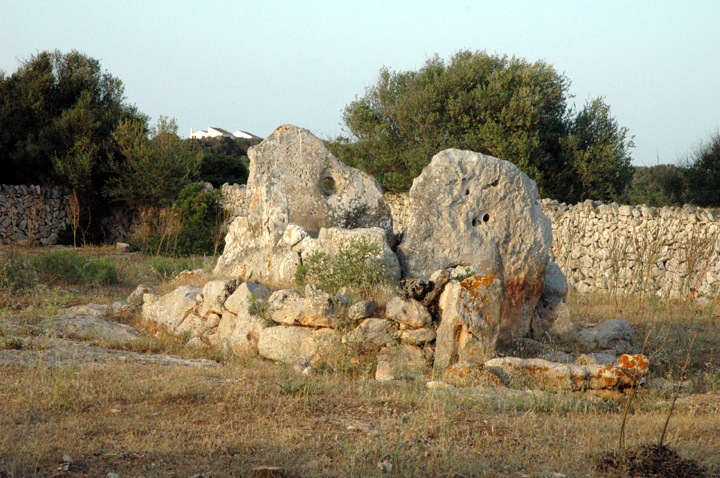
Torre Llafuda (see page 319 of TME) is a delightful poblat with all the usual features (talaiot, taula, caves, etc, but it’s in a helluva state. Badly wrecked with rubble all around the place, the taula sanctuary is hidden in a dip beneath some trees. It has two small but complete taulas still up, though one of them was supported by an ugly pillar of rubble.

You could get right close up to the neatest taula and admire the fantastic stone mortice and tenon joint used to keep the top of the T up.

As we stood on top of the wrecked talaiot we saw an Egyptian vulture, which was nice.

Torre d’en Gaumes

We could see Torre d’en Gaumes from the front porch of our villa, its three talaiot towers rising up on the horizon just about 2kms away. However, such is the state of Menorcan roads we had to drive miles to get to it. This is government operated site and has had money put in to it – areas roped off, nice concrete paths, wooden walkways, even toilets. This is a rare one for which you pay an entry fee. However, the young woman working in the ticket collection booth was very helpful and gave me a poster (featuring taulas, of course) which I admired on the wall for free. This woman, who had an unpronounceable name, would later help us find two amazing monuments within 500ms of Gaumes.

Gaumes is a very complex poblat monument which we didn’t have time enough to unravel. It comprises all the usual features and them some more. Although it didn’t have an intact taula to thrill me, it did have one or two other features which blew me away.

The first was to do with the taula. The capstone has at some point in antiquity been removed and inverted. The carved socket which the upright once slotted into now lies skywards like a watertrough or font.

The second was a fabulous system of water storage cisterns, great holes cut into the rock.

On such a dry island, fresh water must have been a premium commodity and the inhabitants at Gaumes collected and stored their water with particular flair. There were six or more tanks.

Thirdly, in one of the houses the roof structure was up. A roughly round space had a pillar in the middle from which long flat stones balanced and radiated out to the pillars in the walls like the spokes of a wheel.

Fourthly, a few intact ‘doorframes’. Moth said that for him, it somehow made the houses much more real.

Finally, the views, the views! Cor! From up here you can see perhaps half of the southern part of the island.

Son Catlar

We wanted to try a beach over to the south west of the island, and see Son Catlar poblat (see pages 310 and 311 of TME) which was on the way.

Extensive and impressive though this complex is, it failed to light my fire in any way whatsoever. It was just too big and too ruined for me to make sense of.

Rupert summed it up in his diary. He wrote: ‘… a huge prehistoric village but it looked like a big pile of rocks, the only good thing was the wall, and even that was boring...’ Gah! Eleven-year-olds are notorious hard to please.

Calascoves

As the evening cooled off, we took the car down the long dusty track down to Calascoves, (see page 306 of TME) a bucolic rocky inlet of turquoise waters not far from where we were staying.

Carved into the rock faces in the cliffs, overlooking the crystal sea, are dozens and dozens of caves, probably hewn initially from existing fissures and naturally occurring caves and enhanced for tomb purposes. Some are up at quite a dizzying height. Made me wonder how the hell the masons got up there to do their work. The sea was alive with fish and crabs and things, boding well for future snorkelling.

Cala Morell Necropolis

At north west end of the island lies the wonderful Cala Morell caves complex (see pages 302 and 303 of TME).

Dozens of spacious rock cut chambers line a limestone ravine apparently used originally as tombs and maybe later as dwellings.

The craftsmanship involved in cutting the rock was extraordinary. Internal pillars, decorated doorways (similar to those I saw in Turkey and Cyprus) and raised platforms vied for our attention with drainage systems, water storage features and sockets for carpentry.

Brilliant!

Biniparraxtet

Biniparraxtet (see page 301 of TME) is actually at the airport. It was moved from its original site to make way for a runway extension and has been lovingly restored.

Its cupboards, chambers, kennels and water storage features reminded Moth and me of Skara Brae. Although my son Rupert claims to find big old rocks ‘boring’, so many has he now seen that he was able to read this monument’s features without even having to look at the information board.

This is a really good site and well worth stopping off to see.

Ses Roques Llises

Ses Roques Lisses, which means ‘the smooth flat rocks’, is an open chamber formed by huge flat slabs of limestone, making roughly a double square 2ms x4ms. In common with the navetas and other Mediterranean sites, the entry stone has a doorway hole cut into it, just big enough for someone to squeeze through.

The slabs sit on their own platform of rubble kept in by a wall. It was once covered entirely with stones, like a cairn, I suppose.

We would NEVER have found this without expert help from the archaeology student/ticket collector at Torre d’en Gaumes who took us straight to it, clambering over stone walls and across a least two paddocks. She was thrilled to have met people like her with so much enthusiasm for the really old stuff – for Ses Roques Lisses predates the taulas and poblats by many, many centuries.

Na Comerma

Lying almost lost and crumbling badly just 50ms away from Ses Roques Lisses is the remarkable Na Comerma taula sanctuary. It should NOT be confused with what Julian calls Sa Comerma de sa Garita on page 315 of TME. What Julian is referring to seems to us be part of the complex at Gaumes, whereas Na Comerma (or Sa Comerma) is a site away from Gaumes, independent in its own right.

It felt as if I’d been let in on local secret. I guess it is hardly ever visited. It would have been impossible to find without local knowledge and/or an extraordinarily detailed map. Though sizeable, so hidden by trees is it, that we didn’t see it until we were virtually upon it.

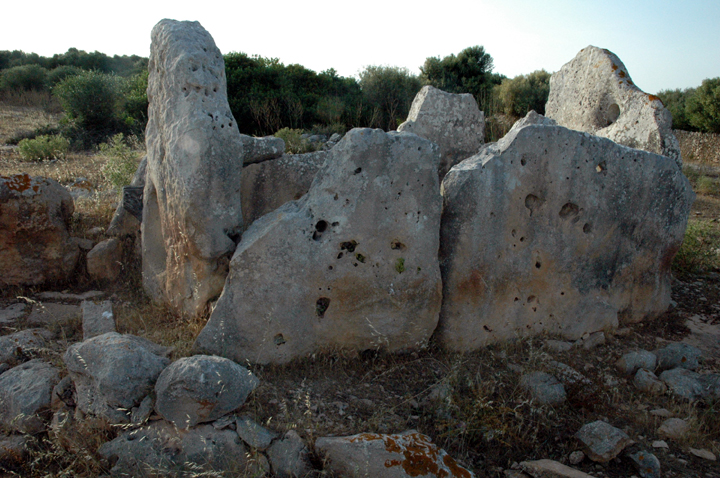
From a terrible higgledy-piggledy mess of masonry rises a tiny taula which by some miracle still has its topstone.

Its upstone is half buried in rubble. You could make out part of a wall which once enclosed the sanctuary, perhaps once as thick as the one at Torre Llisa Vell (see previous weblog.)

In addition, there were beautiful ruins of what I read to be houses, with flat dressed cross-beams still mounted on top of their supports.

Absolute magic.

And the day was made complete when we spotted a tortoise. We’d seen a few small ones playing ‘chicken’ on the roads, but this one was safe from becoming roadkill. They are a protected species now, their numbers having been cruelly depleted for the pet trade up until the late 20th century. Like this monument, they feel like ancient survivors.