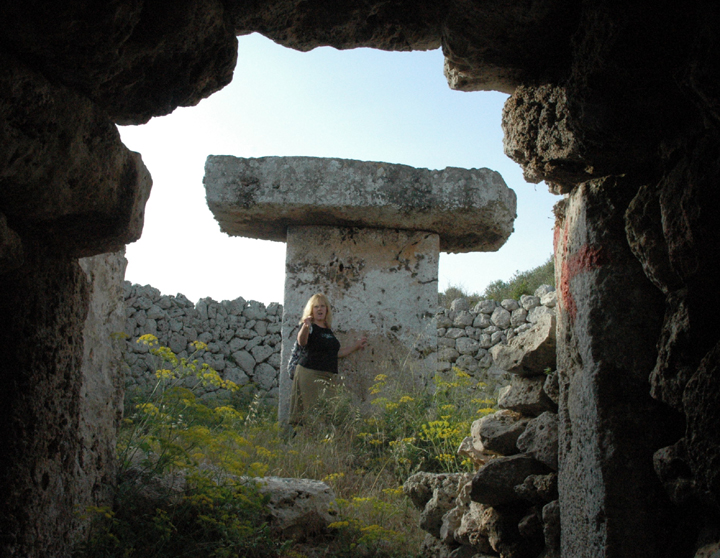


Very close to our villa in Calan Porter was the poblat of So Na Caçana. Julian incorrectly calls it Torre Llisa Vell, which, to be fair is nearby. So go to pages 320 and 321 in your copy of TME, cross out the title and replace with So Na Caçana. Here, beneath the gargantuan talaiot lie not one but two taula sanctuaries.
Sadly both Ts are wrecked but there is still plenty to admire: the tall pillars surrounding the sacred spaces and the niches in the walls. I wondered what magical objects were once placed in these – skulls or horns, jars of oil or bull’s blood, perhaps?


Torre Blanca, also known as Sa Torreta de Tramuntana, is an unusual monument as it lies in the northern half of the island, above Mahon towards Es Grau. It lies on an outcrop of limestone at the point where the geology seems to change to something more slate-like.
We’d see it on a couple of basic maps and thought we’d have a crack at finding it, despite having absurdly inadequate directions, having the kids with us, it being midday and very hot, and haing to go a long way from our favourite beach….
Our initial attempt took us up to the Favortx lighthouse in the national park, too far north. Our second attempt was more successful. Follow the main road north for about 5.3 kms after the roundabout leaving the Mahon ringroad. Then turn right by a small white building with orange painted detail and then immediately fork right. This leads us down a long narrow lane which eventually turns sharp right. Here a gate finally barred us from going any further. Privado. We parked, knowing we were close. Moth went stomping off for a look around.
A car pulled up. A man opened the gate and drove through. As he closed it I asked ‘Torre Blanca?’ He replied in Spanish which I didn’t understand. He pointed and twiddled his fingers implying that we walk in the direction he was pointing. ‘Gracias.’ Not having a clue how far, we set off into the midday heat. Moth caught up having also asked the man for directions. After a pleasantly warm walk perhaps 1-1.5kms uphill we reached the farm, vaulted over the gate and asked a farm labourer who pointed behind the barn. Suddenly it was there. What a result!!!
From the top of the talaiot the views stretch over the tiny fields towards a bay and down the coast as far as Mahon, rocky land tumbling into the sea. Magic.
And the taula! Wooo! Great taula! Dinky and entirely self supporting, thanks to the vertical ridge at the back as at Torralba, it has that cheese-like colouring on the front I so admired at Trepuco. We liked it here muchos.


El Toro is Menorca’s sacred mountain and can be seen lurking or dominating the horizon from almost every point on the island of Menorca. It is the highest mountain on the island, measuring 358ms above sea level. Certainly we could see it from just about every talaiot tower we visited. It had to be visited. Everyone traveller to Menorca should see it, and probably does.
Bristling with ugly communications towers, it is now inhabited by nuns who run a convent up there with café and tat-shop because somebody once had a vision of the Holy Virgin up there. Frankly, I’m not surprised. Imagine climbing that after no breakfast and little water in the midday heat. Reckon I’d start seeing things, too! Thankfully visitors can now drive to the summit in air conditioned vehicles to enjoy the astonishing views of a beautiful and largely sparsely populated island.
My children tittered with glee as I read out the inscription beneath an 18th century statue of a local monk who was ‘interred beneath the altar in the church’. “In holy shit, perhaps?” Cleo mused. (Interred/in turd… geddit?)
The lane between Alaoir and Cala’n Porter where we were staying was a tortuous one we had to travel many, many times... There’re some great sites down here though. Torralba d’en Salort (see pages 316 to 318 of TME) lay at the top of this lane and having seen the top of the taula sticking up already I was itching to see the place.
All the regular poblat features here: caves, talaiot, cisterns, houses and also a wonderful quarry area.
The place was crawling with caterpillars though so I had to move with extreme caution. Cleo and Rupes liked this one as there were tons to explore and had informative signs to help them understand what they were seeing. As ever, the main attraction for me was the taula itself.
To aid stability, this taula has a ridge carved up the back and is thicker than Trepuco’s wafer thin cheese slice. I chose a caterpillar-free area to sit in and made a sketch.
Torrellonet (see page 322 of TME) is one of many talaiot towers on Menorca. They occupy positions of height or view and almost everywhere you look on Menorca, you can see one of these on the horizon.
Torrellonet is a really nice example of a talaiot as it is still tall with intact walls, is uncovered by vegetation, is easy to climb and has great views of the runway, so you can watch the aircraft coming and going. Fab. Ancient and modern engineering simultaneously.
From here we could see Talati de Dalt talaiot and others rising through the trees as well as the remains of a prehistoric house two field away.

There are two navetas at Rafal Rubi.
Both are in magnificent condition and have huge cool chambers with whopping great slabs in the ceiling.
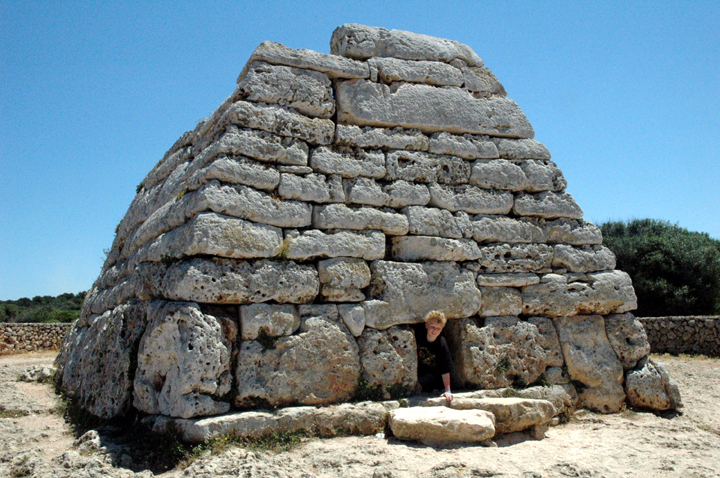
Time to tackle some navetas. Structures less like boats, after which they are named, I cannot imagine. ‘Pyramids’ is what Rupert called them. I like that, because they are burial chambers, stand above ground level, slope inwards like pyramids and are made of large dressed blocks.
There are four close together just off the main road, all signposted and dead easy to find. (see page 307, 308 and 309 of TME).
Naveta de Biniac Argentina Occidental is a bit trashed, the roof has gone and its chamber is open. Still well worth a look.

Time to tackle some navetas. Structures less like boats, after which they are named, I cannot imagine. ‘Pyramids’ is what Rupert called them. I like that, because they are burial chambers, stand above ground level, slope inwards like pyramids and are made of large dressed blocks.
There are four close together just off the main road, all signposted and dead easy to find. (see page 307, 308 and 309 of TME).
Naveta de Biniac Argentina Oriental is reather trashed but has some really lovely steps built into the side of it which are well worth checking out.

Naveta d’es Tudons (see pages 304 and 305 of TME) is just off the main road at the western end of the island and judging by the huge car park with spaces for buses, frequently visited by coach parties.
Fortunately, we had it pretty much to ourselves. ‘Naveta’ means ‘boat’ and some archaeologist has interpreted the large burial chambers on the island as boat-shaped and given them this name. I can’t see it myself. They are more burial chamber-shaped to my mind. Anyway, Es Tudons has been restored according to this boat theory so you have to visit this one with a pinch of salt.
It is an impressive pyramidal type structure and beautifully cool inside its double-decker chamber. We liked it a lot, despite it being a bit overly restored.
Talati de Dalt is a gorgeous poblat quite close to the airport with loads of stuff to see – all the usual poblat features: caves, talaiot, cisterns, houses, etc. The houses here were really excellent with lots of rock cut details. This time, VERY Skara Brae. We climbed the talaiot and watched the planes come and go.
It was alive with birds here too; tons of finches, swifts, swallows and hoopoes. I found this site very, very peaceful, and sat and made a study of the taula which has its very own flying buttress.


After a busy day snorkelling at Binidali beach we took an early evening excursion out to see Trepuco (see pages 326 and 327 of TME) poblat on the southern outskirts of Mahón, Menorca’s capital where mayonnaise may have been invented in 1756 to commemorate a victory over the English who were holding a castle in Mahón – hence ‘mahonnaise’.... I digress.
The site at Trepuco is dominated by two gargantuan monuments – the mammoth talaiot tower and most sublime taula sanctuary. The talaiot was probably the biggest I saw on the island, about 8 metres tall and at least 12 metres in diameter, possibly more. I was a bit spooked when Moth started climbing it, but he took it slowly and was rewarded with great views. But the taula captivated me completely.
Glowing yellow in the evening sunlight and thin like rice paper, the great stone is carved on the front as if Canadian cheddar cut with a serrated knife. On top of this impossibly thin slab of something you’d put in yer butty, a bloody great grey horned block is somehow held aloft. I was in awe.
I should also mention the setting of this ancient cheesy wonder as it follows an approximate pattern of most taula sanctuaries.
The T stone usually stands roughly centrally in a horseshoe-shaped enclosed wall, built using giant stones. Many of these are tall pillars which appear to mark out chambers or spaces. The front, or approach end, always the only way in, is usually a very shallow concave forecourt with a clear entry point. Whatever happened in these ritual places, they were not public affairs. The space is intimate and the walls originally too tall to see over. These taula sanctuaries usually stand within just a few metres of a talaiot. And from the top of most talaiots you can see El Toro, Menorca’s centrally-placed sacred hill (now hijacked by Jesus, his mum and some nuns.)
All this is the case at Trepuco. We stayed here for some time so I could make some studies. It was sublime.
Not far from Naveta d’es Tudons is the poblat of Torre Trencada (see pages 323, 324 and 325 of TME) which was the first Menorcan prehistoric talaiotic settlement I had seen and my first taula. (We were to see many more!)
At Torre Trencada, as at most other bronze age poblats, you get your usual shopping list of:
- a talaiot (tower) or two which dominates the site, rather like a watchtower or uninhabitable broch
- some wrecked houses
- a wall surrounding the settlement
- a cave, usually enhanced megalithically in some way
- some kind of water storage feature, well or cistern
- a taula sanctuary, the ritual heart of the site
Torre Trencada is delightfully unrestored with shady olive trees growing up through the stones.
It was rough, unkempt and a haven for birds and butterflies. Rupert also saw a snake. We wished we’d had some food as someone had built a rather lovely megalithic picnic table in the shade of some olives.
As this was my first taula monument I was deeply impressed, although I would later discover the sanctuary it once stood in was pretty much gone entirely, leaving only the great T behind.