


The tallest stone in the surrounding circle, at the SW. It appears to have been split, to form the smooth face, but whether this happened before or after it was used in the circle I don’t know.


Stones in the western arc of the surrounding circle, separated from the rest by an unsightly fence. As at Tordarroch, the removal (or at least moving outwards) of this fence would enhance the site greatly.

General view south across the cairn’s diameter. The centre was dug out to make a pond(!), leaving just the kerb and the surrounding stone circle.

The mound is perfectly sited on the high point of a raised churchyard.


Whatever its origins, it’s certainly an impressive mound.


The house behind is part of the hamlet of Megstone.

In front of the road to Belladrum Farm, looking approx north.


I absolutely love this site, for all that the monument itself is a wreck.

Welcome arrival of the sun after a damp and dull morning.


Overview of the site from the southeast.

Fallen slab and upright orthostat on the eastern side of the chamber.

Looking across the ruined chamber to the two portal stones that led to a postulated inner chamber.

The monument from the east. The ground drops away steeply to the north (right) to the Allt Eoghainn burn, which gives the site its alternative name.

The chamber itself consists of four upright orthostats (pictured), surrounded by a number of prostrate slabs. Audrey Henshall (The Chambered Cairns of the Central Highlands) suggests that the two stones in the foreground are the portal stones of a chamber that would run beneath the photographer’s feet in this shot.


The lovely woodland setting of the cairn. The monument itself reminded me of a sea creature or turtle, head lifted and flippers thrust out to either side.

Elevated view of the chamber from one of the clearance blocks.

Looking north across the chamber as the cloud began to lift from the surrounding hills.

This huge slab on the south side of the site, together with various boulders dotted about, is field clearance rather than a displaced capstone.

The tallest stone, at the north of the chamber, has unfortunately split diagonally in fairly recent times.

The chamber from the west.

The site sits just below the top of the hill, looking SE to the valley of Belladrum Burn. The field is cropped, so access may be limited at some times of the year.

What a great site this is. Come on a sunny Spring day and I imagine it will be beautiful.

View across the cairn from the north.


Lovely pinky-orange vein of quartz running through one of the smaller stones in the southern arc of the kerb.

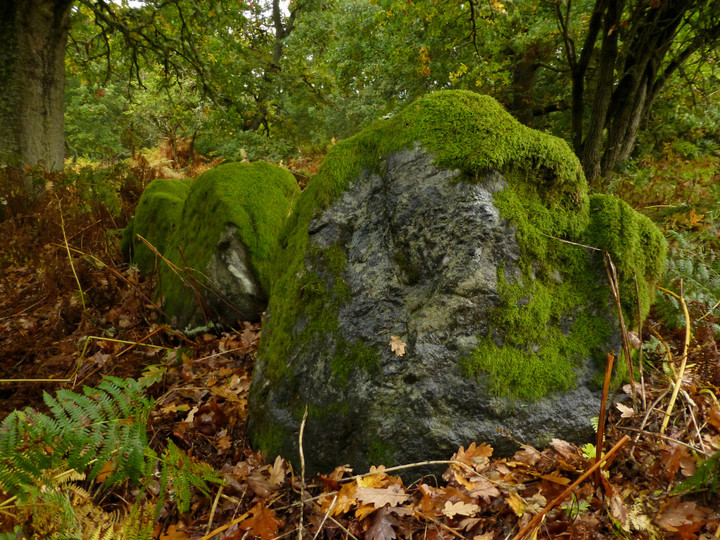
The tallest stone of the graded kerb (about a metre tall) on the western side of the monument.

Kerb on the southern arc, freshly freed from the covering bracken.
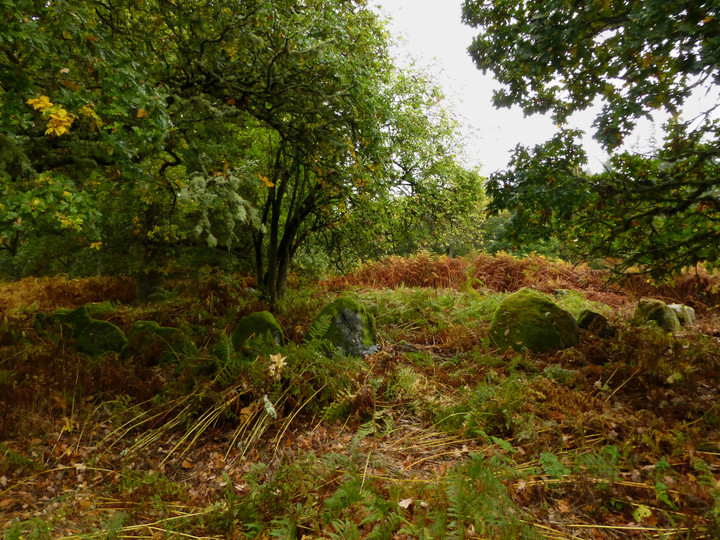
General view of the site from the west.

As we left our final site of the day, the sun finally broke through the cloud cover.

Small upright on the SW edge of the mound, which may be all that’s left of a kerb.

Looking west across the chamber.


What remains of the central chamber.

The Temple from the northeast.

Huge upright, 1.85m high, forming the south side of the western (inner) chamber.

The oak is slowly consuming the southern portal stone.


From the SE, with the remaining stone of the south section of facade in the foreground.

Showing the distance between the stump at the NNE edge of the cairn and the chamber. Some monument this must have been before the mound was robbed away.

The broken stump is at the NNE extremity of the original cairn. A low bank of rubble curving away to the right is all that now remains of the mound.

General view of the structure from the north. The two widely spaced stones set apart on the left are remains of the original facade. The slab at the left-hand end of structure is the north side of the eastern chamber. The next stone (in front of the tree) is the northern portal stone, marking the division between the two chambers – its southern pair is underneath the oak tree. The remaining stones to the right are the sides of the western chamber. The viewpoint is within the perimeter of the original cairn, which would have been absolutely massive.