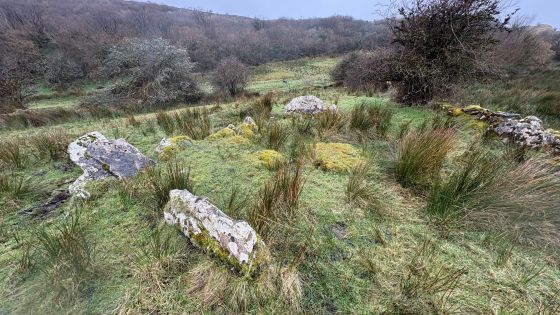
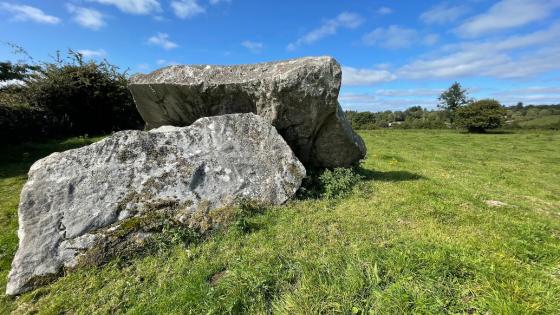
Looking south-east over the forecourt.
Image credit: ryaner

Looking south-east over the forecourt.

Structural stones of a chamber on top of the tomb.

The rear of the monument.

The whole thing is being colonised by trees. This shot is taken from the south-east.

A full view of the front of the tomb.

The forecourt of the tomb. My mate was heard to mutter: “This is some mad Lord of the Rings shit here.” He wasn’t wrong.

There is just the right amount of space between the monument and the surrounding forest plantation.

The tomb in its very boggy setting.

The tomb, as we first saw it, at the bottom of the fire-break.
Head west from Derrygonnelly in Fermanagh on the Knockmore Road. It leaves the main street in the town sharply south-east but veers due west after a couple of hundred metres. Knockmore cliffs soon rear up ahead after some hairpin bends in Glenkeel. They’re impressive, towering above the road, with the added intrigue of ancient caves on their back, some said to have been inhabited in ancient times. A couple more hairpins later the road rises higher and you’re in the badlands – but not before stopping off at the ruined Rossinure Beg court tomb. The henge to its east looks fine on the satellite photos but difficult to access on the ground. We’re on the move anyway and heading for Big Dog forest and its megalithic wonders.
Big Dog, Little Dog, Dog Little, Giant’s Stone, Giant’s Grave, Skaghlea Cairn, let’s just get out of the car and head in. This is wild country, isolated, sparsely populated if at all – it’s good to be out in the fresh air, much old man’s beard lichen in evidence, a portent of what lies ahead. The forestry is in a state of mixed maturity, about 10 square kilometres with a reported 4 megalithic tombs – one unclassified, two court tombs and a wedge.
We head for Dog Big court tomb, deceived by the map and satellite into believing that it’s just a few metres into the forestry from a track – there is no track, just an overgrown and boggy firebreak that reeks of treacherous clomping and sweaty effort, all for “… 3 earthfast stones & 2 displaced capstones…”. Forget it. There’s an almost complete court tomb further in. We decide to head there.
As we swing back on ourselves, both of us are blowing hard, the result of a long hibernation. Still, this is what it’s all about, on an adventure with plenty of time to shoot the shit and clear the head. Huge swathes of the forest have been harvested, the usual tumbledown mess replanted with fresh pines, ready to produce a return from the barren land hereabouts. Soon we are heading directly north, deep into the plantation with the most mature trees to our left and right. Skaghlea is close, but still elusive.
Again, the promised tracks are just firebreaks. The first seems treacherous, the second, further up the track, looks navigable. We take a risk, fleet of foot, determined – the tomb is deep into the forest, but in its own clearing and seeming to beckon us now. Off the firebreak and back south through a sliver of forestry and onto the first, badly waterlogged (rubber boots a godsend) firebreak, I can see the opening that leads into the the clearing where the tomb lies. Thomas has lagged behind, maybe losing some small bit of faith but I push on, and then… Wow! There she is, 150 yards down a boggy track, almost lost and very overgrown.
Sodden and saturated and almost with its own eco-system, the clearing is borderline-bog. The cairn is colonised by a verdant, trippy, almost mutant, fractal explosion of dripping plant life. The forestry people left a good deal of space and the cairn is enclosed, surrounded now with mature pines. It’s like having entered the Shimmer, otherworldly and spacey and disconcerting, drenched in mysteriousness. This is the real deal. Before long we’ve almost forgotten ourselves, lost in the isolation of the place – me clambering around and over the cairn in a futile attempt to capture its magic, my companion still and eager to drink in its desolate ancientness.
It is a court tomb, but it could be one of the first of its kind, reminding me of some of the early Carrowmore sites – maybe it was built by the people who landed at Ballysadare Bay 50 kms west-south-west of here 6,500 years ago. The court is discernible, just, its stones enveloped in moss – it’s quite small in comparison to some, the stones mainly rounded boulders and mostly unsocketed, as far as I could make out. There’s what looks like a passage tomb entrance stone at the place where the first set of gallery jambs-stones should be. This could be a fallen lintel but, again, it’s hard to tell. There is a chamber or cist-like structure on top of the cairn, not where you would expect and further deepening the confusion.
Go to Dog Little soon. The splayed cairn is not massive but its construction, with larger than normal boulder-type stones, could lead you on a path of wild speculation. I’ve a feeling it might not stay the way it is for much longer. The mature trees in the section of Big Dog forest that surround the tomb may be well set for harvesting. I’ve never really been a fan of forestry-enclosed megalithic sites and if the authorities do decide to fell the trees, this place, as it is now, will surely lose a lot of its magic, whatever the benefit of the all-round views might be like.