Looking through the entrance jambs to where the chamber/gallery used to be.
Image credit: ryaner

Looking through the entrance jambs to where the chamber/gallery used to be.

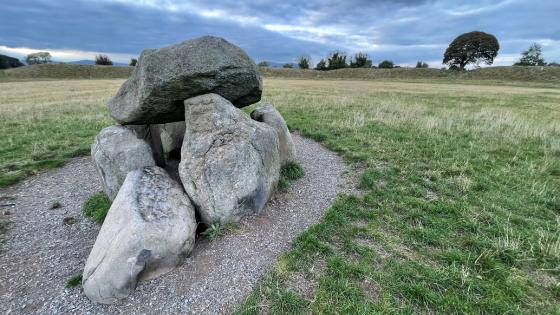
A pair of unmatched entrance jambs, bulky and substantial.

From where the first chamber once was, looking out through the entrance jambs into the court.

Very scant remains of the gallery/chamber.

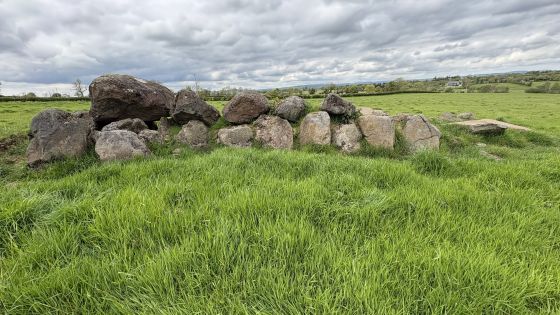
Beautiful, almost complete court at Ballyutoag. The stones in the foreground are from an ancient wall that crosses its opening.
In the hills north-west above Belfast, at the end of the urban part of the Crumlin Road where the city runs out, lie the remains of Ballyutoag court tomb. It’s marked on the OS map as a cairn, probably because its excavator named it the Hanging Thorn Cairn. Some of the surrounding terrain has the blasted look that many areas so close to the city have – trashed old machinery and rubble, half wasteland, half dustbin. There’s wide open green spaces too but with a slight feel that you’re on your way to somewhere else, away from the iron giants that maraud over the landscape and the raucousness of the city, but just haven’t made it yet.
The fence lines around here are taut, unforgiving. Fortunately enough the monument is only about 50 metres from the road and there’s an easy enough point to traverse the barbed wire without endangering yourself. An ancient wall runs right down to the fence – this wall and bank seems to be an old dividing boundary and it runs right across the front of the forecourt of Ballyutoag. This forecourt is all that remains here, bar a few embedded possible chamber stones that seem to be in line with the entrance jambs.
There is a prehistoric sense here – this would have been a fine megalith before the gallery was pulled asunder. Facing out of the court from between the jambstones/portals, the construction, especially of the two massive opposing boulders two stones into the forecourt, looks robust and would have taken a serious and time-consuming effort. We didn’t really hang around, on the way to the sun cairn up the road, but it was worth checking out, imagining what once was and witnessing what remains.