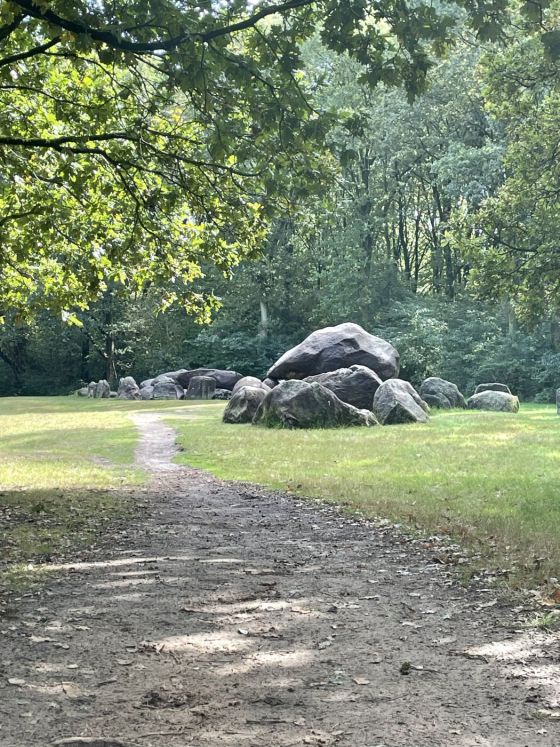
Visited September 2025
Image credit: Uwe Häberle 09/2025

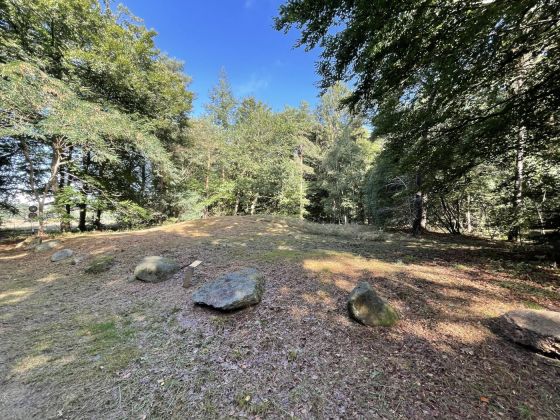
Visited September 2025

Visited September 2025
Galgenberg


Galgenberg

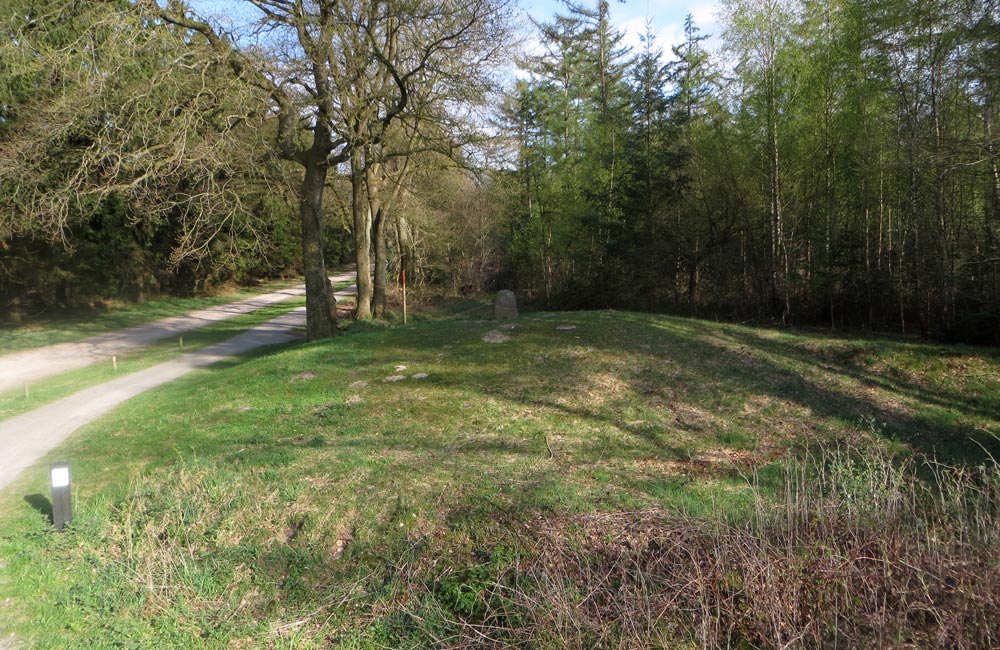
The boundary marker stone on the Galgenberg.

A group of enthusiasts on a guided tour of local archaeological sites on top of the Galgenberg (Gallows Hill) near Annen.
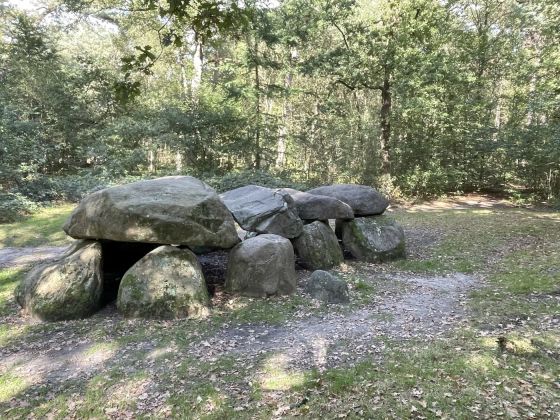
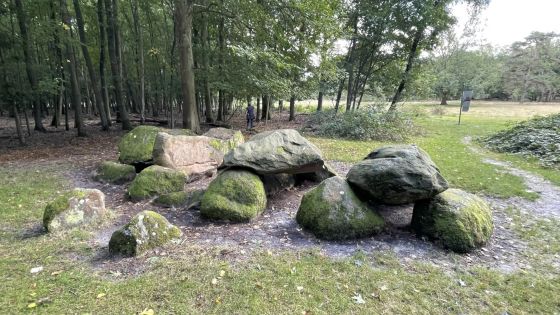
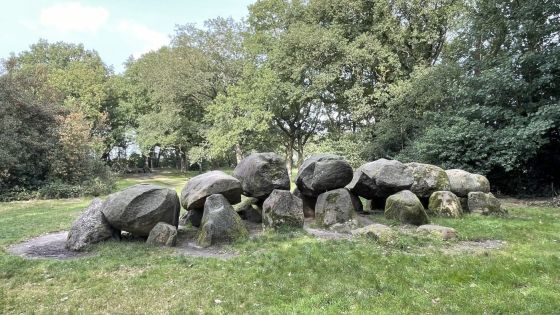
If you plan to visit Hunebeds D7 Schipborg and D8 – Anloo-N, do yourself a favour and include during your scenic stroll through the beautiful landscape of the Drentsche Aa National Park / De Strubben Kniphorstbosch the cairns Driemarkenpunt and Galgenberg (Strubben-Kniphorstbos) during your walk (about 3.6 km).
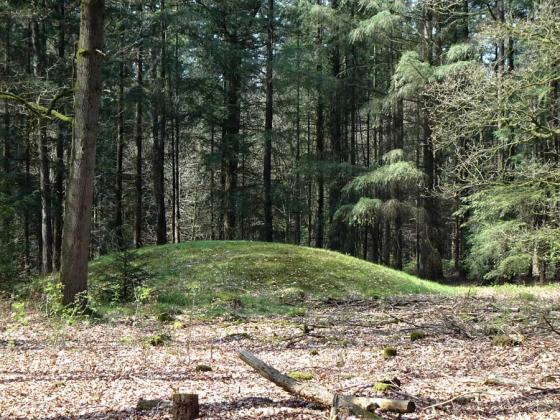
In De Strubben Kniphorstbosch you will also find dozens of burial mounds from just about all prehistoric periods. One of the largest mounds is called the Galgenberg or Gallows Hill. In the Middle Ages places like this were chosen to hang criminals. The authorities would let the body hang for days on the mound so that passers-by could see the fate that awaited wrong-doers. And this place is still very busy, as many paths cross here, meaning that lots of pedestrians, walkers and cyclists pass by.
Visited September 2025
Visited September 13, 2013
The Strubben Kniphorstbos is an area of woodland extending over some 150 hectares, located between Anloo and Schipborg in the Dutch province of Drenthe. It is the only archaeological reserve in the Netherlands. Its double name comes from its native stobbige oak trees and Gerrit Kniphorst, a 19th century owner of the area. In addition to two hunebedden (D7 and D8) the area contains some sixty or so burial mounds, one of which is the Galgenberg (you pass the Galgenberg, on your left hand side, as you walk from D8 towards D7).
The Galgenberg (Gallows Hill), so-named since at least 1332, probably dates from the Late Neolithic or early Bronze Age, and stands on a crossing point of ancient routes through the sandy Hondsrug region of Drenthe. Although this burial mound is not particularly high, it was very much a landmark for traffic crossing this level terrain. The single large stone on its crest is one of the very few old mediaeval boundary markers that remains today. Until 1900, when the region was planted with trees, this was an area of open heathland.
During the Middle Ages, a gallows was set up on this burial mound (hence its name) and the bodies of those hanged were displayed as a warning to others.