
E Face of Clach-a-Charra (Onich) Standing Stone. (30.04.10)
Image credit: Mark Johnstone

E Face of Clach-a-Charra (Onich) Standing Stone. (30.04.10)

Ascending Parbold Hill and proceeding eastwards in the direction of Standish, a slight descent is made into a ravine called Sprodley Wood, locally known as Fairy Glen, and along this wood runs Sprodley Brook. Shortly after passing over Sprodley Brook, in a field on the left may be seen a grass-covered mound which from time immemorial seems to have been called Boar’s Den. (...) A magnificent view presents itself at every point of the compass.
(...) Mr Price has from time to time noted down traditions, superstitions, and folk-lore as related to him by the inhabitants of the district. The traditions and superstitions which have gathered round Boars Den seem to be very similar to those associated generally with tumuli in other parts of the kingdom, the prevailing idea being that the neighbourhood is infested with spirits, boggarts, and fairies.
There is a tradition that a battle was fought at Bury Hey Wood, and another at Courage Low, and about fifty years ago, when the old pasture fields to the north of Boars Den were ploughed up, a number of badges or soldiers’ metal buttons were found – relics it was supposed of a battle fought here with the Scotch.
In a solitary cottage near Boards Den there lived in 1899 an old man of 85, whose father lived in the same cottage all his life, and died at the age of 90. this old man told Mr Price that in his early days he was employed as a labourer at Bury Hey Wood in levelling the ground and planting cover for game, and that in the course of his work he unearthed “some implements of war” which were taken away by Mr Scarisbrick of Wrightlington, the owner of the land, who placed great value upon them. He believed they were taken to London.
Robin Hood Lane runs past Boars Den, and between a certain gate and Dangerous Corner the old man declared the road was haunted by a boggart. His brother had seen it many times, and it “went clankin’ round th’ field in chains.” Boggart House, too, received visits from the house ghost, and during the sickness of one of the inmates the visits became so frequent and terrifying that the inhabitants finally flew in terror. It was also said that “sperrits” were frequently seen at Hill House Fold, an adjacent farm on the
hill near by.
‘Old Wigan’ in the Wigan Examiner, 19th July 1907.
A 1909 piece in the Wigan Observer mentions “[the] interesting tumulus, locally called Borz Dane but marked on the map as Boar’s Den. This name, I think, arose from Boorh, a hill (e.g., a barrow), and the name Dane, so that the compound implies Dane’s Hill. I do not rely much on the field names on the ordnance maps of this locality, for the surveyors did not understand Lancashire talk.”
For some reason this small area seems to have a very high Weirdness Density Index – in nearby Appley Bridge they even have Skull House with one of the terrors of my childhood, a screaming skull (which I trust the current owners are looking after properly).
Planning permission has been granted for construction of a large solar farm located near “nationally significant” Bronze Age rock art.
I found on a map exactly where this was, and given that the road of houses next to it is still called “Fairy Street” I felt I had to add it, sorry. Google Streetview doesn’t seem to suggest there’s any bump left at all. But at least it’s still part of a strip of green.
“In a field,” says Surtees, “on the right-hand side of the road from Eppleton to Hetton, and only one field from Houghton-lane, is a remarkable tumulus, consisting entirely of field-stones gathered together. At the top there is a small oblong hollow, called the Fairies’ Cradle: on this little green mound, which has always been sacred from the plough, village-superstition believes the fairies to have led their moonlight circles, and whistled their roundelays to the wind.
The subterraneous palaces of the fairy sovereign are frequently supposed, both in England and Scotland, to exist under these regular green hillocks:‘Up spoke the moody fairy king,
Who wons beneath the hill;
Like wind in the porch of a ruin’d church,
His voice was loud and shrill.‘But the Hetton fairies, of whom, however, there is no living evidence, spoke in a voice remarkably small and exile.”
Quoted on p369 of ‘An Historical, Topographical, and Descriptive View of the County Palatine of Durham’ (1834).
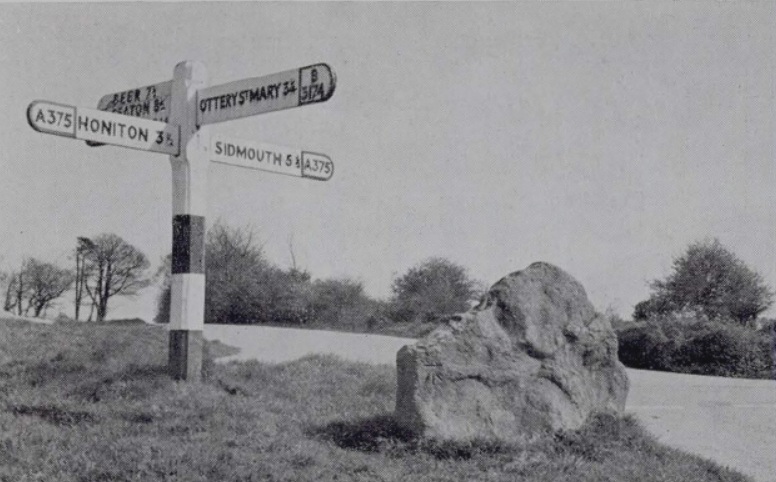
Accompanying ‘Bywayman’s’ letter to Country Life (9th May 1957). In contrast to his theory, the East Devon National Landscape website suggests its geology is actually local.
The Devon and Dartmoor HER says this stone could be a prehistoric way marker, since used as a parish boundary stone.
This stone is at Putts Corner, a crossroads on Gittisham Hill, and near numerous barrows. It now finds itself in the shrubbery of the Hare and Hounds Inn. There’s a nice little watercolour sketch from 1855 on the East Devon National Landscape website, annotated as follows:
Block of stone on Honiton Hill at Putt’s Corner or Hunter’s Lodge, concerning which several traditions are current in the neighbourhood: – as how the Witches used to sacrifice their victims on it – how some fabulous person used to bury his money under it, – and so on.
I also found that “According to legend this stone possesses a distinct and decidedly reprehensible character of its own, for it goes to “have a drink” at Sydmouth every night. Moreover, no horse has ever been known to pass it without attempting either to shy or bolt.” (From the ‘English Illustrated’ quoted in the Manchester City News, 30th June 1906).
Or has it got another motive?:
Sir, – The Rolling Stone at Putt’s Corner must receive a glance from less than one per cent of the motorists who drive past. Yet it is the subject of an interesting local tradition, according to which it used to stand on end as one of the supports of a sacrificial altar. At midnight, when the moon is full, the story goes, it occasionally rolls itself down to the River Sid, there to attempt to wash away the blood stains of its human victims. The stone is a sarsen (not found naturally in the immediate neighbourhood) and its weight is computed to be about one ton. – Bywayman, Somerset.
(From Country Life, 9th May 1957). If it just rolls itself to the source of the river, that seems to be just down the road to the west (much easier than going all the way to Sidbury).
Another tale has it that “it danced at night when it heard the bells of Sidbury Church” (mentioned by Mr Pearse Chope to the Devonshire Association, reported in the Western Times 22nd July 1927).
I read a very imaginative article about various people actually seeing the stone rolling. But it’s in a 1970s newspaper feature called ‘Stranger Than Fiction’ – I’ve seen enough of these to know they’re made up on the spot (John Macklin I’m looking at you). That would be too silly. And terrifying.
The quality of these stones is a species of granite, reddish, and full of large white shining specks of spar-like appearance. When polished, some of them are veined, and have an ornamental appearance. There is no regularity in their shape, and few of them present sharp angles; indeed for the most part they seem from their rounded forms to have been long subjected to the action of water.
This species of stone is called by the country-folk thunder-stone, but upon what authority seems a matter of much doubt. I have heard the inhabitants assign two reasons – one, that the stones have fallen from the clouds during thunder-storms; and the other in consequence of their giving out sparks of fire when struck against each other, at the same time emitting a faint smell of sulphur. But in fact the great majority of the people would not be able to assign any reason for so singular a name, not troubling themselves to inquire into the origin of names.
This species of stone is very scarce in that part of the country; indeed, where the stones are found at all, they are mostly found singly, and at great distances from each other; and from an intimate acquaintance with the whole neighbourhood, I feel quite sure that the Druid stones could not be replaced from a surrounding district of very considerable extent. From whence they were brought to the situations they so long occupied [before many of them were blown up, that is], I have never even heard conjectured; that no human means were used to place them in their relative positions would be an opinion too wild to be hazarded.
From ‘The Druid Stones near Shap, in Westmorland’, in the Kendal Mercury, 18th April 1840.
Near to the roadside going from Orton to Shap is a large granite boulder or stone known by the name of “Galloway Stone,” where it has been said goblins have been seen. I knew a person who chanced to be out on the large tract of moorland, not far from the stone after daylight had disappeared, when he saw an apparition which made such an indelible impression upon him that he afterwards became very unsettled in his mind.
Penrith Observer, 22nd July 1890.
It would be strange if such a wild, sparsely inhabited district did not boast a “boggle” or two. The Shap Fells have a few traditions, particularly in the region of the Galloway Stone, a huge granite boulder on the roadside leading from Shap to Orton, within a mile of Shap Spa.
The worst behaviour related of this Galloway “dobbie” was in connection with a well-known local carrier. He had passed the stone scores of times and “hed niver seen nowt nea [..] nor hissel’.” Nor on this memorable occasion did he see “owt” – that pleasure was reserved for his powerful steed. For one night on returning from market, the usually quiet, steady-going nag “took the st[..] – i.e., a determined stand – as it neared the block; and neither by coaxing nor threats could be got to move.The animal ended matters by rearing and getting the mastery; then it smashed carrier’s cart, and damaged his marketing stuff, chiefly goods of his neighbours, alas; that the poor horse was completely unnerved was obvious from its trembling, foaming commotion.
Other human beings in the district were more unfortunate, for they did see uncanny objects at that very spot: “Summat ter’ble,” with the natural result that they were “varra n’ar scarred to death.”
[*]these words were in the gully of the scan and I couldn’t read or guess them! From ‘A glimpse of Shap Fells’ in the Yorkshire Post, 12th October 1910.

S Face of N Stone of Clach Stei Lin Stone Circle

E Face of N Stone of Clach Stei Lin Stone Circle.

Clach Stei Lin Stone Circle viewed from N. (03.07.11)
The lady [in this narrative] was no less than a princess and queen. She lived as long ago as Saxon times in a city on Eddisbury Hill. The hill can be seen to this day to the south of Delamere Station and only a mile away.
Ethelfleda, for that is the lady’s name (now reduced to Ethel), was a daughter of Alfred the Great, and she ruled over the kingdom of Mercia right up to the banks of the Mersey. She married Ethelred (not the Ethelred of history). [...] She ruled the city of Eddisbury firmly and well. But after she died, it fell into all sorts of lawlessness and disorder, so that it was destroyed, and not one stone stands upon another. But broad lines, marked by the turf in darker green where the damp is arrested, still shew the presence of foundations, and there is, or was, an old draw-well, partly filled up and fringed with thorns and briers.
[...] Why the spirit of the lady should haunt a woodland brook more than a mile away, and why the turbulent souls of the departed city should stream down the hill at night (according to the testimony of a well-known farmer, long since gone to his rest), seems purposeless and inconceivable. does the lady go to meet anyone, and are the turbulent souls afflicted with insatiable thurst?
“Dinna thee goo thear – there’s a buggin thear,” said an elderly native, as I struck into the forest on a summer night, along the well-known Buggin Walk, by a woodland brook! Turning back to the old gentleman for particulars of identification I was told the lady was of commanding presence, with long, golden tresses – dressed, of course, in a white costume, but not of the prevailing fashion – that the lady seemed to be expecting someone – in short, this was the Lady Ethelfleda! [...] J. A.
From the Cheshire Observer, 6th March 1915.
A collection of our research on Hoyle’s Mouth Cave
For many years it was believed that burial at the an ancient Irish passage tomb was the preserve of kings and other dignitaries, who represented a dynasty that practised incest.

Blessington barrow, Summer Solstice 2025.


Had a nice view of the mound during winter die back..


N Face of Clach an t-Sagairt Carved Stone (Ronnie for Scale). (01.07.11)

S Face of Clach an t-Sagairt Carved Stone (Oystercatcher for Scale). (01.07.11)

S Face of Clach an t-Sagairt Carved Stone. (01.07.11)

Inscribed Cross in NE Quadrant of S Face of Clach an t-Sagairt Carved Stone. (01.07.11)


18/05/2025 – Looking back along the low passage from inside Corrimony Chambered Cairn. The roof is long gone. Lovely and sunny today.


