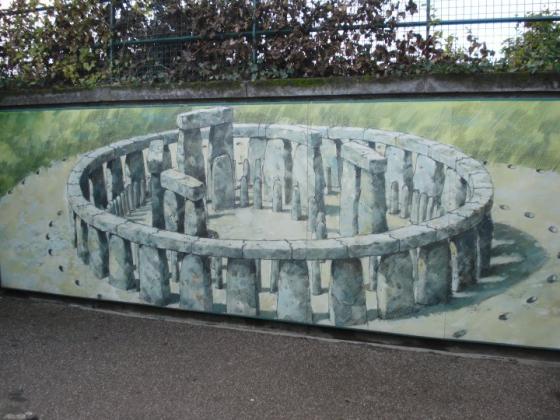
Stonehenge and its Environs 134
Image by Chance

That's a fantastic description, Moss... Really sets the scene!

I had a theory a short while ago, about the bluestones and the folklore/story of Merlin removing them from Ireland (or Wales?) and placing them at Stonehenge.

A slight diversion (but it explains my line of thought a bit):

I read a book some time ago that related actual physical archaeological fact to events written in the Bible. It made very interesting reading - in particular the fact that at the the stories in the Bible were set, there would have been no written language, and therefore the stories would have been handed down verbally, probably changing slightly as they were passed from person to person, or village to village.

Now, as we know, the winners of any invasion or war are the ones that write history. It is highly probable that some of said stories would have certain embellishments in them to either make the victors appear more strong, or worthy, or make their enemies believe they had a little help from whatever gods might be around at the time.

End of diversion.

The story that Merlin levitated the stones from Ireland is obviously untrue, but I have often wondered if there is an origin to this based in fact.

Could it be that the stones were not quarried from Preselli especially to be transported to Stonehenge, but came from an already existing stone circle? Maybe the stones were removed and transported to Stonehenge as a show of strength or victory over whoever's hands the circle was in at the time.

The story that the winning army had the means at their disposal to use magic (form a wizard or a god) to transport the stones all that distance would surely have made any enemy think twice about attacking.

I'm intrigued by the fact that there are so many springs and wells in the mountains! And I'm so glad there seems to be a connection to the stones.

Anyway. That's it, really: Could it be that the bluestones were already an existing stone circle that were uprooted and moved to Stonehenge?

Or has this theory already been done to death and utterly disproved?

;)

G x

goffik wrote:
Anyway. That's it, really: Could it be that the bluestones were already an existing stone circle that were uprooted and moved to Stonehenge?
That's a big bit of what Darvill's been looking at. He has looked at where the stones came from in the landscape, and how they are arranged at Stonehenge.
(Bear with me here as I can't remember it all) Even with the various re-erections of the blue stones it seems that their position at Stonehenge correllates with which bit of landscape they came from.
There are also apparently similaritys in bluestone arrangements at Stonehenge and Bedd Arthur.
I heard this from Darvill's own mouth at a talk in February but forgot to take any note making equipment with me!

'Could it be that the bluestones were already an existing stone circle that were uprooted and moved to Stonehenge?'
The bluestones have been moved around at Stonehenge haven't they? and they were also chipped about on site. But I don't know whether they were cut when they first arrived, or later on when they were moved again. Because would make a difference ? - if they were valued as a stone circle elsewhere, would you want to tidy them up when they got to Wiltshire? maybe you wouldnt or maybe you would.
Also if the stones were thought of as healing at the time, I would have been selling those chips not letting them lie around - wouldn't they contain some of the healing benefit?
But presumably they'd have this healing reputation when they were first brought over.. if we're saying that's the reason behind them being lugged all the way from Pembrokeshire.

I'm intrigued by the fact that there are so many springs and wells in the mountains! And I'm so glad there seems to be a connection to the stones.
Couldn't agree with you more Goff (and FW). Where there are stones there often seems to be a nearby spring or well and/or a river. In the Avebury/Silbury area there are eight churches close to the course of the Winterbourne and Kennet, several with what appear to be un-worked stones in their foundations. Same at nearby Alton Priors, Clyffe Pypard, Pewsey and, in Essex, at Alphamstone* (thanks to ocifant for telling me about the latter). Maybe the key to understanding the 'stones' lies in the water (in which case you'll have been right all along goff :-)

At East Kennet, "There was a church on the same site as the present one in the 12th century... local poverty and negligence on the part of the owner... resulted in reports in the 16th and 17th centuries of the decay of the church fabric, and by the 19th century the church had become dilapidated." (from the church info sheet). Seems like the old church was completely demolished in the 19th century and then a new one built in the Early English style. That might account for there being nothing of megalithic interest in the church foundations. However, the site does have a 'pre-Christian feel' to it: it's built on a mound, yew tree about as old as the one at Alton Barns (younger than the one at Alton Priors which Nigel spotted last year and which might indicate that Alton Priors is a pre-Roman site while Alton Barns has never been anything other than Anglo-Saxon). There's a pond along the outside of the East Kennet churchyard wall with one large sarsen (maybe two sarsens as there's something completely covered with ivy) at the pond's edge. There's also another large sarsen in a nearby garden and a heap of broken sarsens by the northern wall of the churchyard. Got the feeling the original church may have been built within the circle not on it.

The idea that Stonehenge was a place of healing (and by extension a place of learning?) is very exciting. The thought that Stonehenge was known throughout the ancient Western world, and a place where people would visit from afar to learn, be healed or just to marvel, is truly astonishing.

* http://www.ansellsfarm.co.uk/alphamstone/alphamstone.html