Visited May 2013
Image credit: Uwe Häberle 05/2013

Visited May 2013

Visited May 2013
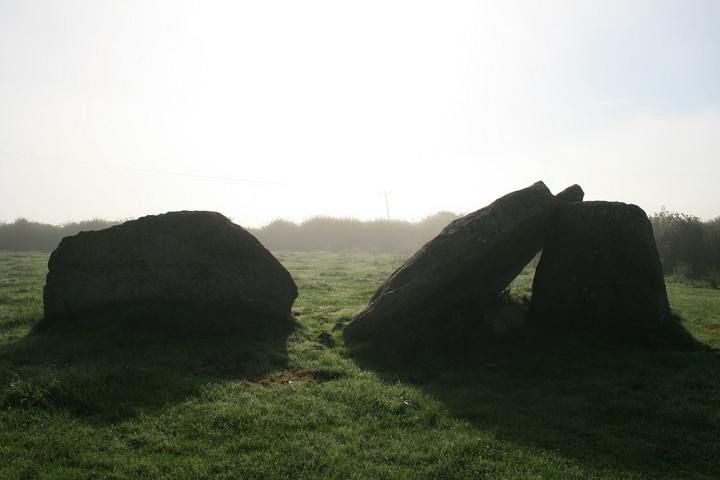
Sun shines through early morning mist.


Early morning mist moves about quickly.


Ok lets go now.


Close up of small stone underneath the ‘cap stone‘


From behind with Helman Tor in background


I was pretty determined to spend ‘Christmas Day’ 2002 on a wind swept moor amongst ancient sites, and I managed to do just that.
I started with a quiet drive to the most famous quoit in East Cornwall, the huge Trethevy Quoit. I had seen it so many times in pictures; it was great to see it for real.
I moved onto toward the Hurlers but not before stopping at The Longstone Cross / Long Tom Cross. It may have once been a menhir that was then Christianised by carving a cross on its face. The stone stands alone, often amongst sheep roaming the moor, and on the horizon a line of old mine chimneys can been seen, marking the lode (course) of a copper vein. Even on this day there were lots of walkers and doggie people around The Hurlers, which was nice. It’s good to see people taking an interest (even a passing interest) in our history. Not only are the circles fascinating, but the whole place is steeped in history, from the Pipers, Rillaton Barrow, the Cheesewring, Stowe’s Pound, and Craddock moor sites, to the plethora of old mining ruins.
Without a map or compass you may be lucky enough to stagger across the fallen Craddock Moor Circle 1 km North West of the Hurlers whilst exploring Craddock Moor. Even with a map and compass you may not find them as the stones are all recumbent and are not visible from any distance. Further on is the tiny Craddock Moor Stone Row. There’s no easy way to describe how to get to this but if you wanna go try my instructions (or practice better compass reading that me – not hard!).
A few kilometres away from the Hurlers area, King Doniert’s Stone(s) stand in a beautiful walled enclosure, complete with stone benches. The Cornwall Heritage Trust could obviously teach English Heritage a thing or two.
I love ancient sites but sometimes you need a break so I went to the Eden Project on the 26th. This is not a criticism but of all the people who needed to go I wasn’t high on the list – I live a few kilometres from Kew Gardens and they are pretty similar in many ways. Anyway, go and see, and if you do, please spend a minute filling in a Gift Aid form, which means that they can claim 28% extra (over and above your admission fee) from the taxman.
On my way to Bodmin Moor I stopped at Lesquite Quoit but couldn’t properly explore, and had a wander around the huge Lanhydrock estate. The rest of the day was spent on the moor visiting the three stone circles of Stannon, Louden Hill, and Fernacre. Many of my stone counts didn’t match other people’s counts, the most interesting of which may have been Louden Hill where I counted 31 stones, as opposed to Craig Weatherhill’s 16/17 stones.
I also stumbled across something that could be interesting, or could just be a few stones in a quarter circle – I’ve taken the liberty of calling it Louden Hill 2?? I take no responsibility for it being just a couple of stones spotted by an eccentric walker on a lonely moor! I also came across a stone cist and two cairns between Louden Hill and Fernacre, which all seemed to align East-West to a stone in the background. As the night descended it led to the photos coming out very dark and now I scratch my head and wonder if it was just my imagination……a strange day.


View of Lesquite from Helman Tor.
You can just make it out in the centre of the pic.


This would look great if some could find the third stone and re-erect the capstone.
It could look just as good as Lanyon Quoit which was re-erected 1824

Taken from the roadside with a zoom lense.
Had to stand on hedge to get this view as there is no public accesss.

Mar 2002
Though Lesquite quoit wasn’t really making much of a blip on my radar, as it wasn’t far from St Austell where we were staying, how could I not investigate the burial chamber marked on the map. Like Carl (again) we parked up in the opening to the lane that leads to the radio mast or what ever it is. And like him we also went off down the road occasionally peeping over the high hedge to see if it was there yet. But it wasnt raining, in fact it was a nice day, a sunny day with fast moving roving bands of low mist.
We located the stones through the hedge and just a couple of meters along was a place to climb over.
Champion !
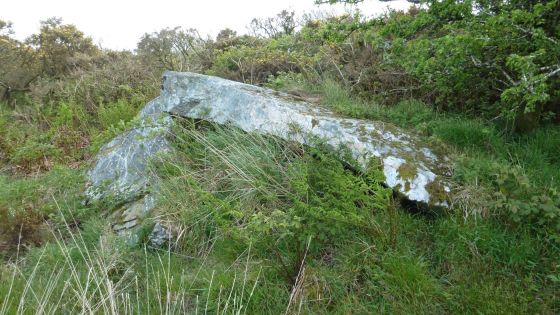
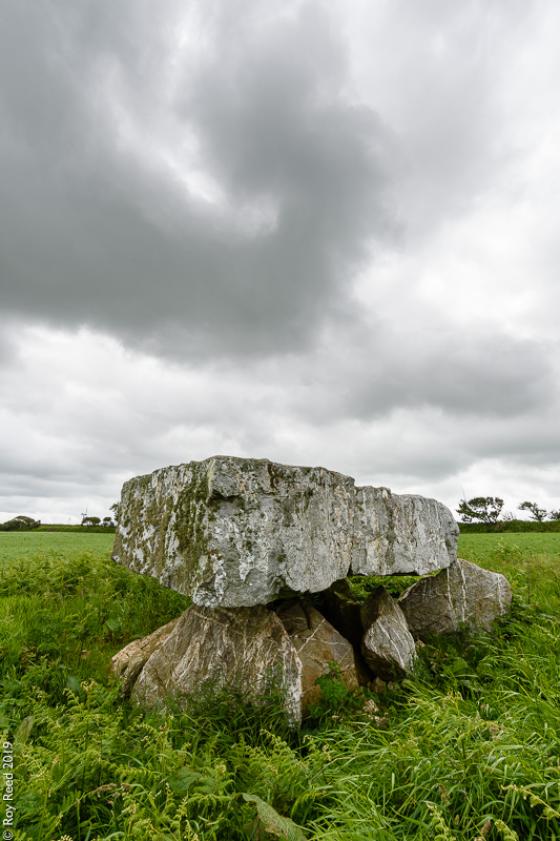
There are only three stones making up this burial chamber, but they are big stones. Two stones are standing up, they are longer than they are tall, leaning upon one of them is the monster of a capstone. It really is a big flat stone, shining white and brightly in the early sun, it looks bigger than most other quoit capstones, or perhaps it was the perspective, do stones look smaller when there up and in their proper place, doubt it, it’s a big stone.
Cows in the other end of the field were beginning to get interested in our expedition, and my new pet hate was starting to make its presence felt, dew, even if it hasn’t rained in days, dew will soak your feet, weeks even, it’s like everyone who loves the morning and lives in Britain has to have wet feet, it’s like a deal with the devil, or an old charter or something. Gets on me nerves. As the kids get older I can leave them at home and go out on my journeys in the evening.
A good few stones, big and bright.
Inspired by CARLs visit, I thought it about time I got to see Lesquite Quoit, especailly as I spend quite a bit of time in the area during the spring due to its close proximity to Redmoor nature reserve.
So, having spent the day watching woodpeckers and blue tits feeding their young, being mugged by three over excited squirrels and generally having a great time deep in pristine woodland, I drove over to the pull in beside the field.
As I got out of the car I spotted a fox cub on the other side of the road scarper into the corn with a vole in its mouth. I walked across carefully hoping to catch sight of it only to be greeted by three other cubs, all happy to have photos taken...
...but back to the quoit.
It’s an interesting one as there is no sign of how, if it did, the cap stone sat atop of the uprights. Perhaps it never did, the other large stone that stands behind is too far away to have been part of one structure, so why is it there? The small stone that sits beneath the sloping cap stone, is it original or just a large stone placed there years ago and now considered part of the group?
Is there a connection with Helman Tor and its supposed Neolithic encampment?
So many questions...
Visited 20.4.12
The lane running south of the burial chamber is very narrow and parking is difficult.
However, we did manage to park at the turning which leads to the transmitter.
The rain was falling and everyone opted to stay in the car while I walked back down the lane to try to spot the burial chamber. This was not easy as the bank is high and topped with a hedge. Coupled with the wet grass I slipped on several occasions before finding the right spot to see the stones.
There are 3 large stones remaining but there was no way through the hedge to get into the field for a closer look. One of the stones was holding the largest up on an angle. Unfortunately I didn’t read pure joy’s notes before visiting so didn’t realise access was via a gate opposite the sub-power station.
When I returned to the car I realised I had dropped my notes and had to walk back along the lane (in the now pouring rain) to retrieve them!
Martin’s directions get you there with no problems. The silage had been cut when I got there and it was easy to approach the Quoit. You don’t get a real impression of the size ‘till you get near, it’s massive and on a par with the other more well known Quoits. Don’t leave it out of your itinary when you are in the area.
Lesquite Quoit – 26.12.2002
SX071628
This burial chamber is in a field to the North of a country lane that is just West of Tredinnick Farm. The lane is signposted ‘Tredinnick’ from the B3268 below Bodmin, just to the South of where the B3268 crosses over the A30. There is no entrance into the field from the lane so go to the dead end road at SX069627. Opposite the sub-power station a gate leads into the field. As it seemed to be private land and I didn’t have time to find out where to ask I just peered at it from the hedge on the country lane and didn’t actually explore it.
This is what Craig Weatherhill’s excellent book ‘Cornovia: Ancient Sites of Cornwall and Scilly’ (Cornwall Books – 1985, revised 1997 & 2000) says about it. “Also known as Lanivet or Trebyan Quoit, the ruined tomb consists of a fallen capstone 5.3m by 2.8m leaning against an upright 1.9m tall. A second upright, at right angles to the first, is 1.7m high and 2.7m long. The capstone could not have been supported by both, which suggests that the original tomb was a fairly complex one. A pipe-laying trench cut just to the South of the remains in 1973 revealed several stone sockets and a post-hole which were possibly connected with the surrounding barrow of which nothing remains. The monument has been in its present condition since at least 1858.”

The capstone of Lesquite is supposed to have been thrown here by the Devil in a game of quoits (so says B C Spooner, in The Giants of Cornwall, in Folklore, Vol. 76, No. 1. (Spring, 1965).
Barnatt (Prehistoric Cornwall, the Ceremonial Monuments, 1982) says that the quoit was thrown from nearby Helman Tor. Apparently there are natural features of a ‘similar form’ at Helman Tor, about a mile away, that can be seen from the quoit.
The remains of the quoit consist of a single upright about 6 feet tall with the former capstonelying on its side against it at an angle of about 40degrees.
the capstone is made of granite and is said to weigh about 12.5 tonnes this makes it the same size as the Lanyon and Zennor capstones