Story here:
jrnl.ie/4356455

ryaner


This is the sealed chamber that splits the two galleries of the back to back dual court tomb.
Image credit: ryaner

Looking southish at the smaller of the two galleries of this dual-court tomb.
Image credit: ryaner

I was fascinated by this arrangement of stones, the small stone being jammed between the shoulder of the right-hand orthostat and the jambstone.
Image credit: ryaner


After many recent trips around the court tombs of the border region, most of which are wrecked, it was great to arrive here and see it in such good condition, without being overly restored.
Image credit: ryaner

Looking out between the jambstones of the northernmost chamber into the court.
Image credit: ryaner


Looking north alone the galleries with jambstones and sillstones still intact. This was excavated, but not overly restored like some of the tombs north of the border.
Image credit: ryaner


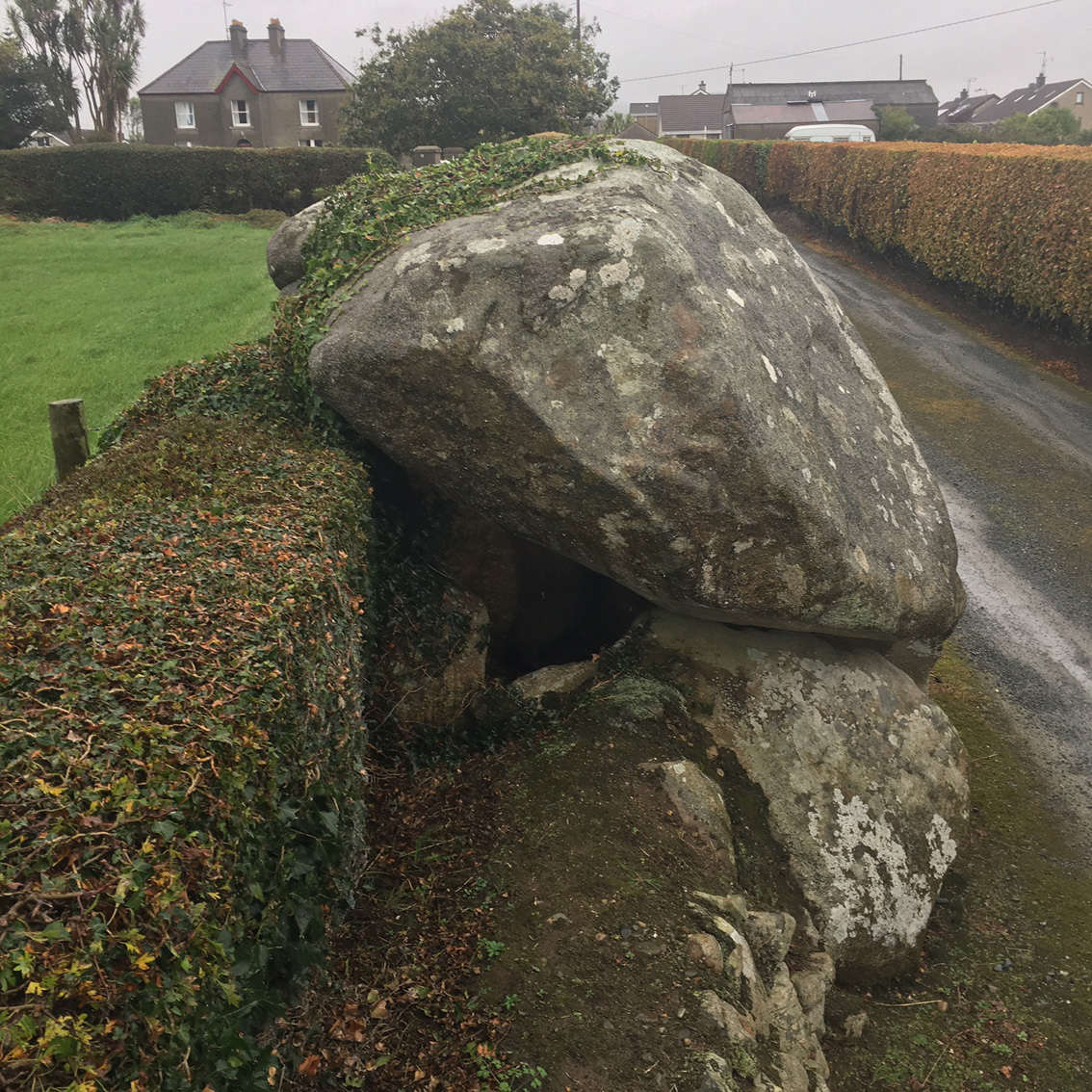
The chamber at Goward is really quite small for a tomb with such a gigantic capstone.
Image credit: ryaner

Our plans to climb Slieve Donard took a hammering.
Image credit: ryaner

Dull, dank day in Down. The Long Stone is in the village of Longstone, coincidentally.
Image credit: ryaner

Quite a phallic old boy from this angle.
Image credit: ryaner

Quite a contrast to some of the shots from other contributors here.
Image credit: ryaner


Shaped stone with the straight side facing inwards. Quite a few of the stones in this tomb are similarly shaped and placed.
Image credit: ryaner


Looking north-north-east. Th fenced enclosure includes the long cairn.
Image credit: ryaner

From the rear of the portal structure, with Knockshee in the distance.
Image credit: ryaner

The monument is in state care and has great access through a farmyard. However, as with many of the state care sites in NI, the fences are tight up to the tomb, almost strangling the atmosphere.
Image credit: ryaner

In comparison to a lot of the court tombs I’ve visited recently, this has a lot of its original structure in place. As is fairly usual, any roof stones have been stripped off. I’m surprised that this hasn’t been taken into state care.
Image credit: ryaner

Two sets of jambstones showing the tomb’s gallery segmentation.
Image credit: ryaner


From this angle it looks like it is trying to scamper over the wall, maybe to get away from the locals...
Image credit: Ryaner

Most, if not all, of the main stones are still extant, though the capstone may have slipped somewhat.
Image credit: ryaner


I had an appointment in a hotel in Letterkenny and it finished earlier than I had expected. Usually if I’m traveling that far I’ll have done an itinerary and have my maps with me, but as I thought I’d be in the hotel until nightfall, I hadn’t bothered. Now I had about 2 and a half hours of daylight to spare so I typed in Drumskinny stone circle into Google Maps and headed off. It was 50 minutes away and was going to add 30 minutes to my three hour journey home but what the hell.
I headed out the Letterkenny to Ballybofey road but was traveling almost blind as I’d never been in this part of the country. I kept pretty much to the GM directions but peered over any hedgerows I could to see if there were any wayward sites. After about 25 minutes and heading downhill towards some forestry I noticed a bunch of upright stones beside a field wall about 50 metres into a field on my left. I was fairly moving it but jammed on a bit past and out of sight of the site. The speed limit sign I parked beside was in mph and as I left the car and headed back, there was one in kph – I was right on the border.
The border-line runs right through this tomb. It is not mentioned in the Survey of the Megalithic Tombs of Ireland, Vol. VI, County Donegal but is mentioned in the Archaeological Inventory of County Donegal. It is very much a court tomb and is a wrecked mess that could do with a bit of tidying up. The remains of the court lie mostly in Donegal but most of the tomb, with an ante-chamber, a full chamber entranced through a classic pair of jambstones and a completely destroyed sub-chamber are in Tyrone. Indeed, the only online mention I can find for this calls it Garvagh, and places it in that townland in Tyrone. It’s mentioned in the inventory section of Tomb Travel, the Northern Ireland Environment Agency SMR number TYR 015:005.


A most peculiar arrangement of stones, and right beside the road, much to my surprise.
Image credit: ryaner

Further to Greywether’s reference above:
From Irish Passage Graves, Neolithic Tomb-Builders in Ireland and Britain 2500 B.C. by Michael Herity
Dw. 6
ANNADORN TD.
Cromlech (1835)
Sheet 30
A rectangular chamber 1.8m across covered by a capstone is all that remains of a chamber approached from the north-east by a lintelled passage, which originally stood under a round cairn 18m in diameter. It stands about 46m (150’) O.D.
Dubordieu, writing in 1802, described it as ‘having been discovered, nearly 30 years ago, to contain within its circumference, which is about 60 yards, and towards the bottom, a large smooth stone, of a square figure, from seven to eight feet over, and supported by several other stones above three and a half feet high, forming underneath a kind of chamber, in which were found ashes, and a number of bones to appearance human; upon the surface of this large stone, when the smaller stones which were pyramidically arranged were removed, a quantity of black ashes were found. The entrance to this chamber was towards the north, and under several flat stones regularly disposed in front of each other, and extending to the outside of the cairn; these stones were some years ago taken away for building.‘
Dubordieu 1802, 270; ASNI, Down, 78; Prelim. Survey 103; Borlase, vol. I, 286; Ó Nualláin 27.


There are many outliers at Ballynnoe, leading one to speculate about alignments and such.
Image credit: ryaner


The remains of the court are in Donegal in the south but are north of the rest of the tomb which is in Tyrone, north of the border but south of the court.
Image credit: ryaner