


This picture shows the Whittlestone situated near the foot of the hill that houses the church where the stone used to lay. Perhaps, in their quest to destory pagan sites and relics, the church builders just rolled the stone down the hill and this is where it settled. Who knows? As seen on 23 August 2006 CE.

The raised remains of Condicote Henge is more pronounced on the north side as (I hope) this picture demostrates through the bushes. As seen on 25 August 2006 CE.

It is difficult to photograph this henge as much of it has been ploughed-out over the years. In this photo the right hand side of the grass is part of the raised henge arching round towards the left of the picture. As seen on 25 August 2006 CE.


The ramparts of the Chastleton Barrow Fort used to be faced with stone and this is sure to be a fallen example of one of them. As seen on 22 August 2006 CE.


Is it or isn’t it prehistoric? I’d like to think it is but it is frustrating that so much of the past is lost to us. At least we know the stone has survived 2000 years when you consider how much of the past has literally been lost through fire, bombs and redevelopment. And I’m glad it has survived because, as a Londoner, the saying is “So long as the stone of Brutus is safe, so long shall London flourish”. My grandad was a great walker and explorer of London and I remember him telling me about this. What took me so long to go and seek it out for myself? Viva!
As seen on 3 June 2006 CE
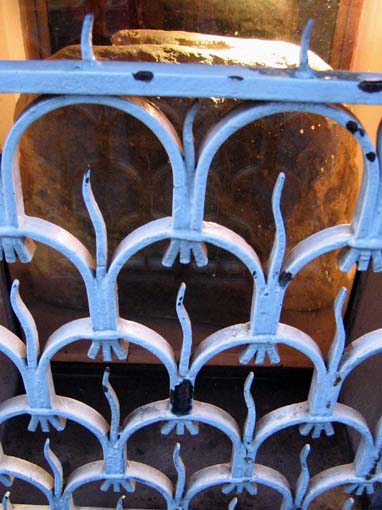
I was struck by how the protective iron work in front of the London Stone made it look like Cernunos, the horned God.
Between the two ‘horns’ you can see a gash in the stone. Is this where Jack Cade struck the stone to declare himself Lord Mayor of London during his rebellion against HenryVI in 1450? Who knows? I’m seeing Henry VI part 2 in Stratford later in the year and like the idea of seeing a prehistoric stone in a Shakespeare play (if it is indeed prehistoric). Some say there was a stone circle on Ludgate Hill, which is just up the road with St Pauls sitting on top of it, and that this stone may be from that. Will we ever know?
As seen on 3 June 2006 CE


I had been wondering if “Hare” and “Harrow” had the same etymology and looked up Harrow in John Field’s book ‘Place Names of Great Britain and Ireland’. The entry for Harrow-on-the-Hill says it means “Heathen Shrine on the Hill”.
Earlier in the year I stayed at the Lodge in Avebury and Andy Burnham told me about this stone. I work in Harrow and Andy, who is from close by, told me about the local sites. It took me a while to find this stone and kept asking colleagues who live locally if they knew of it. finally I was pointed to a restaurant in the Harrow Weald area which used to be a pub called the Hare (probably after the stone). I am also told that the name Harrow (famous for it’s public school) derives from ‘Hare’. Apparently Harrow Hill itself, where the school is, was sacred and used for worship but I am not sure how my colleagues come to know this.
I have yet to find out more about this stone and it’s more famous neighbour (the Weald Stone, OS ref: TQW150908) ) a mile or so down the hill. It looks like it has been broken in the past and I was wondering if it was perhaps part of an old tomb or burial mound.
I believe that further up the hill (the Harrow Weald hill, not Harrow-on-the-Hill) is an old earthworks but this is going to take longer than a lunch break to discover and so will it have to wait for another day.
If and when I find out more about this stone I will add information here.

The building behind this stone is now a Bluebeckers Restaurant but used to be a pub called the Hare. As seen on 22 November 2005 CE.

My friends add perspective to the picture. As seen on 22 November 2005 CE.


Despite the fact you can see Addington Long Barrow from the road that runs straight through it the land that it lies on seems to be owned by the same woman who owns the land that the Chestnuts are on. This site would be much better apreciated if you can actually access the land it’s on instead of looking at the stones through the barbed wire fence. Unfortunately the owner was just leaving when we arrived and was unable to show us around.
People reading this website before visiting the Chestnuts will see that there’s information about calling ahead to arrange your visit. To get the best out of visiting this site I advise ringing the same number.
So, if you are looking at the Addington page on this site without realising there’s an more exciting tomb situated just behind this one I advise calling this number before planning your visit to make sure you can get access:
Phone: 01732 840220

A small section of the Addington Long Barrow. Yes, a road really does run through this long barrow and more stones lie on the other side of it behind where this picture was taken. As seen on 23/10/2005 CE.
Kent ... the garden of England. The car park of England more like! This longbarrow which, despite it’s name, survives with more than one stone, is sandwiched between the Channel tunnel rail link and a motorway. It even has it’s own petrol station attached! OK, as tombs go this place isn’t the greatest surviving monument in Britain, but surely it deserves better.

The Coldrum seen with ribbons, berries, corn, etc, tied to the surrounding trees. As seen on 23 October 2005 CE.


The Coldrum is well worth a visit. A great monument and in excellent condition. As seen on 23 October CE.

This tomb must have been incredible in it’s day. These fallen stones are still fascinating thousands of years later and this site made me think of how some of the ancient sites first appeared to people like William Stukely before many ruined tombs were repaired and fallen stones re-errected. As seen on 23 October 2005 CE.

Perspective for these small stones is added by a 2 year old. As seen on 04/10/2005 CE.

Five of the Nine Stones of Winterbourne Abbas. You could be forgiven for thinking this is a picture of a tranquil place but it’s not. The constant roar of traffic behind where this picture was taken is very distracting. Even the Weald Stone by a roundabout in London is a more relaxing place to visit!
As seen on 02/10/2005 CE

The circle with a navel within one of the alingments at Merrivale as seen on 04/10/2005 CE.

There’s a lot to see at Merrivale with the alignments and stone circles but there are many other stones around the site that invite speculation. How many of the standing stones are ancient, for example. These stones caught my eye with one balanced on top of the other sandwiching two smaller stones.
04/10/2005 CE.

The undulating ramparts of Maiden Castle as seen on 02/10/2005 CE.

The Lanceborough King Barrow as seen from the steep ramparts of Maiden Castle on 02/10/2005 CE.

