In this weird little watercolour, I have tried to express the sense of rotation of the energy that the stone circle creates. It’s for you to decide whether or not I have achieved this!
(Private collection, Teesside)
In this weird little watercolour, I have tried to express the sense of rotation of the energy that the stone circle creates. It’s for you to decide whether or not I have achieved this!
(Private collection, Teesside)
Yippee! At last! There may be peace and quiet for the walkers, bicyclists and horse riders who use the Ridgeway...
From the Oxford Times, Thursday 10 July 2003
Laws banning motor vehicles from the Ridgeway national trail may come into force if a conservation project to repair the damage they have caused fails.
The Government is considering barring four-wheel-drive vehicles, motor cycles and quad bikes from the historic 85-mile trail next year, if a national trails improvement scheme is unsuccessful.
Liberal Democrat and Conservative MPs called for the Government to agree to introduce a ban if the project fails.
But Tony McNulty, parliamentary under secretary of state for transport, said the project needed to be given a chance.
The Countryside Agency has pledged to restore and improve the national trails, including the Ridgeway, which runs across south Oxfordshire.
About £1m is also being sought by the Oxford-based National Trails Office to repair stretches of the route, with support from Oxfordshire County Council.
Speaking in the House of Commons, Mr McNulty said: “If the Countryside Agency’s management plan and the work of local authorities do not produce results within 12 months, the Government is committed to consider promoting a ban.”
A section of the Railways and Transport Safety Bill is likely to be amended to include the possible ban. It was scheduled for discussion in the House of Lords on July 10.
Lord Bill Bradshaw, who lives in Wallingford, was expected to be among supporters.
Don Foster, Liberal Democrat MP for Bath, who was among those calling for the amendment, said the Government must ensure the issue was taken seriously.
Peter Gauld, secretary of Friends of the Ridgeway, which has campaigned for vehicles to be banned, said: “I would be pleased to see this amendment go through.”
In April, county councillors from the three main parties supported a motion to ban vehicles.
The executive board was asked to use traffic regulation orders to protect sections of the route, which are advertised on websites for four-wheel-drive enthusiasts.
Webster admires the barrows dotting his landscape.
(They’re just between his ears!)
Oscar and Webster look with disgust at the huge cruciform erection which has defaced Churn Knob.
“They would never have allowed that to happen when I was a foal”, mused Webster.
A narrow chalk footpath/bridleway leads up from Blewbury to the Downs. Today the track is lined with field scabious, poppies, cornflowers, lots of blue flowers which I couldn’t identify and the most wonderful little purple orchids which are quite rare and only grew on very chalky soils such as was now underhoof. A quick canter past the old chalk pits lead us up to the top of Churn Hill and... there it is! Churn Knob! We couldn’t actually get very close on horseback, ironically, because it lies directly beside one of the privately owned ‘gallops’ which casual riders are forbidden to use by The Expensive People. We got as close as we dared without being shot or set upon by slavering hounds for me to take a couple of pics.
It’s quite big, perhaps, 10 or 15 metres wide at it’s base and seems to rise quite steeply. At this time of year it is resplendent with wild flowers glowing purple in the hazy sunlight. But it’s the position of the knob which is so impressive, for the views up here are remarkable. Looking north you seem to look vertically down over Blewburton Hill and across to the Wittenham Clumps. The graceful curves of the cooling towers of Didcot Power Station are just over to the west and on a clear day I’m sure you’d be able to see Oxford. It’s from this position that St Birinus (whoever the f**k he was) preached a sermon. To remember this, for the millennium, local Christians have erected an unsightly and monstrous cross on the Knob. A deeply offensive and outrageous piece of vandalism in my opinion. Throw the perpetrators to the lions!
...I rode south out of the stables in Blewbury and trotted alongside Blewburton Hill. This cracking hillfort covers the entire area of a ‘freestanding hill’, if you know what I mean, with phenomenal terracing all around it. It looks really ‘sculpted’. You get a really good view of it as you drive along the A417 Wantage to Reading road, as many people do every day, but I bet they haven’t a clue about this gloriously placed defensive village.
Only a few metres from the Andle stone is this petite beauty. It was a miracle we found it really, not having any maps or anything. But I was beginning to develop a ‘sense’ for these places by now. Nestled at the edge of a wood this teeny weeny little circle of six standing stones and a couple of fallen ones reeks of skipping elves, dancing pixies and kindly woodland folk, a place where the magic of childhood storybooks comes alive. The dappled light falling through the leaves, the pink wild flowers, late foxgloves and unfurled bracken fronds seemed to echo with little whispered voices of long dead spirits, urging you to ‘keep it a secret!’ I wanted to. I wanted it all for myself!
Badly ravaged over time, this probably survives due to it being so tucked away. And it’s this ‘tuckedawayness’ that makes it so captivating, bewitching, charming and hopelessly appealing. The others went back to the pub for more beer, but I stayed here: I wanted to drink in the atmosphere. (And make a sketch, obviously!)
The Andle Stone is a naturally occuring rock – truly massive and quite splendid! There was no mistaking it standing in the field before the land fell down sharply towards the dale bottom. Some footholds had been cut into it so that the brave and the foolhardy may climb to the top. Being fearful of heights and of falling (weird, that, coz I have fallen off horses a lot and it hurts!) I didn’t climb it. Les did – rather bravely, I thought. She said there were some marks on the top, but my phobia was stronger than my curiosity.
A gentle stroll of no more than half a mile from Nine Stones Close takes you to this magnificent natural outcrop of Robin Hood’s Stride, where some attractive, muscly-legged young bucks were busy roping themselves to it and
scaling it’s faces. We sat admiring the great trees growing out of it’s crevasses and massive boulders hanging on the grassy slopes. Now THIS is a place to sit and contemplate your life.
Visited August 2001: Ah! Road altases. How marvellous that the cartographers still mark places like Nine Stones Close. Without an O/S this could be hard to find, but my vague hunch as to its whereabouts and some chaps with a tractor pointed the way and although it’s on private land and we had to wade through a sloppy, well-manured field of friendly cattle to reach it, it was truly worth it. Each of the four remaining stones stand tall, proud and each is uniquely individual. The view they enjoy is quite superb – one way looking out over gentle dales and the other way back towards Robin Hood’s stride. You get a very clear sense of there being something much, MUCH larger here at one time. Though precisely what is a secret it retains. We noticed some large stones in the walls of the field – perhaps these were once part of it?
Visited August 2001:
Some kind soul had erected a very roughly painted wooden sign by a very clear track. We chanced it. A longish walk through the woods somehow lead me and Kath to this charming stone circle. There were a couple of people camping in the woods about 30ms off, but other than that we had the place to ourselves. After the 12 mile ride earlier that day, Kath did nothing but lie in the dappled sun and drifted off.....I got out my paintbox and sketchbook and all was peaceful.... I have only since found out about the painful struggle fought by the eco-warriors to defend its very existance. Good on ‘em. This delightful place exudes fairy charm, certainly a place where the little people live and dance and sparkle. We sat and lost ourselves here for 2 hours or more.
A double page spread from my sketchbook.
Me painting Doll Tor. I was bewitched.
A double page spread from my sketchbook
‘A midsummer night’s sky’ painted by me. Now in a private collection, West Midlands
‘Purple haze’, painted by me. Now in a private collection, Cheshire
Diagram of known ring ditches and cropmarks in the area of the Devil’s Quoits, plotted by Grimes in the early 1940s.
I found this amazing aerial image of the site of the Devils Quoits on page 4 of ‘Excavations at the Devil’s Quoits’ by Barclay, Gray and Lambrick, published by Oxford Archeaological Unit, 1995. The photo was taken in the 1940s and shows the runway bisecting the henge. But what gets me is all those incredible ringditches. All sadly, now lost to us.
A walk through a managed pine forest took 4Ws and me to the now horribly jumbled mess of stones that make up Ballyedmonduff Wedge Tomb. Imposed upon by the encroaching trees and with no room to breathe, this huge place had two distinct chambers and apparently once had roof lintels. Now lost. Hard to tell what should have been where, this is an example of staggeringly careless excavation. FourWinds thought that it once looked out over to Howth, a promentary just a few miles away, but the trees obscured its reference point inthe landscape. Bloody foresters. My protest was made by urinating in the trees.
The wonderous treaclechops relaxes for a moment at Pentre Ifan
This extinct volcano totally dominates the landscape around Newport. This is taken looking over the Nevern River, once where perhaps, the bluestones of stonehenge were floated down from their quarry...
My daughter Cleo attempts (and fails) to topple the capstone from Llech y T
The photographer at work at Tre Fach. Note Carn Ingli in the background...
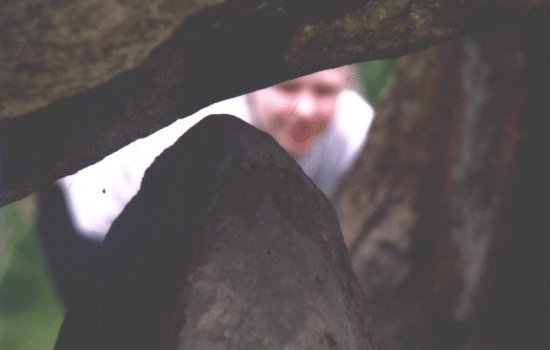
Cleo peers in to marvel at the tiny gap between capstone and upright....
Ah! the lovely Kammer at this beautiful dolmen
Notice the peak of Mynedd Carningli looming over everything in the background
Treaclechops and Rupie point out the menhir camoflagued at the field edge. We were thrilled to find it!
Don’t you think it looks a bit like an bronze age axe head?
Rupie at Tafarn y Bwlch
With palettes still tingling from a visit to the nearby cheese making farm, we visited Carreg Samson. Thrilling! The view is awesome, surely one of the finest placings of a dolmen in these parts? It certainly rivals Pentre Ifan for sheer gloriousness. But what of the cromlech itself? Outwardly it appears to be just another typical dolmen. But look more closely and you see a puzzling construction of two kinds of stone. (I’m no geologist, as I’m about to reveal!) One kind is a smooth bluestone type, the other a lumpy-ricepuddingy kind, shot through with stars and splats of quartz, edged with black. The capstone is of the latter and deserves particular observation. I studied it for as long as I could without getting ‘in shot’, as treaclechops was photographing.
Driving out in the blazing sunshine (again! yippee!) towards the soaring, dramatic cliffs of Ceibwr Bay we called in here. It lies up a track leading towards Penlan farm. You have to hold your nerve as you drive up the deeply tractor-rutted track and pray the undercarriage of your car isn’t removed by the central raised strip! Fearing it would be, we parked at a point wide enough to let a tractor through and got out and walked the last few hundred metres. Although it’s on private land, the construction of a wooden stile implied it was OK to go and view it. The great thick capstone, resembling a grand piano, is held up by only three of the five stones and looked a little precarious, but we liked this very much.
If you do get here, I urge you to continue on to Ceibwr Bay, 2 kms up the lane, where we sat blinkingly in the brightness, cooled by the breeze which whipped up great waves crashing into the wild contortions of the black slate cliffs. The cliffs were topped with grassy green ‘icing’ and great patches of pink sea thrift. See it!
The roundhouses blew me away, and the detail of the interiors was wonderous! I loved everything about this place, and apart from the lack of sunshine, it looked and smelled just like being back in an African village: the smoke seeping out through the deep thatched rooves, the inky blackness of the interior of the huts, the smouldering logs, the woven withy fences, the cow shite and mud walls, the dust underfoot, the rough branches holding up essential furnishings, the sense of constant activity needed to maintain the place; rethatching, weaving and so on. I would have been quite happy ‘surviving the iron age’. I felt quite at home here and it rekindled my spirits.
Massive ditches and ramparts enclosed a small interior centre, but a quarter of the earthwork had apparently been ploughed up in the 1950s so its sense of enclosing anything at all was now lost. I liked this place a lot.
As its on private land, ask the farmer before you enter, as you might disturb his bullocks.