

Jane


Image credit: Watercolour painting by Jane Tomlinson, 2003
From BBCi
An investigation has been launched into concerns that increased visitor numbers may be damaging the Stone Age village of Skara Brae on Orkney.
The heritage agency, Historic Scotland, has brought in state-of-the-art technology to determine whether stones are moving or developing cracks.
Read full article
US Author Bill Bryson appointed EH commissioner
He comes from Des Moines, Iowa. Somebody had to. You can’t blame him for wanting to be here.
Mr Bryson has been a resident of the country, on and off, for the past two decades. He said: “I am taking this very seriously and I am honoured to be appointed. It’s not every day that an immigrant more or less fresh off the boat gets invited to help run a national institution.”
Britain BC by Francis Pryor reviewed
From BBCi, 4 September 2003
Next Thursday is the deadline for people to express their views over a proposed £193m road development around Stonehenge. It is hoped that the re-routing of the A303 road, and a £57m visitor centre, will rescue the World Heritage site from its label as “a national disgrace”.
Read whole story here....
Farmers in Northern Ireland encouraged to preserve heritage
from Farming Life, 3-9-03
Northern Ireland is well known for the diversity of its landscape features, particularly the many archaeological sites which are scattered throughout the countryside.
Examples of the many different types of site include standing stones, stone circles, raths, forts and underground souterrains (tunnels).
However, many important sites have been lost or damaged over the years.
Protection of these unique landscape features is paramount as they not only preserve a visible link with the past, but also contain a wealth of information about the way of life of our ancestors.
These sites can be safeguarded under the Environmentally Sensitive Areas (ESA) Scheme and the Countryside Management Scheme (CMS).
In these schemes, the farmer receives an annual payment for the positive management of an archaeological feature.
Do I detect the hand of our very our BrigantesNation at work here?!
From www.24hour museum.org.uk
Archaeologists and local campaigners have expressed their concern at the possibility of further gravel extraction close to the Neolithic complex of henges at Thornborough in Yorkshire.

Private collection, Oxfordshire
Image credit: Watercolour painting by Jane Tomlinson

Private collection, Oxfordshire
Image credit: Watercolour painting by Jane Tomlinson


A time-travelling family is back in the 21st century this week . . . after going back to the Bronze Age!
For the Pogmores are now enjoying the luxuries of modern life after taking part in a reality TV programme on ITV’s Central News. As revealed last month, dad Phil (38), mum Vickie (35) and six of their seven children had to face life without coffee, chocolate and mobile phones for the week, filmed at archaeological site Flag Fen in Peterborough. But after returning back to a normal family life again, dad Phil reckoned life back in 3000BC wasn’t all that bad.
“I’d go back like a shot. I loved it,” he said. “There were no telephones, TVs or computer games, no hustle and bustle . . . it was great.”
...story continues here...
Fantastic place! See the oldest bread in Britain!
By Ian Johnston of the Scotsman:
The number of visitors to Skara Brae on Orkney – one of the world’s leading Stone Age attractions – may have to be cut amid fears they are damaging the monument, Historic Scotland has admitted.
The heritage agency has launched an investigation to discover whether the thousands of people who visit the ancient village each year are causing serious damage to the walls of the unique dwellings.
Every year up to 55,000 tourists explore the site, which dates back to 3200BC, but numbers may now have to be limited to help preserve the buildings.
A chambered burial cairn known as Maeshowe is also being examined for potential damage as part of the study.
Read carpenter Gordon Pipe’s fascinating theories and follow his real experiments about how to move huge megaliths, perhaps in the same way the ancients did, using levers. Coming from a carpenter, not an academic, his theories ring absolutely true.
A proposed skip yard near Waddon Ponds could drain the River Wandle and destroy the remains of a Bronze Age settlement, a local historian has warned.
Plans to house the storage site on derelict land on the corner of Croydon Road and the Purley Way have outraged local residents and environmentalists.
Their case was strengthened this week by local historian Raymond Hague, who said the yard would devastate the local ecology and destroy an area of archaeological value.
He warned that building work could disrupt or drain the Wandle and cause environmental damage to the Waddon Ponds beauty spot...
A holiday-maker has stumbled upon elaborate carvings believed to date back to the Bronze Age on a large granite stone at Gorleston beach.
The man spotted the markings, which were gouged deep into a rock used as part of the sea defence to protect the promenade and sea wall, and reported his findings to the Norfolk Archaeological Unit.
Archaeological enthusiasts from the unit visited Gorleston beach to carry out further analysis of the stone carvings and were extremely excited by the revelation....
Following baza’s careful and precise instructions (below) we drove down beyond the ‘Private Road’ sign. Nervously we proceeded, aware that not only were we trespassing (and therefore not setting a good example to the children!) but there were some mean-looking bullocks lurking around. We spotted a pile of what were clearly (to us!) fallen megaliths – the ones hamish had seen – and jumped out to take pics. Were these the Goose stones? The longer we proceeded down the lane, the more we saw! Were they ‘erratics’ or something else? There were tons of them! As we reached the end of the lane, we saw the one Celia Haddon had pointed out when she was taken there by Bennett and Wilson (authors of ‘The Old Stones of Rollright and District’). Which ones were the Goose stones? Had we seen them at all?
It was only afterwards it occurred to me that maybe ALL of them are the Goose stones...
This really quite BIZARRE stone is tangled up in the long history of Cropredy and its lost stone circle. On the maps its referred to as a ‘cross’ and certainly feels as if it had a Christian past, but it seems to me there is *much* more to it than that.
The stone itself consists of a font-type construct with what appears to be a spoon-like appendage sticking out of the top. I can honestly say I’ve never seen a weirder stone arrangement. (I felt it should have more accurately been called ‘mug and spoon’.) The fact that a small close of council semi-Ds has been built around it on what was once common land gives it an even stranger feel. It may be that some part of this monument (perhaps the ‘spoon’ element?) is the last remnant of Cropredy’s stone circle and that rather than discard it (and annoy the Dark Forces) it became Christianised and passed into the local folk legend.
A straight track runs from it to the burial ground on the edge of the village.
This one’s a complete mystery. And profoundly weird.

There are SO many stones hanging out at Chastleton Common, its hard to know WHICH are the Goose Stones.... perhaps they ALL are?


How HAS this stone survived? It must SURELY be the oldest erection in Chipping Norton.

The stone probably goes unnoticed by most passers-by, peeping out as it does from under a large bay tree on the feeder road to New Street car park in the centre of Chipping Norton.


I’m not sure what’s more bizarre – the oddness of the cup and saucer stone, or treaclechops doing ‘I’m a little teapot’ (for scale purposes, you understand)

On the right, treaclechops points out the cup and saucer stone standing in an aptly named street in Cropredy, Oxon.
As the deadline for raising objections to the Government’s road development plans for the Stonehenge World Heritage Site approaches, experts have been airing their opinions on the controversial scheme.
Read more here.... 24hourmuseum.org.uk/nwh/ART17921.html
Directions: Well hidden just off the east side of the busy A361 in a small copse. It’s about 5 feet tall and stands on the inside edge of the wall on the right towards the back leaning at a sharp angle.
Standing about two feet tall under a large bay tree, this stone has somehow survived in it’s position in the very centre of Chipping Norton’s genteel urban landscape. Like all the other stones in this area (Goose stones, Hawk stone, Rollrights, etc) it is of oolitic limestone and is very badly weathered. Massive holes are worn right through like a huge piece of sweet gruyere. It screams ‘genuine’ to me. It’s probably the oldest erection in Chippy!
Directions: It’s just inside the feeder road to Chipping Norton’s New Street car park, on the right under a large bay tree. Parking’s free, too!
I noticed these quite by chance after having visited the Churchill village stones. I spotted a tall stone, looking for all the world like a gatepost, but bigger. Stopping to investigate I saw that the standing one was about 3 or 4 feet tall but looked taller by virtue of it’s position on the edge of a sunken track, and it had three or possibly four fallen companions each about 4 feet long.! (I couldn’t see *exactly* due to dense undergrowth.) It most certainly wasn’t a gatepost. The stones are not marked on the map but their proximity to the Churchill village stones certainly made me wonder if something else has been going on here.
Ten days after seeing the Churchill Three stones, I found a reference for them in a book I thought I’d lost, ‘The Old Stones of Rollright and District’ by Bennett and Wilson and I was heartened to find that they too thought them as suspiciously genuine as I did.
Directions: You’ll find them just as you leave Churchill, heading out towards Sarsden, on the corner of the last trackway on the left, which heads up to the vicarage.


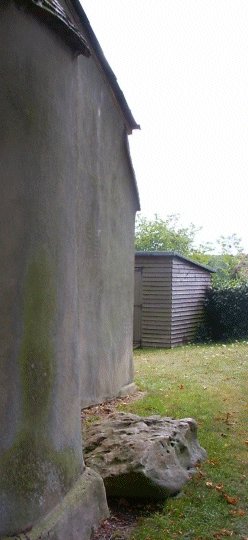
This pretty flint-built church with dark clapboard tower and pointy red clay-tiled roof hides a secret. Where have all these idley strewn about megaliths come from? I counted two at the entrance of the path, one in the church and seven lying about amongst the gravestones. There may be more, lurking just under the surface of the turf. I did a reccie to make sure there weren’t others, naturally occurring on the edges of the field next to the church, but they were so different to be inexplicable. Undoubtedly, this was an ancient site, though precisely what it is impossible to say. The lie of the land seemed right, and I was reminded of the Churchill village stones which I had seen only the week before. In response to ocifant’s musings on whether or not the indentations on the stones are cup-marks or weathering, I would join the weathering school-of thought, but I have no real experience on which to base this hunch. I’d need to know more about geology to tell.
'Incredible' Bronze Age finds in Ulster
From the mid-Ulster Mail, 21 August 2003ce
WHILE 20 diggers and dump trucks shifted soil on a 35-acre site at Loughry near Cookstown on Friday they couldn’t drown out the noise of a trowel scraping.
As bulldozers prepared the ground for the new £1.9m Mid-Ulster Sport Academy at Tullywiggan Road, a team of archaeologists – with more modest shovels – were delving deep into Mid-Ulster’s past on the edge of the site.
Sports fans may be excited at the prospect of the new complex but their enthusiasm is surpassed by the archaeologist heading up the Loughry dig – Galway man Robert Chapple.
Mr Chapple, site director of excavations for Northern Archaeological Consultancy, said that the amount of material uncovered is “phenomenal”.
There are two sites being investigated and Mr Chapple said he was hoping that one of these – to the north – could turn out to show evidence of a Bronze Age (2000-1500BC) house. The more southerly site is giving an amazing insight into the burial customs of our ancestors.
An ancient British , used to stamp a horse design on Iron Age gold coins, has been found near Alton in Hampshire.
A member of the public handed it in at the Curtis Museum where it caused huge excitement, with curator, Tony Cross, describing it as “the most significant find in Alton since the discovery of the Alton Buckle some 40 years ago”.
So rare is the die that the British Museum has only ever seen one before.
The Megalithic Yard
In the mid 17th century the architect Inigo Jones was instructed to survey Stonehenge. He declared the ruins too sophisticated to have been built by the barbaric Druids and proposed a Roman origin.
Almost a century later, the antiquarian William Stukeley overturned Jones’ theory, noting the site’s ancient age and astronomical alignments. Stukeley also suggested the ruins shared a uniform system of measurement. Whoever they were, our ancient monument builders were no barbarians.
Read on here
Six members of the Pogmore family are spending a week living in a Bronze Age roundhouse.
The experiment, organised by Carlton Television, is taking place at the Flag Fen Bronze Age visitor’s centre.
The Pogmores are dad Phil (38), mum Vickie (35), Keeley (19), Gavin (17), Phil (15), Claire (14), and 12-year-old twins Steven and Brendan.
They are living and sleeping in a roundhouse typical of the age.
Iron Age find is oldest brass
THE old northern motto “Where there’s muck there’s brass” has proved to be literally true down South as well: an Iron Age sword found in the Thames mud near Syon Park turns out to be decorated with the oldest brass in Britain.
Brass is an alloy of copper and zinc, and was widely used by the Romans: the sword was at first thought to be Saxon, until Ian Stead of the British Museum identified its stamped decoration as dating to the Iron Age in the 3rd or 2nd century BC. Then Paul Cradock at the museum analysed the gold-coloured foil that covered the decorated areas, using X-ray fluorescence, and showed that it was not gold, but an 80:20 alloy of copper and zinc, the precise formula for brass.
Six other swords from this period have a similar “gold”-covered stamped ornament, which has been interpreted as either a maker’s or an owner’s mark. The mystery is, where did the brass come from?
It is difficult to make because of the volatility of zinc, but was used in Anatolia by the 3rd century BC for coins. One possibility is that one or more coins made their way from Turkey to Western Europe and were melted down, beaten into thin foil, and used by a Gaulish or even British swordsmith to enliven his creations.
From ‘The Times’ online, 19/8/03
A 2,000-year-old spoon, used for scooping out shellfish, has been discovered at the site of a Celtic village.
The tiny, copper alloy metal Romano British spoon, the handle of which is missing, was found by workmen at the Chysauster site, which is just three miles from Mounts Bay, near Penzance, Cornwall.
A similar spoon was found during recent excavations in Newquay, north Cornwall.
Cornwall County Council archaeologist Charlie Johns said the spoons would have had long, prong like handles to open shellfish.
“They are the only two such spoons to have been found in Cornwall, and could have been of local manufacture,” he said.
The Chysauster settlement of eight stone walled homesteads is one of the oldest in Britain.
Story filed Monday 18 August 2003 by Ananova

The eight stones placed closely together are all of the same rough size and shape as many of the original Rollrights, just a couple of miles down the road, and most notably, in the same weathered condition. Many of the stones used as kerbstones at the roadsides in the village were not as weathered, but we did notice that some of the larger ones bore tell-tale signs of a different past, more weathered, dressed differently, more ceremonial and probably part of the same something that the alignment were once part of.... but what, we couldn’t say.