Almost unrecognisable to the untrained eye but nevertheless thrilling to find when one is into this stuff, it lies just off the main path. Now just a low ring of overgrown bank, you have to inspect pretty closely to find the stones. But they’re there! You’d be forgiven for thinking it looked more like a ring cairn.

Jane
Even once actually inside the circle, it doesn’t become apparent until pointed out. The low stones, the high heather, deep bracken and the broken outline of the circle all conspire to camoflague the place almost entirely. I was glad I didn’t attempt this one without a stubob! I think even a GPS would find this tough to locate. The views over the surround country are quite lovely.
Access: Impossible except by the hardy and able-bodied!
Now reduced to little more than a big pile of scraggy rocks with a dip in the middle, the only clue to what-it-once-was is the big fuck-off Ministry of Works (who are they exactly?) rusty sign, erected rudely at its periphery. Despite its appalling condition, the cairn is impressive right on the edge of a ridge and with Wet Withens just metres away.
Probably missed by the copious numbers of ramblers passing this way, this unobtrusive stone circle lies about 10 metres from the main drag along the ridge. Surrounded by silver birches, in the most wonderful setting, the largest of the stones, standing about four feet tall at the southern edge of the ring had a huge weathered dip in the top, which today was full of water and reflected the blue sky.
A clear circle, well defined and peaceful, certainly worth a look and reasonably accessible for those who don’t like or can’t walk too far.
What a fantastic place! Pretty and with small stones, of immense charm in this enormous landscape, the circle looks skyward. It is of a very human scale somehow. We mused as to the weathering patterns on the stones and wondered if what looked like a recumbent had actually been upright once, but our ponderings were conclusion-less and Barbrook I kept her secrets.
Ancient Axe In 'Buried Treasure' Exhibition
The oldest man-made object found in Britain has been unearthed in Norfolk, offering dramatic new evidence that the history of mankind in northwest Europe began up to 200,000 years earlier than previously thought.
A stone axe unearthed along the coast by a man walking his dog is thought to date from 700,000 years ago. Experts at the British Museum say that it could revolutionise our understanding of our ancient origins. While further research is now taking place at the Norfolk site, the axe is to be displayed next week at the British Museum, in an ambitious exhibition on British archaeology.
Whole story here from The Times Online


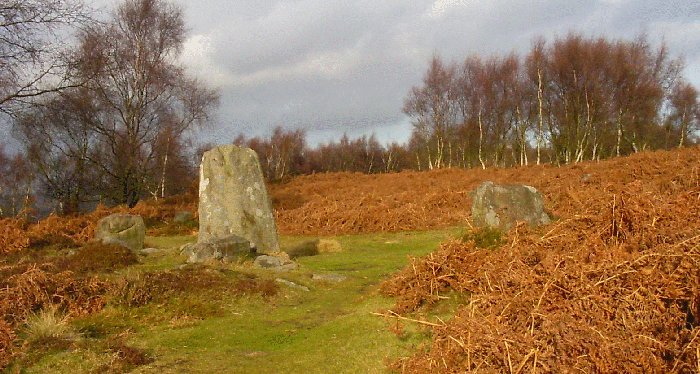


I think this shot shows how bloody difficult Wet Withans is to find. Even when you’re on top of it, you can hardly see it.
Image credit: Jane Tomlinson

The group in the distance are inspecting Eyam Moor barrow, which lies just 10 metres away from Wet Withens
Image credit: Jane Tomlinson


stubob and IronMan inspect the rubble that is Eyam Moor barrow. Wet Withans lies just behind...
Image credit: Jane Tomlinson

Stubob and Ironman admire the beautiful ruins of Barbrook 1.
Image credit: Jane Tomlinson
‘Ancient Scots may have enjoyed sophisticated economic, social and cultural links with the builders of one of the world’s most mysterious ancient monuments, according to new research.
Experts have revealed a previously unknown link between the elite of ancient Scots society and Stonehenge, dispelling the myth that Scotland’s Bronze Age tribes were uncultivated barbarians.’ says STEPHEN STEWART of ‘The Herald‘
One of Britain’s most important archaeological finds is under threat – from North Yorkshire potato farmers.
Scientists have discovered a vast area of buried buildings and villages spanning 6,000 years, under fields at West Heslerton, near Malton in North Yorkshire.
...which is good.
Read the story from the “This is Richmond” Website here.
Acoustic Archaeology – the new rock ’n roll
Mark Pilkington in The Guardian
Thursday November 6, 2003
Were some ancient sites designed to be acoustically, as well as visually, awe-inspiring?
Ongoing research at Neolithic sites around the UK has revealed striking similarities in their acoustical properties. Key examples, both in Ireland, are the huge passage tomb of Newgrange and the burial mound known as Cairn L at Loughcrew. These sites contain passageways leading to large circular chambers, and have a resonant frequency (at which sounds naturally echo and reverberate) of about 110hz – the frequency of the male baritone, the second lowest singing voice. Standing waves, whereby sounds are reflected off walls and superimposed on to one another, and other acoustic curiosities, have been observed in these and other sites. Stone circles including Avebury and Stonehenge also appear to reflect sound in distinctive ways.
Archaeologists have suggested that chanting, singing and drumming at these sites would have produced reverberating echoes that might have been interpreted as voices of spirits or gods; they may also have induced physiological and psychological changes in people, adding to their potency as sites of spiritual importance.
These acoustic discoveries may also shed light on some of the visual motifs etched into the walls of many ancient sites. Experiments in a replica of the Newgrange passage, at Princeton University, showed that if a site was smoky or misty, standing sound waves would become visible as they vibrated particles in the air. Could this visualising effect account for the zigzag and concentric ring markings on the chamber walls?
Intriguing acoustic effects have also been noted at sites in the Americas, from Anasazi kivas (ritual chambers) in New Mexico, to Chichen Itza on Mexico’s Yucatan peninsula. Here, the famed Mayan pyramid of Kukulcan, or Quetzelcoatl, is known for the way the solstices and equinoxes are reflected in its stones, but professional acoustician David Lubman has observed another aspect to its design. If you clap in front of the pyramid, the sound is reflected back by its stone steps, sounding, Lubman claims, like the chirp of the quetzal bird, sacred to the Mayans.
Acoustic archaeology is a young field finally gaining academic respectability. New discoveries are made constantly, so next time you’re at an ancient site, sing, clap your hands – and listen carefully.
Lots of details about the bronze age bridge found at Testwood Lakes, including how you can see the artifacts discovered, and so on....
Orkney may have been the largest prehistoric settlement or ceremonial site in Britain, new research reveals today.
Archaeologists using the latest techniques to map under the soil discovered the world heritage site covering the Ness of Brodgar in Stenness, was a massive centre of activity in Stone Age times.
Orkney’s landscape has largely managed to avoid the rigours of industrialised farming and may yet yield its secrets about the recently-surveyed site, which in terms of scale, puts the likes of Stonehenge, Avebury and Skara Brae in the shade.

Showing the depth of the reconstructed ditch.
Image credit: Jane Tomlinson

Access: when you get to the end of the lane, turn left and park facing the lake. Get permission to visit the henge by signing in at the weighbridge/reception building behind you and walk off round the right hand side of the lake for 400 ms. You can’t miss it.
Dix Pit Waste Disposal Centre, Stanton Harcourt is open Mon-Sun 8.30-5.00 (winter) and 8.30-8.00 (summer).
Oh, and wear wellies!
Here is a quote from the book “Stanton Harcourt, a moment in time”, which gives a bit more detail.
“...The Devil’s Quoits were a major ceremonial site in the Thames Valley 4500 years ago. The village of Stanton Harcourt derives its name from them”
(“Stanton” means settlement near the stones, the “Harcourt” bit comes from the local family who still live in the manor) ...
“Thirty five stones were set in a 75 metre circle, with a two metre ditch surrounding them. The gravel extracted from the ditch formed a bank outside it. Most of the monument was destroyed by medieval farmers. The remaining three stones were buried in 1940 to make a wartime aerodrome. Excavations took place by the Upper Thames Archeological Committee in the early 1970s when the site was used for gravel extraction. Part of the ditch was excavated amd more recently the remainder of the the holes for the stones have been located by the Oxford Archeological Unit...”
Oetzi’s home village pinpointed
By Helen Briggs, BBC News Online
Scientists have pinpointed the likely birthplace of Oetzi the famous Iceman.
The ancient hunter probably spent his childhood in what is now the Italian South Tyrol village of Feldthurns.
Evidence suggests his lifelong travels were confined to a 60-kilometre (37-mile) range south-east of where his body was found.
The 5,300-year-old frozen mummy emerged from a melting glacier along the mountainous border between Italy and Austria in 1991.
Scientists have been carrying out detailed studies of how he lived and died ever since.
The latest research, published in the journal Science, looked at isotopes found in the Iceman’s teeth and bones. Whole story here...
Archaeologists are engaged in a race to save the remnants of an Iron Age settlement built by one of the most mysterious early peoples of Scotland.
The prehistoric site at Carghidown, near the Isle of Whithorn, Galloway, could illuminate the lives of an ancient tribe called the Novantae.
However, the promontory fort located 100ft above the sea, which has a number of extremely rare features, faces destruction after years of wave and wind action and could collapse into the sea... Whole story here.
Sky-religion in the Bronze Age discussed on TV
A lecturer will be explaining the history of a sacred calendar – that could be Germany’s equivalent to Stonehenge – on the BBC’s Horizon programme in January
Professor Miranda Aldhouse-Green, a senior lecturer at the University of Wales College, Newport has been filmed discussing a Bronze Age sky-disc, which features in early man’s attempts to map the heavens.
Prof Aldhouse-Green, a European prehistorian specialising in the archaeology of ritual and religion, was filmed for the popular Horizon TV series.
“They spent a day interviewing me about the significance of an ancient sky-disc, dating from around 1600BC, which may have been used by priests as a sacred calendar,” explained Prof Aldhouse- Green.
Archaeologists are investigating whether Wittenham Clumps was a centre for human sacrifice – after the chopped-up remains of a woman were found in a grave at Castle Hill.
The skeletal remains of the women were part of a remarkable discovery by archaeologists of a shared grave containing skeletons of a child and a man.
Read whole story here
Dig unearths ancient mine and Roman road
Last posted: Friday 10 October 2003 12:10
ARCHAEOLOGISTS have unearthed evidence of a Roman road and Bronze Age settlement at a multi-million pound business and leisure park development.
The dig at the 300-acre Gibfield Park site in Atherton has revealed fragmentary remains of the badly damaged road, which linked Roman forts at Manchester and Wigan.
A 10-strong team of archaeologists from Manchester University spent the summer excavating the former site of Gadbury Fold, off Atherleigh Way. Their survey also revealed that mining had been carried out on the site since at least the 14th century.
All 54 Dutch burial chambers are documented on this very informative site by Hans Meijer. It’s in English, too!
From BBCi
Archaeologists believe they may have stumbled upon a major Stone Age site – on the route of a new bypass.
The site dates back between 250,000 and 300,000 years and may even provide evidence of one of the earliest uses of fire.
Archaeologists discovered a range of items at the location in Harnham, near Salisbury in Wiltshire, including 44 “very rare” flint hand axes – the earliest form of tool used by man.

We parked at the end of the lane leaving a walk on flat ground of only 200 metres or so to reach this elegant pair of beautiful standing stones. The taller one is about 10 feet high and slimline like a blade. Their shape and grace reminded me of the shape of stones I had seen pictures of on Orkney, which I haven’t (yet) experienced. Hauntingly lonely, this pair’s angled tops seem to be pointing, but to what is unclear. I wished we’d had more time.
The walk from the only realistic car parking space was not hard, maybe 20 minutes at most, and if you know what you’re looking for you can see it as you pass over the first cattle grid, but I could not, despite Moth’s insistence, “look, woman, it’s there!” For me it was more of a ‘slow reveal’ and a thrilling one at that. As we got closer, its distinct shape came into view and I become more silent, gobsmacked by it’s beauty.
Imagine the Rollrights, and now combine that vision with Castlerigg... yep! you have Sunkenkirk. Over fifty beautiful stones, some fallen, but predominently still standing, enclose a wonderful space somehow of a human scale. I walked round, pausing to admire the craftsmanship in each carefully dressed stone: the snooker-table flatness of the dressing, the sharp edges where the flatnesses intersected... oo-er, but this is a blinder! Something about its completeness is utterly alluring. The rise in the land just at the back of the circle affords views of its entirity, which you just don’t get at other circles.
Prehistoric Maltese Mystery Solved?
Posted in anticipation of The Megalithic European!
The mystery of a prehistoric site cited as, variously, a launch site for little green men or the tracks leading to Atlantis, could be finally solved.
Known as the Maltese Clapham Junction, the expanse of scrubby fields and barren rock is a bewilder ing complex of tracks believed to be up to 6,000 years old, gouged into solid limestone of the island whose megalithic temples are the oldest stone buildings in the world.
Now an Australian archaeologist, inspired by the evidence of the Aran Islands off the west coast of Ireland, has demolished both the myths and the con ventional explanations. Claudia Sagona, from Birmingham University, suggests the site may be simply a relic of stone age agricultural enterprise. Whole story here...

I sat with the wind in my hair, thinking I had died and gone to heaven....
Image credit: Moth Clark

A scan of a study in my sketchbook, spanning two pages (hence the ugly dark line down the middle – I must buy a bigger sketchbook!) The portal is on the ‘fold’ of the image.
Image credit: Jane Tomlinson

How the stones managed to glow blue in the apricot sunset light, I simply don’t know!
Image credit: Jane Tomlinson


It is covered with a fine collection of ancient cupmarks and marks created by more modern tossers who had decided to add their names to the collection, including Christine, Dave and 1984. May they rot in hell. Then it occurred to me that perhaps, before the advent of writing, the cupmarks themselves were little more than neolithic tribal graffiti, which would mean that Christine, Dave and 1984 were actually no different to the cupmark makers. Or maybe not.
