



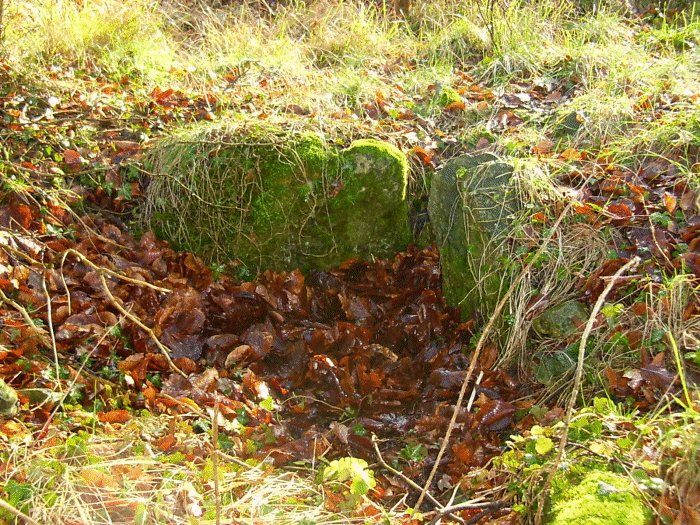
The little cist, exposed at the north end of the barrow.


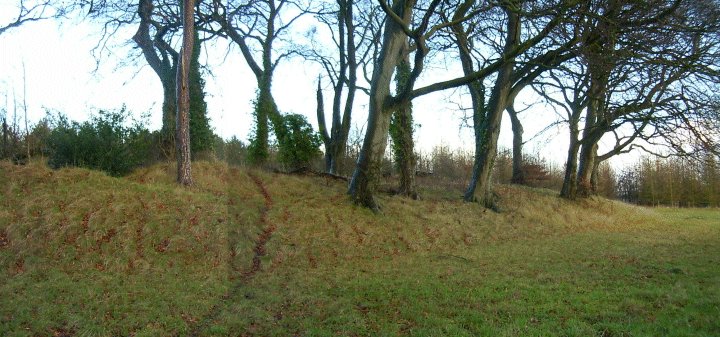
Moth stands on top of the great, tall mound of Lower Swell LB, now the overgrown home to a great colony of badgers by the looks of things.


Moth clears ivy and moss to expose the stones. (It’s the closest he’ll ever get to gardening.)
Note that there are standingstones on both sides of the driveway and the proximity to the church, outside of which lie the Churchill village stones.


‘September sunset, Avebury’ watercolour by (c) Jane Tomlinson, 2004
Following on from this painting, themodernantiquarian.com/post/21576, I wanted to have another crack at this view, to increase the sense of ‘something else’, something unknown going on to do with the land itself, related to the stones, but not actually the stones themselves.
So I have raised the horizon and emphasised the foreground shadows; the stones which cast them are unseen.
A Bronze Age axe head unearthed in a Lincolnshire field is baffling archaeologists – because they think it is too heavy to use.
Made of stone, the axe head weighs 4.4lb and was produced some time between 2000BC and 1600BC. It was found when a walker stumbled across it last summer in a farmer’s field near Scotter, north of Gainsborough.
Once the axe head was cleaned it was reported to the Portable Antiquities Scheme – a project run by North Lincolnshire Council which records artefacts found by the public.
The artefact is a traditional axe shape and features a hole through the middle where a stick would have been placed as a handle. Archaeologists often refer to these items as axe hammers.
But principal keeper of archaeology Kevin Leahy (57) said the artefact would have been hard to use. Continues here...
It feels like it’s on the edge; crouching, clinging like an animal to the very crest of the hill, on a threshold between the known world of the Marlborough Downs and beyond, between land and sky, between the earth here and now and the heavens. And what a view! Leaning heavily into the wind, I watched the low winter sunlight fade fast producing weak yet dramatic shadows on the very sexy figure of Knap Hill just opposite.
I never expected this long barrow to be so dramatic and frankly so bloody big. I never expected to see a bank and ditch running round it, today providing welcome relief from the howlin’ wind. I never expected to like a place so much in such foul conditions.
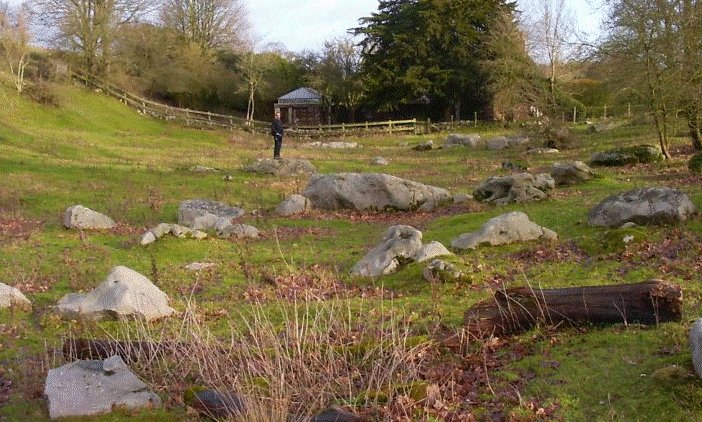
For those unable to get up to the Mother’s Jam, here’s a great way to see how the landscape up there is littered with massive stones. Why this little valley escaped field clearance is not apparent, but it did and very impressive it is, too. And we’re not just talking about a handful of big stones here, there are hundreds of them lying exactly where the long-forgotten glacier dumped them as it melted into history. Fantastic.
...but climb it and it seems even larger still. Phew -whee! As you climb, its spiralling terraced design and construction become more apparent and from the top its bulk is quite overwhelming and makes the ugly school buildings seem tiny. Lurking in a dip at the top of the mound is a huge ugly water tank and a kilny/chimney thing. I wondered if it was a rudimentary crematorium for disposing the bodies of schoolboys who’d been thrashed to death by an over-zealous master. Maybe not. But perhaps it should be.


With the big trees on the top not in leaf, its easier to see the shape and height of the mound and to make sense of its spiral construction.

Adam’s Grave lies on the peak to the far right of the image. This view taken from Alton Barnes. The white horse on the left was cut in 1812.

The sky seemed to be bearing down upon the long barrow.


From ‘The Grauniad’, January 2004
The secrets of how the ancient ancestors of modern Britons lived and died could be lost forever because the evidence is being destroyed by badgers.
Salisbury Plain in Wiltshire has harboured the mysteries of civilisations for more than 5,500 years, making it one of Europe’s most treasured archaeological sites.
Just beneath the surface are the remains of Bronze Age burials, Iron Age enclosures, Roman villages, Saxon and Medieval settlements and the Second World War.
Yet a fast growing population of badgers, attracted to easy digging conditions, is building networks of tunnels that threaten to wreck Britain’s historical treasure trove.
Read whole story here
In a large field opposite Little Kit’s Coty lies the natural outcrop of the Coffin Stone. We could see it clearly, but it was right in the middle of a crop of developing brassicas and we walked as far along the field edge as we could, but the light was fading fast and despite attempts I failed to get a decent photo of it. However, even from the distance from which we viewed it, it looked monumentally huge.
The sign says twenty. Moth counted n-n-n-nineteen. Countless? I think not, baby puppy. Whatever the number they’re certainly countable, though you have to have a very lively imagination to reconstruct in your mind the fabulous monument that this once was. A huge burial chamber at some point has just laid down and died. Hopelessly collapsed, its bleached long-dead elephant bones lie strewn ingloriously in a heap. You have to be keen on stones to be impressed by this. It made me want to weep.
Parking precariously in the recommended spot, we squidged the 200 metres up the muddy sunken path to the top of the hill and there it was – looking as cute as a puppy dog’s nose.
With great views over the Medway valley, in spite of the murky weather, this little construction is rudely caged, with a fuck-off spiky fence reminding me of a fluffy chinchilla sitting inside razor wire. But look closely and you see why. The interior portal stone has been a honey pot to the graffiti bees. Mostly delicately carved in classical caps in the late 19th century, they nevertheless have all the charm of repetitious spray-painted ‘Fucks’ on a subway train. The delicious thing about Kit’s Coty is, I think, it’s proportions. It doesn’t overwhelm or impress, it simply enchants with its human scale.
Standing broadside at the chalky escarpment, the stone screamed “Tomb!” to us, though there is no evidence of anything else to justify our assertion. It just felt ‘tomby’ on account of it being big and longer than it is tall.
Like a rock ‘n roll star, the chamber perches on top of the edge of a ridge, so that its stones look for all the world like some Freddie Mercury figure, arms aloft, allowing itself to bask in the glory of its adoring fans. Climb the steps to the left and rise up behind the ‘stage’ to see the pattern of placement of the kerbstones marking out the depth of the longbarrow. And look over the Freddie Mercury chamber and you see that the the rolling fields of Kent are the audience.
A ranch style fence indicates that you’re not meant to walk on the top of the barrow, but people clearly had. Had the weather been better, I may have done so, just to get nearer the chamber, but it was so wet, and I so fearful of going arse-over-tit, I decided against.
This is a cracker of a monument, grand and spectacular and a real surprise to find such a beast lurking in Kent.
Once mistaken for two monuments – bit of a burial chamber one side, bit of a stone circle the other, a road was driven through the middle in the 19th century. Only it isn’t two monuments. At one end is a burial chamber, for sure, but what was once mistaken for a stone circle is in fact the kerbstones of a beautiful long barrow. Joan lovingly preserves it and proudly told us that, thanks to her guadianship, 47 different species of wild plant grow there now. She has had it designated as a nature reserve.
This great monument of enormous megaliths comprises what is left of a whopping burial chamber, aligned, Joan thought, on the winter solstice. Carefully selected, shaped sarsens stand in a line 10 to 15 metres across making up the portal stones and main interior chamber which is all that is left now, but these are incredibly impressive. It remined me of Pentre Ifan, but without the cuttlefish topping. I liked the glistening of them in the drizzly rain and the way the peppermint-green lichens shone out of the surface of the stones. The idly strewn capstones, which must weigh 15 tons or more each lie at the back of the stones which still stand. What a fabulous thing to have in your back garden! What a huge responsibility! Fortunately for us all, they’re in the safe hands of Joan Bygrave. Learn from her, ploughmen.
You must book to see The Chestnuts. It’s on private property owned by Joan Bygrave. Joan also owns the Addington long barrow but you can see this from the lane without booking.
Call Joan – she asks that you call her in advance please, and not when you arrive at the gate! – on 01732 840220.
She gives a nice little guided tour and takes her responsibilities as custodian of the sites very seriously.

