


This turned out to be quite a surprise. I wasn’t expecting much at all, and although many the stones were horribly littered about, you could still make sense of a chamber (two of the side slabs still stand) and a capstone – albeit a capstone partly morphed into a millstone. It still has enough to satisfy.
It also sits on a nice little mound about 70cms high so you get a real feeling for its size.


We couldn’t find anyone to ask about entering the field, so we climbed over the wall and walked along the field edges as respectfully as possible, other than when I fell over in the mud! Ha!
What a wonderful little barrow this is, crouching like a hermit crab on the edge of big field. We were expecting it to be overgrown and gorsey, but some kind soul had recently been along with the secateurs.
It still retains a pleasing amount of height and nearly all of its kerbstones.
Hot on the heels of this: themodernantiquarian.com/post/24862
comes this:
tavistock-today.co.uk/news/newsdetail.cfm?id=74945
Huzzah!
A BRONZE age burial chamber has found a new place of rest after almost two years in limbo.
The 4,000-year-old grave or cist, which weighs well over a tonne, was moved to its new home at the High Moorland Centre in Princetown last week.
The granite slabs that make up the cist were transported by truck from Torquay Museum and lifted into position using a crane.
Its reconstruction is as close to the original as possible, aligned in a south easterly direction and covered by the ancient capstone for protection from Dartmoor?s fiercest weather.
It is the second time the cist has been relocated ? after its discovery on Thornworthy Tor in 1880 it was transported to Torquay Museum and spent the next 120 years embedded in the entrance hall floor.
Having removed the cist during refurbishment two years ago the curators could find no alternative site for it within the museum so offered it to Dartmoor National Park Authority.
They arranged for the grave to be reconstructed in the Jack Wigmore garden at the High Moorland Centre where it is now on permanent public display.
The cist will soon be accompanied by an information point describing its fascinating and eventful history.
Copyright: Tindle Newspapers Ltd 18 March 04

Whooo! This one’s a whopper! Amidst an area teeming with standing stones, this one really stands out – and its the sheer bulk and height that does it. It was flatter and wider than I first thought and perhaps 3 or 4 metres high.
When we saw it, it looked beautiful surrounded by rows of scented narcissus. Lovely!
What a reet bugger to find! With two maps, a diagram AND ocifant’s GPS, we still spent over 40 minutes scouring about eight fields before we spotted it. But it was worth the hunt to see its ancient construction. There was other evidence of quite a large settlement here.


There’s not much left to see here, but its worth finding if you’re up at Zennor.

This rocky outcrop is the key to locating Sperris if the gorse and heather is high.

Moth looks mightily underwhelmed as we realise that the few stones left of Sperris Quoit are not large.
The triangular shaped thing on the mid-horizon is Zennor Quoit.


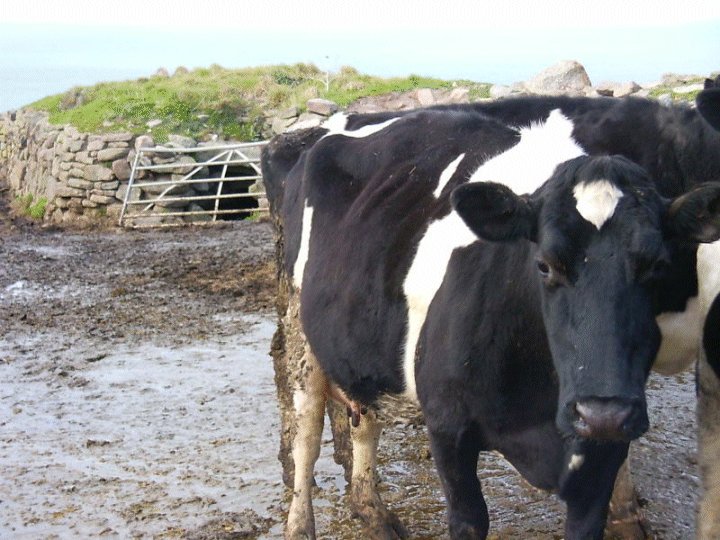
The entrance to the fogou is just by the cow’s arse behind the gate.


No wonder William Borlase became such a well respected antiquary – he was born in a house with a fogou outside the front door...


...a piece of cake to find, thank God. Isolated on the edge of a field, it’s gorsey mound forcing the ground up slightly, we reached it as dusk fell and the hand of starvation threatened to force me to murder Moth and consume his flesh in some debauched food ritual.
A very impressive chamber about 8 metres long and high enough to force me to have to reach up to feel the stones overhead. I was intrigued by its isolation. Every other fogou we had visited had some sign of settlement very close or nearby. This has nothing now. Perhaps it once did.
It’ s clearly marked on the roadmap, but a reet bugger to find the access to. All the access roads to the Trelowarren estate said “No Entry” and we were on the verge of giving up when we stumbled across the main entrance back at the Garras end. Halligye fogou is clearly signposted once you’re in. But we were to be disappointed. It was already dusk and although we found the fogou, a padlocked metal gate barred our entry to the main passageway. But the approach itself is impressive: great keyhole-shaped slit in the earth, (Moth said he thought it looked like something specific to women, but I can’t repeat what here!) recently shored up with new walling and steps. But the fogou’s locked chastity belt prohibited us from further investigation.
Allowing our eyes to become accustomed to the blackness, we could just make our the creep at the end of the passage. I fear we missed something special here :-(
It was wonderful to see a fogou within the context of an ancient village and to muse upon what it might have been for. It was here that it became obvious to me that this fogou was a place to store the excess goodies; the community’s ‘bank’, ‘saving’s account’ or ‘life insurance’ policy, if you like. It’s construction is quite amazing, especially the internal beehive chamber, leading off from the main passageway – a masterpiece of engineering, 3 metres tall reaching up to ground level and 5 metres diameter.
The village is wonderful to walk around and easy to imagine a small community of farmers making a living from their land. As you stand in the ruins of their roundhouses you can almost smell the woodsmoke, hear the children playing, the grain being pounded, feel their tie to this land.

