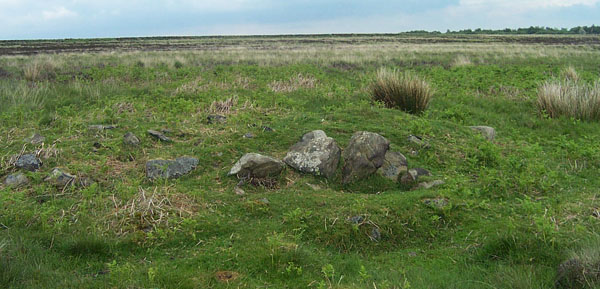
For anyone with a GPS device the eight digit reference is NY57127088.
There are four carved stones lying in the field near to the fence marking the edge of the military Danger Zone. A series of cairns also lie nearby (west and east).

For anyone with a GPS device the eight digit reference is NY57127088.
There are four carved stones lying in the field near to the fence marking the edge of the military Danger Zone. A series of cairns also lie nearby (west and east).
Carreg Leidr, the “thief stone”, is said to be a thief who, having stolen a bible from the local parish church, turned to stone as he carried it away on his shoulders.
“At Llandyfrydog, in Anglesea, there is a curious stone, resembling a humpbacked man. It is said that a man who had stolen several valuable articles from the parish church at last desired to obtain the Bible from a cupboard under the altar, where it was kept locked up when not in use. The sacred volume was contained in a special cover made of carved wood, inset with precious stones and gold. It took the man several hours in the night to secure the Bible, and, under cover of the darkness, he ran away with it on his back. For this shameful theft he was turned into stone. [Rev. Elias Owen, “Welsh Folk-lore,” p. 260]”
An unlikely tradition says that this site was once part of a much larger, more complex monument – the two stones standing at the centre of a stone circle, with a burial cist between them.
This is one of a few tombs in North Wales to have a name from folklore. ‘Llety’r Filiast’ means ‘Lair of the Greyhound Bitch’, a name shared with several other tombs in Wales. There is no surviving story to explain it.
“A local tradition records that the larger ring was used as a cockpit in the 18th century, when cock fighting was very popular in this region.”
Frances Lynch, Gwynedd
Local tradition says that this stone was used in some way (?) to rid the place of a fiery dragon! The stone may have been moved in 1840, only to be returned to it’s original setting.
According to Frances Lynch the exact origin of this stone is unknown – it hasn’t been excavated. It may well be a prehistoric marker but it could very well be a Christian stone, like the one (7th-9th Century CE) found in the nearby church SH588009 or it may just be a rubbing stone for the cattle!
Cyfanned Stone Row is listed in Frances Lynch’s ‘Gwynedd’ as Bryn Seward Stones. The following additional information about the site and it’s environment is also provided:
“Settlement traces, walls and a possible round hut, occur on the shelf of level ground below the stones, and the mound just west of them, through the gate, may be the remains of a large Bronze Age cairn. There is another about 500m further west on the left of the road, beyond the fields and huts.”
A later monument than Carneddau Hengwm (2nd millenium BCE).
The chamber collapsed some time in the 19th Century – the capstone still lies on it’s supporters as it has since 1873. Like Bodowyr there was a sill stone on the east between the passage and the burial chamber. The sill stone allows the monument to be classified as a small passage grave and probably one of the earlier tombs on Anglesey.
In terms of location they don’t get much better than this. The walk down past the church is great and the views from the site are fantastic. Definitely a good place to hang out. On the way back from the monument it is worth checking the church grounds out – the sundial, as mentioned by Cope in TMA, and a couple of large boulders are of particular interest as is the church itself.
Despite the ruined state of this monument, it is well worth seeing. The setting is great sharing it’s view out to sea and the local mountains with the Clynnog Dolmen. When we visited the friendly farmer was watching his cows and proved to be an invaluable source of local information – tipping me off on one or two sites I’d overlooked.
Cefn Isaf sits in a field, which at the time of my visit was completely overgrown. The sun shone down and we chilled here for a while – Mrs IM commented that the site looks just like a Megalithic bus-stop. The capstone is huge as is the slab at the back of the chamber.
We started here, intending to take the path up to Ystumcegid. When we reached the concrete bridge between the two sites found that it was closed. It definitely wasn’t worth the risk, so we turned back – vowing to return to see Ystumcegid another day.

In the Clynnog churchyard. The sundial mentioned in The Modern Antiquarian can be found at the back of the church, with another large stone beside it. According to Cope the church is built on megalithic foundations. I do not know the history of this large boulder which lies outside the main entrance to the church.


A colourful and very mixed crowd just after sunrise Midsummer Solstice 2002.


A great place to chill. I’d had an absolute bastard of a journey down to Derbyshire. First I was fined for speeding (for the first time ever) and then involved in an accident with two other cars (not my fault!). I visited the bull ring after the accident, and was brought down even further by the disgusting way the monument is treated. By the time I arrived at barbrook I just wasn’t in the mood but my bad mood soon lifted as i took in the various sites on the moor. The circle seems to be a victim of it’s own accessibility – the cup marks in one of the stones were filled with coins which have left black marks.


Little Meg, at the time of this visit, lay in very tall grass making the stones barely visible until I was right beside them. It had been raining all afternoon so the stones gleamed like polished gems in the lush green grass.
Earlier in the day I had visited the museum in Penrith to see the Stone Circle exhibition (runs until September 2002). On display was a small carved stone taken from Little Meg.
This lovely henge is in almost complete disgrace. The perimeter is treat like a rubbish dump, yet the interior seem well looked after. A cricket pavillion sits at one side of the henge – couldn’t the people there spend a little time looking after this amazing site right on their doorstep?