


Northern rampart, looking westward... the crag falls sharply away to the west rendering minimal artificial work necessary (as far as I could tell).


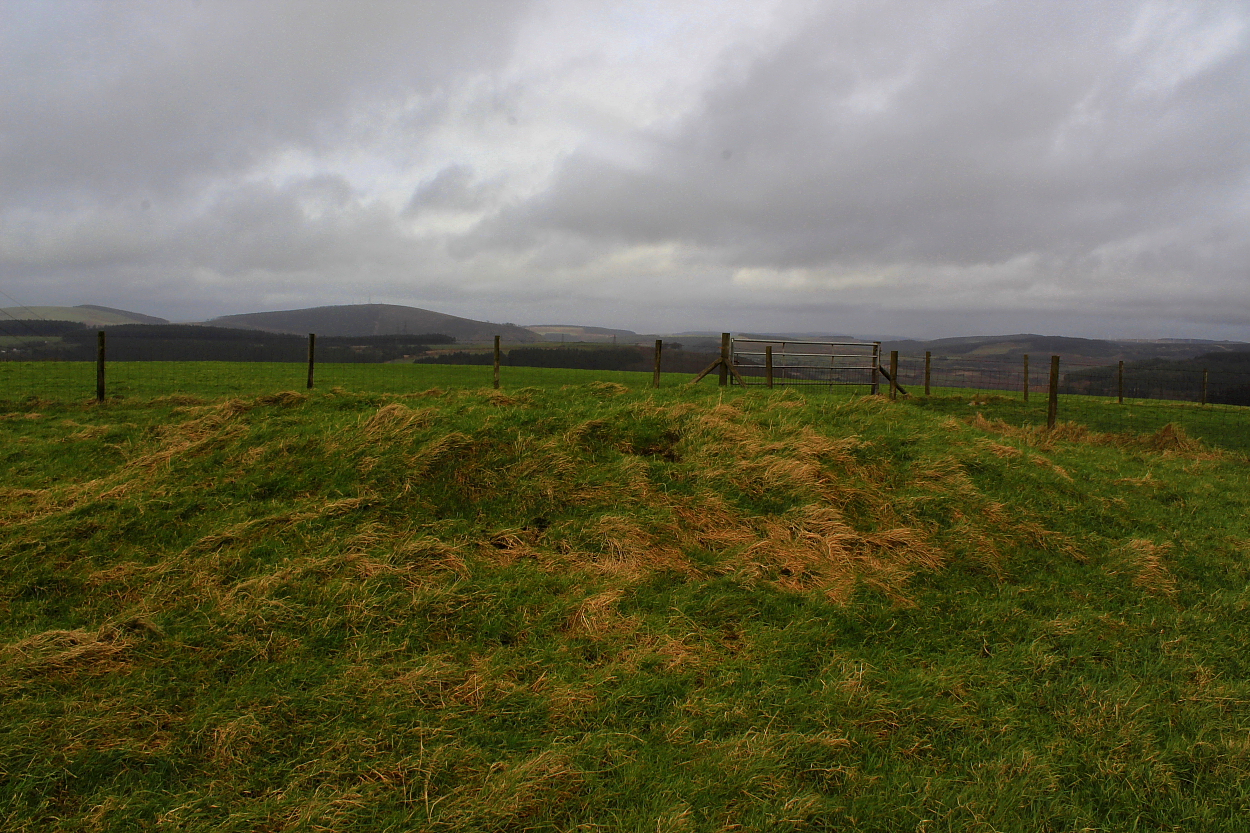
Eastern flank, looking north(ish). Fan Gyhirych battles with the inclement South Walian weather, beyond.

To the north – the most powerful defences facing the path of least resistance, as one would naturally expect. Including a rock-cut ditch, it would appear.

To the south/south-west... highlighting the shattered ‘rock pavement’ prevalent in the area.

For such an assumed ‘peripheral site’ the defences are quite substantial. This is to the south-east.

Viewed from the north... this is a tidy, well-sited hillfort set amongst a landscape of numerous Bronze Age cairns.
Main cairn of the (apparent) trio near Ysgubor-wen, north-west of Ystradfellte.

With (at least) several more cairns plus an excellent hillfort in the locale, I did wonder why I hadn’t been here sooner? But there you are.


Great place to hang out for a while, this. I popped in again on the way back to use up the remaining daylight. As you do.


By far the most substantial of (according to Coflein) a trio of cairns to be found here – like carl before me, I noted two.
Now I have been aware of this ‘Black Cairn’ for about a decade now, initially following TSC’s visit, then having baulked at an extra 2 mile diversion while scanning the map upon the summit cairns of Coedcae’r Gwarthog – to the southwest – back in 2013. Jeez, time flies for us humans, does it not? Although for Carn-ddu... hell, that was only yesterday!
I start from the A470 service area beside Llwyn-onn Reservoir, the haunt of comically posturing local boyos emerging from moron-mobiles to consume fast food from a vendor clearly onto a good thing. One might even credit that the occasional rustle in the trees represents the perennial landscape ‘sighing’ at such puerile nonsense... if it wasn’t for the near-constant interruptions of the morning traffic rendering any thought at all pointless. So, time to don boots and ascend steeply past Fedw farm, continuing through forestry prior to a traverse of the soggy crest of Garn Ddu rising beyond. Upon the conclusion of a c1 hour slog the cairn, standing aloof above the source of a stream (hence some industrial-strength bog must be negotiated), is not immediately obvious, despite my compass bearing being more or less ‘on the money’. For once. This state of affairs is somewhat ironic, given the fact that the great stone pile is almost 60ft across! Yeah, this is a top-rate upland cairn, make no mistake about that.
The central peaks of The Brecon Beacons grace the northern skyline in a linear array, no doubt overflowing with punters on a clear day such as this. Here, however, all is quiet, save the wind... and the farmer pootling about on his quad bike in the distance, engaged in moving sheep here and there. To the east, the great ridge Cefn Yr Ystrad is crowned by numerous great cairns of its own, rising beyond the Pontsticill Reservoir, the latter cradled unseen within the folds of the mountainside.
The topography of Garn Ddu is not in itself dramatic. No, the palpable sense of drama – for it is indeed to be found here, regardless of the dearth of exposed rock face or soaring arete – is derived instead from the acute sense of isolation; from the massive skies putting everything ‘earth-bound’ into perspective. Yeah, Carn-ddu is a place for those who appreciate the chance to chill out away from the constant information bombardment of the ‘modern world’. If only for a few hours.... for there can be no subterfuge here, no hiding from what one really feels. Only a naked truth arising from unfettered input of the primary senses.
Speaking of ‘truth’.... having just listened, with utter incredulity, to the moronic monotone rantings of pathetic Putin puppet Sergey Lavrov – apologist for an indefensibly evil gang of Communist criminals – methinks the existence of such physical oases as Carn-ddu suddenly becomes all the more precious, allegorical to human beings possessing the fortitude, the courage to think for themselves, to reject the demonstrably false dogmas and cowardly unsubstantiated belief systems of violent extremists. Whether such lunatics be Communist, Fascist or religious, wherever they may infect this planet.
Hey, having now (hopefully) come to terms with one Global pandemic, what say you we concentrate upon consigning another mindless, murderous virus to the dustbin of history? Once and for all. So get yourself to your personal Carn-ddus whenever possible... and never stop thinking for yourselves.
Set overlooking the massive steelworks of Port Talbot, looming a couple of miles to the west, the coastal height of Mynydd Brombil is crowned by a pair of ‘tumuli’ at Ergyd Isaf. Both burial cairns are reasonably well preserved – the southwestern monument by far the larger – and reached by a steep, yet interesting climb from the village of Goytre within Cwm Dyffryn to the north.
Things are not as they should be, however, the western environs of Mynydd Brombill having been chosen as the site of a ‘wind farm’ whose owners, far from being receptive to those within the community wishing to better understand their heritage (as might perhaps have been expected from such a ‘progressive industry?’), instead, vehemently threaten ‘prosecution’ upon any antiquarian wishing to view the primary cairn up close by venturing into its field via the gate. Now while irresponsible trespass (a ‘civil wrongdoing’) clearly needs to be stopped for the good of everyone, the fact that – as far as I’m aware – the act of erecting of a fence upon (and thus damaging) a scheduled ancient monument is a CRIMINAL offence would appear to have escaped the notice of otherwise very observant landowners? Not to mention the authorities. But there you are. For the record, I settled for a view from behind the fence.....
Despite these shortcomings, there is still much to celebrate at Ergyd Isaf, the assumed final resting place of a Bronze Age VIP – hey, a precursor to local greats Anthony Hopkins or Richard Burton perhaps? One can only hope a more inclusive attitude will one day be considered for these prehistoric treasures in order to restore them to their former prominence within the local landscape. Not too late to make amends, people.

Such was the OTT nature of the ‘keep out’ protestations, I chose to restrict myself to looking over the fence here. The large cairn is pretty well-preserved, all the more pity it is being treated with such disdain. But then South Wales isn’t exactly enlightenment central. Isn’t it tragic such so-called ‘progressive’ industries as ‘wind-farming’ appear to have no concept of the land their infrastructure exploits?



The large southwestern monument. Pretty well preserved but unforgivably bisected by – and isolated behind – a barbed-wire fence, the owners of the wind-farm threatening “prosecution” against any more intelligent visitor. Although, come to mention it... isn’t damaging a scheduled ancient monument supposedly a CRIMINAL offence?
This large, powerful hillfort lies just a mile to the southwest of the wondrous Black Cliff promontory fort... but couldn’t really be any more different in terms of siting or ground plan. Hence, combining visits made a lot of sense upon a somewhat inclement February day. Well, while in the area it’d be rude not to, right?
Furthermore, unlike the much smaller enclosure, access is pretty straightforward, a public footpath sign indicating the way at the junction with the road approaching Penterry Farm etc (where, incidentally, I was able to park up with undue fuss). Hey, if in doubt, look for the transmitter antennae which now also crown the hilltop – one assumes not an original Iron Age feature.....
Understanding the ground plan of Gaer Hill is not so simple should you happen to lack a 1:25K OS map. However, in summary, a powerful inner enclosure is nowadays supplemented by significant surviving outer ramparts to south and east, the latter (together with the eastern flank of the inner) lying within the trees and quite substantial in form. One presumes these outer defences – once upon a time, anyway – formed a continuous circuit?
Also of note is a rather fine panorama looking across Chepstow racecourse to the mouth of the Severn Estuary, whereby the spellbound traveller can appreciate a grandstand view of journey’s end for two of Pumlumon’s iconic watercourses: Hafren and Gwy. Pumlumon should really need no introduction.


Western flank, looking approx north(ish). Clearly, no significant artificial defence was required here. Coflen mentions ‘scarping’, although I was pretty sure there was some stonework beneath the vegetation? Maybe not.

Within the ditch, looking approx south, bank to right (obviously)


