drewbhoy

drewbhoy

All posts 1,351-1,400 of 13,885 posts

Folklore

The Standing Stones of Stenness
Stone Circle

Several eighteenth- and nineteenth- century sources describe ceremonies performed at the Ring Of Brodgar and the Stones Of Stenness. On the first day of the New Year, young people of the neighbourhood used to meet at the Kirk of Stenness, taking enough food with them to last four or five days. Pairs of lovers would then leave the rest of the party and go to the Stones Of Stenness, known as the Temple Of The Moon, where women would pray to Odin that he would enable them to perform the promises they made to the men; after that the couples would go to the Temple Of the Sun (the Ring Of Brodgar) where the men made similar prayers. They would then go the Stone of Odin, a standing stone with a round hole in it through which the couples would clasp hands and plight their troth,

‘a pledge of love which to them was as sacred as a marriage vow’.

The Archaeologia Scotica (1792) records the case of a young man who had got a girl pregnant then deserted her:

The young man was then called before the session; the elders were particularly severe. Being asked by the minister the cause of so much rigour, they answered, you do not know what a bad man this is; he has broke the promise of Odin, they put him in mind of the Stone at Stenhouse with the round hole in it; and added, that it was customary, when promises were made, for the contracting parties to join hands through this hole, and the promises made were called the promises of Odin.

It was further said that a child passed through the hole when young would never shake with palsy in old age. When visiting the stone it was customary to leave an offering of bread, cheese, a piece of cloth, or a pebble.

The Ring Of Brodgar and Stones Of Stenness can still be seen, although many of the stones have fallen and are embedded in the ground. The Stone Of Odin, however, was removed in around 1814 by a farmer, not a native of Orkney, who was annoyed by the number of visitors coming to see it. He is said to have used the stone to build a cow-house, and although no supernatural punishment is reported to have followed, two unsuccessful attempts were made by aggrieved neighbours to set fire to his property.

The Lore Of Scotland – A Guide To The Legends Of Scotland

Westwood & Kingshill

Folklore

Lynchat
Souterrain

The Cave Of Raitts, a little way off the main road near Lynchat, is a horseshoe-shaped and roofed with large slabs of stone, and is sometimes claimed to be an Old Pechts (Picts) House. The semi-subterranean low-roofed souterrains or earth-houses, probably once used for storage, are often popularly identified as having belonged to the Pechts or Picts, sometimes equated with fairies.

The structure may look low from the outside, but as its other name An Uaimh Mhor (The Great Cave) implies, it is actually quite ample, and another tradition more suitable to its size is that it was built by giants. According to Alexander MacBain, writing in 1922:

The women carried the excavated stuff in their aprons and threw it in the Spey, while the men brought the stones, large and small, on their shoulders from neighbouring hills. All was finished by morning, and the inhabitants knew not what had taken place.

The Lore Of Scotland – A Guide To Scottish Legends

Westwood & Kingshill

Folklore

Clava Cairns
Clava Cairn

A little way east of Inverness are three circular chambered cairns of an unusual type, each surrounded by a stone kerb and a ring of standing stones. While the passages of most chambered tombs in Scotland face approximately east or south-east, those at Clava face south-west towards the mid-winter sunset, an alignment which may have had symbolic significance.

Although archaeological evidence dates them back to the third millennium BCE, tradition connects the tombs with a later period. They have been said to mark the burial place of the family of the sixth-century Pictish king Brude, and Otta Swire suggests in The Highlands And Their Legends (1963) that this theory may have been inspired by the digging up of a gold rod during drainage operations near the site. She does not mention when this discovery was made, but in any case the area had pre-existing associations with King Brude, whose castle is said to have been at nearby Craig Phadrig. Brude himself was one of St. Columbas‘ most important converts to Christianity, and was reburied on Iona, sacred to the saint.

The Lore Of Scotland – a Guide To Scottish Legends

Westwood & Kingshill

Folklore

Dalchreichart
Cairn(s)

A short way south-west of Dundreggan, before the A997 bends and crosses the River Moriston, there is a cairn said to have been built by visiting pilgrims who added to it stone by stone. They came to honour the memory of the itinerant Presbyterian preacher Findlay Munro, who was preaching here in 1827. His text was Amos 4:12, which catalogues the punishments visited on Israel for oppression and idolatry and threatens worse to come: ‘Therefore thus will I do unto thee, O Israel: and because I will do this prepare to meet they God, O Israel.’ In Munro’s sermon, ‘Israel’ could easily be understood to stand for the Episcopalians in Scotland, and behind them the English government.

Some local boys, possibly Catholics, challenged his words and called him a liar, to which he answered, ‘As proof that I am telling the truth, my footprints will forever bear witness on this very ground on which I stand on.’ Just as he said, on the spot where he had stood his footprints were left indelibly in the ground. It became custom for visitors to stand in the marks, and people claimed that the hair stood up on the back of your neck when you did so. Janet Ford, in Footprints in Stone (2004), reports that the prints were vandalised in the 1990s, but her latest information was that they were becoming visible again.

The Lore Of Scotland – A Guide To Scottish Legends

Westwood & Kingshill

Image of Pole Hill (Cairn(s)) by drewbhoy

Pole Hill

Cairn(s)

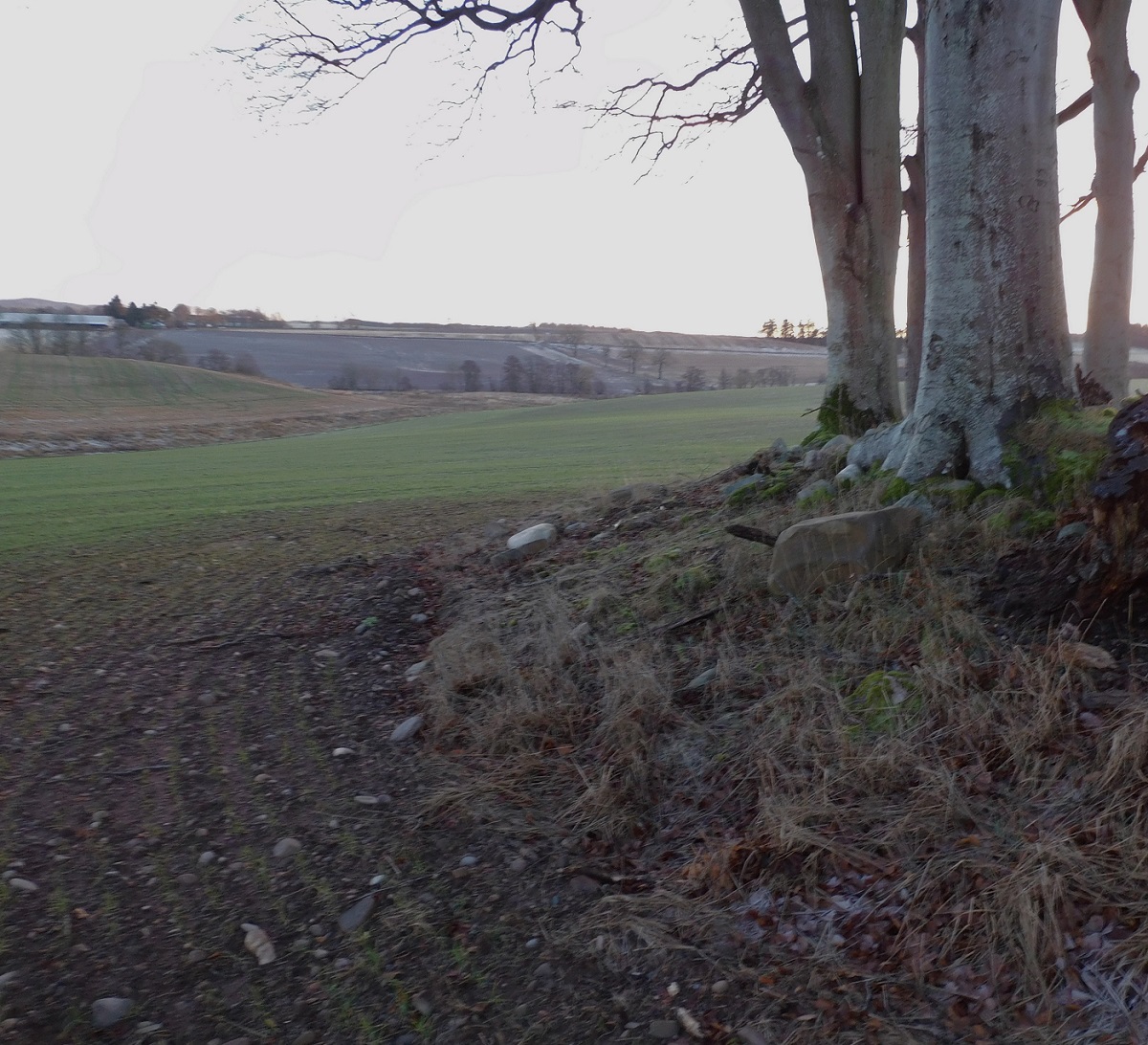
Taken from Pole Hill wood to the west. Looking for a cairn in head high gorse/furze/jabby stuff proved fruitless. 1-0 to the vegetation.

Image credit: drew/AMJ

Folklore

Craig Phadrig
Hillfort

Some ancient forts, mostly from the Iron Age, had ramparts constructed from a double wall of stone with layers of wood and rubble sandwiched between. If the timber were set on fire as it might during an enemy attack, certain types of stone melted and fused other stones together. The great lumps of of heated, cooled, and solidified rock have patches that glitter like glass, giving rise to the term ‘vitrified’ forts.

Folklorists used to speculate that these were the origin of the glass castles of tradition. David MacRitchie, in 1891, wrote:

when one hears some wild story of a dreaded giant or ogre living in a castle surrounded with glass‘,

one knows, that such a castle could not have existed, but that the real glass castles may have been vitrified forts. He cites the example of a famous glass castle said to stand on Tor Inis or Tory Island off the north coast of Ireland, but as castles of glass often appear in fairy tales in places where no vitrified forts exist, this seems no longer a workable proposition, however tempting such a rationalisation may appear.

Craig Phadrig, a wooded hill west of Inverness, is crowned by a vitrified fort. Radio-carbon dating suggests that its ramparts were originally built in the fifth or fourth century BCE, although they may have been strengthened around 500-600CE. It has been proposed that Bridei or Brude, King Of Picts (c.555-84), lived here, as it is recorded that he had a royal palace near the River Ness. There is a King Brude Road on the way here from Inverness.

Brude was visited by St. Columba, who wanted permission to continue his work of Christian conversion, but the saint and his companions were refused entry. Then says Columba’s biographer Adomnan (627-704), Columba made the sign of the cross on the great doors, knocked and laid his hands on them and immediately the bolts shot back of their own accord. Brude is supposed to have been converted by this miracle, and he and his retinue in the fort were all baptised.

A local tradition said that this baptism took place at the foot of a fir tree growing at the centre of the fort. In 1963, Otta Swire noted:

This tree was still growing, one of the finest and largest Scotch firs that I ever saw, when Craig Phadrig was sold to the Forestry Commission in the 1920’s and much strong feeling was aroused by their decision to fell it as part of a clearance scheme.

The Lore Of Scotland – A Guide To Scottish Legends

Westwood and Kingshill

Sig More

Follow the same directions as Mark, and stop at the same place. The way over to the cairn was kinder to me, there was hardly any seaweed and in any case I’d had my troubles for the earlier at Ardnamonie.

Unlike the previous two sites I could get to this one and there is quite a lot to see. At 20m wide, damage by both humans and erosion has led to stones falling all around the site 13 in total, some of which might be capstones. Thanks to robbing the chamber can be seen and thanks to the robbing its difficult to tell if there are three areas / compartments. Two can be certainly seen, of the third only two stones remain standing.

One of the nicest ‘what ifs’ I’ve seen.

A great way to finish the trip.

Visited 13/08/2023

Dun Buidhe

Slightly to the east Ardnamonie is the much more recognisable broch Dun Buidhe. I walked along the fence line until I reached the site, the ground looked drier so I jumped the fence, walked 8 or 9 paces to end up almost waist deep in the bog.

Sadly it appears that, on drier days, it looks like the site is used as a rubbish tip. Also later buildings have been attached to site, as at Ardnamonie. Even from where I stood or sank, you could see the circular shape of a broch despite being covered vegetation.

Luckily no washer-woman was washing or drying any shrouds on my visit, so all would be fine.

Worth a (re) visit when much, much drier conditions.

Visited 11/08/2023.

Ardnamonie

From Loch an Daill we headed south on the A865 and took the first road heading west.

Similar to Loch an Daill Mary provided a parking space, or rather her shrine did, at the end of the road, or just before it headed south. From the shine I jumped the gate and headed south east, the site is easily spotted.

It has been a trip in which water levels have featured quite a bit, and this is a massive example of dropping water levels. What used to be loch has vanished and changed into a large marsh, perhaps you can get in from the south but looking at aerial photos on Canmore I’d suggest not trying.

However, I got as close as I could, before deciding it was unsafe.

What remains is a bit of a shambles, it appears to have been used for several functions, the outlines of buildings can be seen. It probably has been a cairn or a dun or a broch. Stones could easily have been recycled but as Canmore suggests a proper excavation is needed.

A bit of a what-if.

Visited 11/08/2023.

Folklore

Dun Troddan
Broch

T.M. Murchison was minister of Glenelg in the 1930s, and his mother’s people had been shepherds in the area for many generations. His parish history was compiled partly from oral tradition gleaned from older relatives and older parishioners. ‘The most famous antiquities in Glenelg’ he records, ‘are the two brochs or “Pictish towers” in Glenbeg.’ At one time apparently there at least two more, but of these only ‘a heap of jumbled boulders and stones’ remained by this time. Dun Telve and Dun Troddan, however, still stand. It is said when the brochs were being built, stones were handed from the quarry along a chain of men.

A broch or ‘brugh’ is an archaeological term for the late prehistoric round towers found chiefly in the Orkney and Shetland islands and the Western Isles and on the adjacent Scottish mainland. They are round stone-built towers, and are often popularly supposed to have been built by the Picts or Pechts. Here, however, the brochs are associated with Fionn mac Cumhaill or Fingal and his followers the Fianna, said to have lived in these brochs and resorted to Skye for their hunting. The women of the band, says Murchison, never took food in the presence of their menfolk, but nevertheless remained healthy and beautiful, and the men wondered how the women managed to live on so little nourishment. One day, therefore, while the other men went to Skye, a warrior named Gairidh (pronounced Gary) pretended to be ill and was left lying on his bed, intending to watch the women.

He fell asleep, however, and the women promptly took strong wooden pegs and fastened Gairidh’s seven locks to the bottom of the bed, to keep him out of the way, and they proceed to feast on the finest food that glen or river could produce. Gairidh suddenly awoke, was irritated to find he was fastened to the bed, leapt to his feet with a mighty effort, and in doing so left every lock of his hair and the skin of his skull on the bed. mad with pain, Gairidh rushed out, gathered brushwood which he placed around the locked door, and set fire to the dwelling with the women inside, so that none escaped.

Over in Skye, Fionn and the hunters saw the smoke rising and knew that some terrible disaster taken place. They hurried back, vaulting on their spears over the narrow channel to the mainland. One of them named Reithe did not leap far enough and was drowned, and the name of the place from which he jumped, Kylerhea, is said to be derived from

Caol Reithe, ‘the Narrows of Reithe’.

Fionn and his men found their women dead and Gairidh missing, but at last he was discovered skulking in a cave and was punished.

An almost identical tradition was reported of Knockfarrel by Hugh Miller in 1835, and used by him to account for the name of Glen Garry, said to be where the murderer was torn to pieces. The tale is a better fir for Glenelg, much nearer to Glen Garry, and Murchison adds further local details: at Kylerhea, he says, you can see the marks made by the warriors’ feet as they jumped the water, and at Bernera nearby is a site called Iomair nam Fear More (’the Ridge of the Big Men’), pointed out as the burial place of the ‘Fingalians’ (the Fianna or Fenians).

It is said that once upon a time a bold man began ploughing up the place, in defiance of local warnings. He turned up a human skull, which was so big that it easily fitted over the biggest man present(alleged to be the Rev. Colin MacIver, minister of Glenelg from 1782 to 1829). Just at that point, however, a terrible storm of thunder and lightning arose, and the ploughing speedily ceased and the skull of ‘Gairidh’ or some other Fingalian was promptly buried again.

The Fianna were commonly said to be of giant size, so the finding of an unusually large skull may have helped to associate them with the site.

The Lore Of Scotland – A Guide To Scottish Legends

Westwood and Kingshill