
Landscape context from the southwest.
Image credit: A. Brookes (9.7.2011)

Landscape context from the southwest.
From stone circle to cairn. Barclodiad y Gawres is a good size (15-20m irregular diameter), composed of large cobbles with a central scoop. It’s dotted here and there with clumps of stonecrop, the pink-white five pointed flowers a splash of summer brightness against the grey stones. We entirely fail to see the cist, or either of the other cairns that are supposedly close by. A little way to the southeast we come across a small arrangement of stones, which look like they’ve been placed deliberately but not as anything obviously identifiable. Blossom’s dogs find nice big boulders to stand on and survey the area.
The visual focus is the prominent Bwlch-y-Ddeufaen standing stones, visible from here, nestled in the v-shaped pass between the ridges of the Carneddau and Foel Lwyd. The flanking pylons fail to detract from the setting, despite their best efforts.
Elsewhere this cairn would be worth a proper stop, but here it’s probably the least arresting of the day’s sites. And we can see the next one already, so it’s time to head off.
It’s always exciting to start the day with a stone circle, especially one you’ve not been to before. Composed of diminutive stones, Cerrig Pryfaid is certainly no Avebury in purely megalithic terms. But the setting elevates it to something quite special.
The near-perfect circle sits in an amphitheatre of rock, broken only to the southeast where Pen y Gaer overlooks the wide sweep of the fertile Conwy Valley. Even here the longer view is filled with rank upon rank of high hills. The southwestern prospect is entirely blocked by the towering wall of the Carneddau mountains, crowned by Bronze Age cairns on the summits of Carnedd y Ddelw and Drum. To the north Foel Lwyd, the western buttress of the Tal y Fan ridge, rises in a jagged jumble of boulders and outcrops.
Two small outliers stand to the west of the circle, both with tantalising sunrise alignments (midwinter, autumn equinox). But today it’s getting towards midday, in July. So we make do with the earthlier delights of the landscape and views before heading back towards the Pass and our next site.
GGAT have reported that someone has scratched a cross into the surface of Maen Penddu.
Not dissimilar from the cross on one of the stones at The Druid’s Circle nearby. Seems there’s still some people who think pagan monuments need to be “Christianised”

Y Brenin Llwyd is in residence today. From Mynydd Ceiswyn to the east.

Looking over the peat bog to the Rhondda Fach (the dam of Lluest-wen Reservoir is below the light green hill just left of centre).

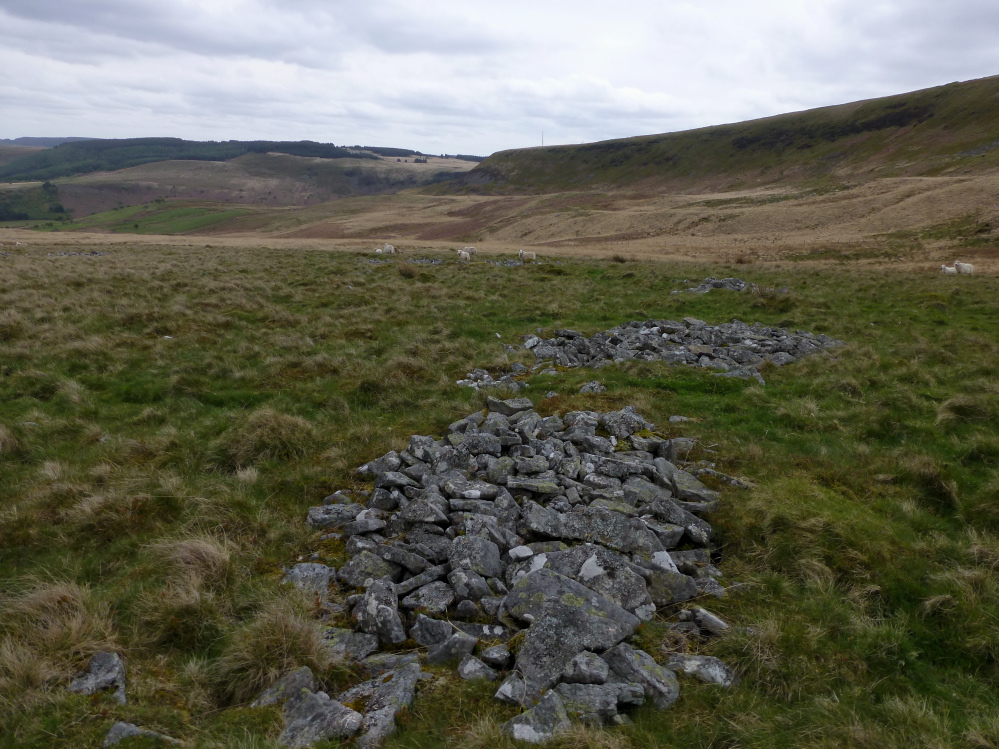
The centre of the cairn has been hollowed out, presumably during excavation/robbing.


Looking northeast to the head of the Dar/Dare valley. The ground on all sides of the cairn is peat bog overlaid with reedy grasses.

Decent sized cairn this. Looking east.


The cairn has a pretty large footprint, in fact it looks larger than the 8m diameter GGAT have for it.

Looking northeast to the open hillside of Mynydd Bwllfa.


The cairn is situated near the upper reaches of the Rhondda Fach, now dammed to form the Lluest-wen Reservoir.

Freed from the trees for the first time in decades. The cairn is behind a temporary wooden fence to ensure it doesn’t get damaged while the windfarm is being constructed.

The great view from Twyn Canwyllyr cairn to Y Mynydd Du.

All three Hirwaun Common cairns are intervisible with each other.

Twyn Canwyllyr cairn and the view of the Cynon valley.

Twyn Canwyllyr cairn, the most northerly along the escarpment. Unfortunately someone has dumped an old post and wire fence next to it, which has subsequently been set fire to.

The prominent Craig y Bwlch cairn from the boggier ground to the west. The treeline on the right is where Carl had his mudbath.

The dilapidated cist at the centre of Craig y Bwlch cairn.

The view from Craig y Bwlch towards the prominent peaks of Corn Du and Pen y Fan.

Looking across Craig y Bwlch cairn towards the mountains of Y Mynydd Du and Fforest Fawr.

Sizeable slab on the edge of Craig y Bwlch cairn, which may be a displaced part of the cist.

Craig y Bwlch cairn, on the highest part of Hirwaun Common (515m OD).

Tarren y Bwlch cairn is situated prominently above the clifftop. Seen from the west.

Looking over the edge of the escarpment from Tarren y Bwlch cairn. The other two cairns in this strung-out group are intervisible with this one.

Tarren y Bwlch cairn. Although it looks like an earthen barrow, the grass covers a mound of stone.

Tarren y Bwlch cairn, fringed with reedy grass. Looking west, the forested summit of Craig y Llyn is over to the left, the highest hill in South Wales outside the Brecon Beacons National Park.

Hut XIV, looking NW.

Hut V, looking west towards Cefn y Llethr Hir.

Hut IV.

Hut VI, looking SE towards the Cynon Valley and Aberdare.

Hut VI, looking southish.

Enclosure II, with internal subdivisions, is post-medieval but likely to have been built from remains of the prehistoric settlement that surrounds it.

Hut II, looking east to the edge of Cefn y Llethr Hir.

Hut II, looking towards the head of the Dar/Dare valley, with Craig-yr-Ysgol rising on the right.
Fragmentary remains of the wall of Enclosure I, on the west side of the settlement.

The cairn is on the edge of the escarpment, left of the small outcrop. The viewpoint is the Mynydd Cefnygyngon settlement to the northeast.

The far-reaching view north to the Brecon Beacons and Fforest Fawr. Corn Du and Pen y Fan are prominent, centre skyline.

The superb view down the Dar/Dare valley towards Aberdare and the Cynon.

Looking SSE towards the forests above the Rhondda Fach. The Cynon Valley is far left.

The cairn itself is not big, but the positioning is definitely clever.

Looking northwest towards the highest part of Mynydd Bwllfa.

Looking west, the rising ground behind the cairn blocks off the views of hills that a rapidly becoming a large wind farm.

The cairn is on the lip of the escarpment immediately ahead. The Mynydd Cefn-y-gyngon settlement is far right, middle distance, with the mountains of Fforest Fawr on the skyline above.

Foel Goch seen from Cerrigpenrhyn on the Dyfi estuary.
