
Arthur’s Seat dominates the Edinburgh landscape, seen from Corstorphine Hill to the west.
Image credit: A. Brookes (2.10.2016)

Arthur’s Seat dominates the Edinburgh landscape, seen from Corstorphine Hill to the west.

The group of four, the main panel is in the background.


The main group covers the rock nearest the camera. The group of four is on the larger slab beyond. I blame the meerkats for stopping us getting here while the sun was high enough to illuminate the site.

Single large cup to the south of the main groups, with leaf in its centre.

The cupmarked rocks are between the camera and the tree, happy hunting.
Analysis of the possible origins of the cultivation terraces on Markinch Hill.

Looking across the cairn towards the earlier Barclodiad-y-Gawres chambered tomb.

Cist stones, the one on the left is pure quartz.


Sea view with rain splodges.

Looking northeast across the low platform of the cairn.

The eastern side of the promontory.

Looking over the sheer cliffs forming the seaward extent of the fort.

Looking along the western end of the bank, across the bay towards Barclodiad-y-Gawres on the opposite headland.


The eroding promontory from the west.

Looking across to the tomb from the promontory fort at Porth Trecastell.

The tomb, on the headland centre, is a prominent landscape feature from some distance. Seen from Porth Terfyn to the south.


The last of the blue skies belie a howling gale that made standing up here challenging.

The superbly situated kerb cairn, overlooking Traeth Mawr.

Hut circle slightly north of the cairn.

The cairn is positioned above the mouth of Afon Ffraw, on the tip of the low headland.

1951 paperback edition of Pevsner’s Cornwall volume of Buildings of England has Trethevy as its cover star.

Yr Wyddfa wreathed in cloud.
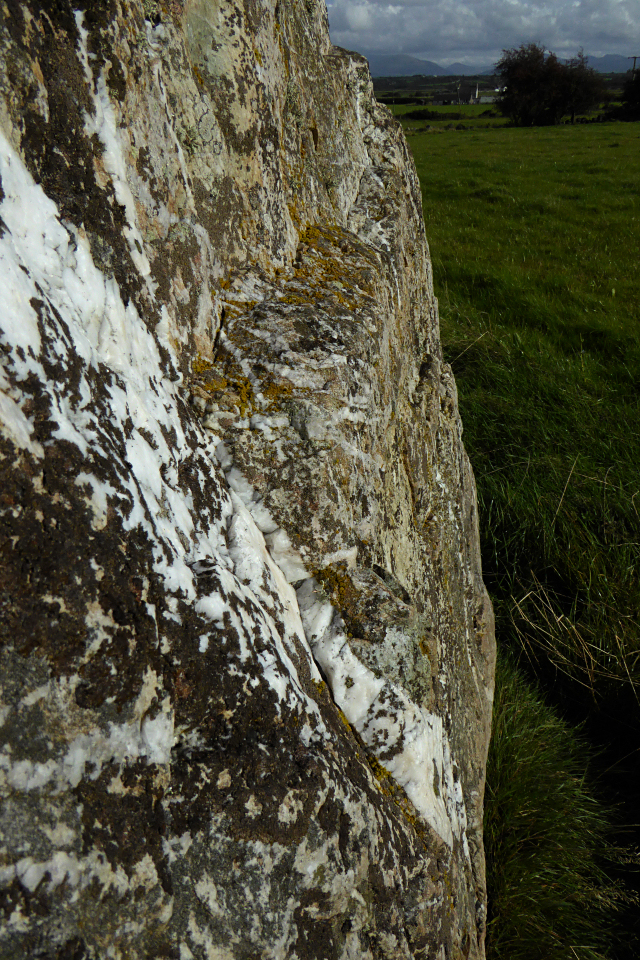


A superb stone, massive and liberally veined with quartz.

Looking to the promontory fort across a windswept Malltraeth Bay from Ynys Llanddwyn.

The promontory fort from Ynys Llanddwyn. Holyhead Mountain can be seen beyond.

Yr Eifl (centre) with Tre’r Ceiri on its lefthand peak and Carn Fadrun over to the distant right. From Traeth Llanddwyn, Ynys Mon.


Quartz and autumn equinox elderberries.


At this time of the year the tree line blocks much of the view of the mountains across the Menai Straits, but Elidir Fawr and Y Garn in the Glyders can be seen. Yr Wyddfa would be visible over to the right without the trees.

For all that it’s partially collapsed, I really liked this one with its massive, quartz-studded capstone.

As Carl says, the hedges are high. It looks as though access to the field is from the north via the farmhouse. The mountains behind are Moel Eilio and Mynydd Mawr, both with substantial Bronze Age cairns on their summits.

Pole for scale (approx. 25”).

There’s a small circular dent in the top of the stone, like someone has taken a drill to it at some point.

The stone just inside the churchyard wall.

The Victorian church at Llanedwen, showing the location beside the Menai Straits with the backdrop of Carneddau mountains. Follow the path to the left, round to the east end of the churchyard to the stone I found. Bryn yr Hen Bobl chambered tomb is two fields away.
22 September 2016
The coast path runs a hundred yards from the church at Llanedwen, so it’s no hardship to detour off for a quick rummage around the churchyard. Cloudless blue sky, sun sparkling on the deeper blue of the Menai Straits, a picture perfect backdrop of the mountain ranges of North Wales from Carneddau to Nantlle ridge, this couldn’t be a nicer spot for a hill-free post-equinox walk.
Llanedwen is one of two possible locations for Maen Morddwyd, fittingly for its reputation as a wandering stone. The other is Llanidan, a couple of miles further along our route today.
Rhiannon has found lots of slightly contradictory information about the stone. The sources don’t seem to agree about which church(yard) it’s in, none really give a description other than the fact it’s shaped “like a thigh” and all of them predate some fairly big upheavals at both sites. And they seem to agree that it went missing before all of that anyway. There seems to be a lack of engravings, woodcuts, potato prints, watercolours and etchings of the stone.
Llanedwen church has been completely rebuilt, but appears to have retained its original churchyard. Llanidan by contrast was replaced by a brand new church, with the original left to fall into disrepair, ruin and private ownership.
So I hold out little hope of finding the missing stone, but it’s always worth a look. Now, I’m not claiming anything here, just reporting what I found.
Round the back of the church (the east end if you like your directions more directional), just inside the wall but not part of it, is a slim, slightly tapering stone, buried in the ground so that its top surface and the upper parts of its sides are visible above the grass.
It’s the shape of a chunky human thigh, if that’s what you want to see. It’s a little over 2 feet long, broader and one end that the other, much like a thigh.
The church itself is locked, so there’s no opportunity to investigate the interior for further thigh-shaped stones. When we get to Llanidan a little later in the day, the whole site is locked, but someone over on the portal has drawn a blank in there. So this might be the best bet we have. Or it might be nothing at all.
Is it Maen Morddwyd? No idea. I don’t even know if this is the right churchyard, after all. But it’s nice to do a bit of investigative nosing about, especially in such a lovely spot.

Lanyon in its landscape, looking towards Carn Galva and Ding Dong mine. Traces of the mound can be seen surrounding the chamber.

Four of the stones in a line. The second from the right is unnumbered and is probably a fragment only.

Magnificent countyard house with Chapel Carn Brea beyond.


The fort boasts a superb view over the Severn estuary, looking across to Cardiff and Newport. The headland to the right is Sand Point, which has barrows and a field system.

