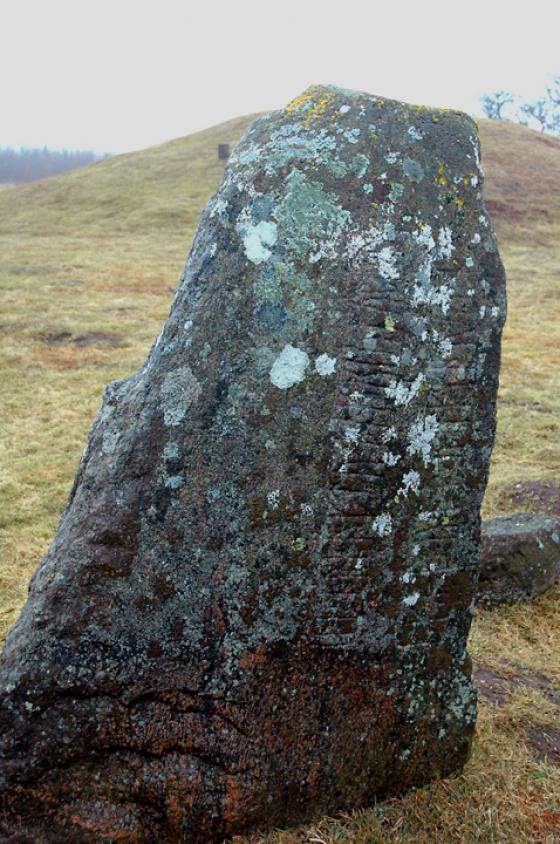
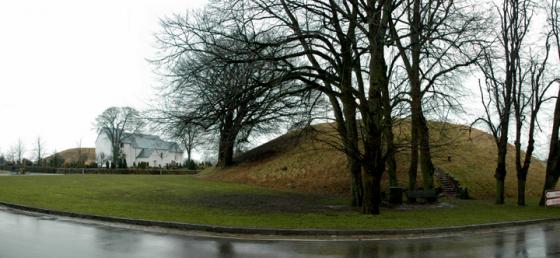
In February 1921, a farmer named Peter Platz discovered an oak coffin while leveling the remains of a burial mound called “Storhøj” on his field in Egtved, west of Vejle in Jutland. Storhøj had originally been an imposing mound measuring roughly 22–30 meters in diameter and 4–5 meters in height, but much of it had been excavated or used as potato pits throughout the 19th and early 20th centuries. Recognizing the potential importance of the find, archaeologist Thomas Thomsen from the National Museum of Denmark arranged to transport the entire two-meter-long oak coffin to Copenhagen so it could be excavated under controlled laboratory conditions.
Due to an oxygen-free and waterlogged environment inside the core of the mound, organic materials were exceptionally well preserved. Dendrochronology (tree-ring dating) of the oak log revealed that the tree was felled in the summer of 1370 BC during the Nordic Bronze Age. A small blooming yarrow flower (røllike) wedged between the coffin lid and the bottom confirms that the burial took place during the summer season.
Although most soft tissues decomposed, the girl’s hair, teeth, nails, a small portion of skin, and brain tissue survived. Dental analysis indicates she was 16–18 years old at the time of her death, stood about 160–165 cm tall, and had mid-blond hair.
The find is world-famous for its complete and well-preserved Bronze Age outfit and grave items:
Garments: She wore a short-sleeved wool blouse (crop top) and a unique knee-length string skirt made of twisted wool cords—the oldest preserved item of its kind.
Jewelry and Accessories: Around her waist, she wore a woven belt with a round bronze belt plate decorated with spiral motifs. A horn comb was tucked into her belt, bronze rings encircled her arms, and a small bronze ring was attached to one ear. Near her head lay a small bark box containing a bronze awl, wool, and remnants of a hairnet.
Ancient Fermented Drink: At her feet stood a bucket made of birch and linden bark. Pollen analysis revealed it held a fermented beverage (“Egtved Girl’s beer”) brewed from wheat, cranberries/cowberries, bog myrtle (porse), and honey.
Cremated Child: Beside her feet lay a cloth bundle containing the cremated bones of a 5–6-year-old child.
The geographic origin of the Egtved Girl remains a major scientific topic:
International Origin Theory (2015): Strontium isotope analyses of her teeth, hair, nails, and wool clothing led a research team to conclude that she grew up outside modern Denmark—likely in Southern Germany (such as the Black Forest region) or north of the Alps—and traveled long distances back and forth shortly before her death.
Local Origin Counter-Argument (2019): Researchers Erik Thomsen and Rasmus Andreasen demonstrated that baseline strontium values in the Egtved area were skewed by modern agricultural lime. Measurements from uncontaminated local soils matched her strontium profile, suggesting she could have lived her entire life locally in the Egtved valley and nearby plateau.
Today, consensus remains open, and the National Museum states that her exact point of origin cannot be declared with certainty.
The original artifacts—including the oak coffin, clothing, jewelry, and bark bucket—are on display at the National Museum of Denmark in Copenhagen, which also created a interactive digital 3D avatar of her in 2022. At the original find site in Egtved, the Storhøj mound has been reconstructed, and the local outdoor museum experience “Egtvedpigens Verden” (The World of the Egtved Girl) invites visitors to explore the Bronze Age landscape where she was laid to rest.
kulturarv.dk/fundogfortidsminder/Lokalitet/56759/
natmus.dk/historisk-viden/danmark/oldtid-indtil-aar-1050/bronzealderen-1700-fkr-500-fkr/egtvedpigen/
en.wikipedia.org/wiki/Egtved_Girl