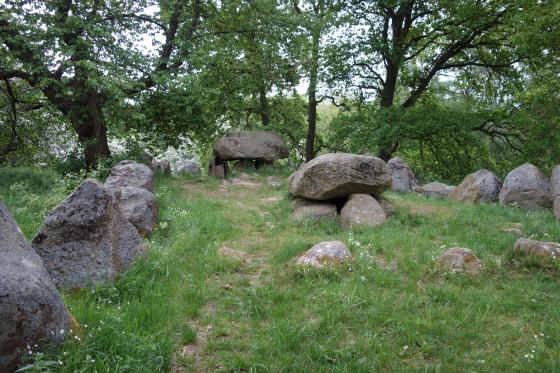
The burial mound, identified as a round barrow (rundhøj), is located in Jægersborg Dyrehave within the Lyngby-Taarbæk municipality. It is situated only a few hundred meters from “Bakken”, the world’s oldest amusement park.
The mound currently measures approximately 2.0 meters in height and 21.0 meters in diameter. Over time, its physical state has changed significantly:
By 1899, it was described as a crescent-shaped earth wall, which were the remains of an investigated grave mound.
In 1928, it was noted as being “very damaged,” appearing as a pair of partially connected earth piles with a large, broad excavation cut through the middle into the center of the mound.
The mound was reconstructed in 1939 and is currently considered “worthy of protection” (fredningsværdig). Its surface has been noted to be covered with grass and deciduous trees.
The site contains several features dating back to ancient times and the Bronze Age:
Brandgrav (Cremation Grave): Dated to the Bronze Age (1700 – 500 BC).
Rundhøj (mound) and Stenkiste (Stone Cist): Both are broadly dated to ancient times, ranging from 3950 to 500 BC.
The National Museum conducted an excavation and construction-related activities at the site as early as 1845. The site has been protected (fredet) since 1937 or later.
Kroppedal Museum is the current responsible institution.
A periodic inspection in 2011 suggested that maintenance or “care” (pleje) should be performed on the monument.