Visited September 2025
Image credit: Uwe Häberle 09/2025

Visited September 2025

Visited September 2025

Visited September 2025
The Sonnenstein von Horsten is an irregularly shaped slab of reddish-grey granite porphyry, approximately 1.1 metres high and slightly wider. Seventeen concentric circles (outer diameter 77 cm) are carved into the flat front surface. A hole with a diameter of 3 cm forms the centre point.
The stone was found west of Horsten in a field around 1900, where it was used as a threshold for a garden gate until 1963. It was not until 1963 that its significance was recognised and the stone, which dates back to the Bronze Age, was recovered. The Horster Sonnenstein was preserved and erected in the Horster primary school in 1981. It is the largest sun stone ever found in Germany.
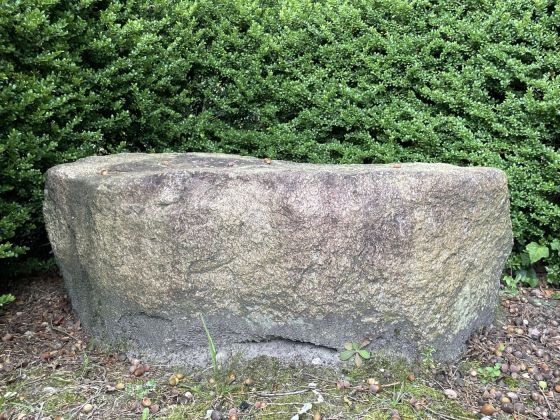
Unfortunately, the stone shown in the pictures (location: junction of “Am Schmelzofen” and “Am Warfacker”) is only a replica; the original is located in the primary school in Horsten.
Visited September 2025
taken from the on-site information board:
The Horster Sonnenstein
During the Bronze Age around 1000 BC, the life-giving power of the sun was probably worshipped, and 17 regular concentric circles were carved into this grey-red granite porphyry slab as a symbol of the sun.
There are only two other sun stones in northern Germany (in Beckstedt with 11 circles and in Harpstedt with 12 circles). Such concentric circles on stone blocks are known from Ireland and on rocks
in Scandinavia.
The front side probably faced east towards the rising sun or south towards the highest point of the sun. Where this Horster sun stone stood 3000 years ago and what significance it had will probably remain a mystery.