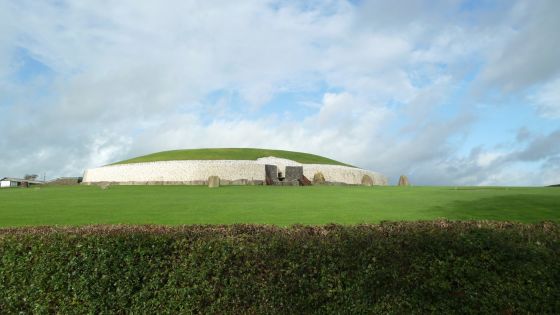

The limits of where the quartz is predominant in the façade are K18 – K83 but it maintains the height of 3m all the way .
The quartz (was it only quartz ? the only mention I have seen says quartz /granite ) in front of K 79 extends the presence further around the mound but doesn’t contradict the O’Kelly findings of a decrease in volume which isn’t reflected in the reconstruction .
It is also problematic in terms of suggesting that it may have the result of a slip .
If only quartz we are back at the usual findings of quartz at monuments when there is no possibility of a wall , it doesn’t mean there was a 3m high near vertical revetment . Worth noting that the the quartz/granite layer was also found up against K 81 (not apparent in 0'Kelly 1982 but noted in O'Kelly 1983 ) more in keeping with the a platform ,and possibly a later one as there was nothing under collpased K96.
