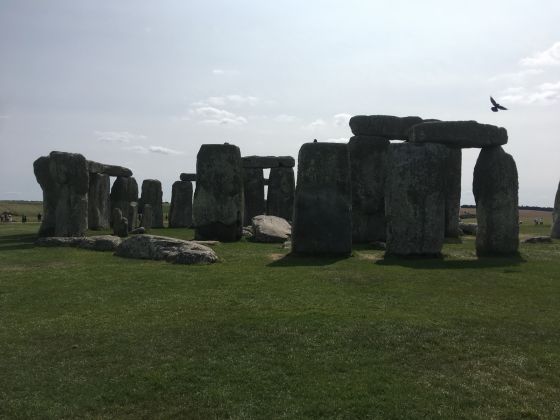
Stonehenge 181
Image by pce1975
Stonehenge

Stone Shifting 2

Gordon, you mentioned that excavations showed the holes had 3 straight sides and one sloping one at about 45 degrees. I can’t find much about the holes – do you have any links? I’m not sure how you’re thinking how the sloping side might have worked (eg. in your model, is it what the stone hits, on the left, or is it to give the stone clearance to pivot, on the right?. Alternatively, in some theories they manoeuvred the stone down the slope so it was tilted, and then pulled it upright).

On the same theme, the uprights are in pairs, one smooth and one rough, and people have suggested it’s male/female representation. But I’ve seen a photo of one of them that is very obviously very smooth on one side and very rough on the other, which would be very strange symbolism. So I’m wondering (only a thought for the sake of completeness) if the sliding action that we’re trying to avoid might have been actually what they were trying to achieve, and if the pairing arose from putting the stones in from different sides.

I’ve been going cross-eyed trying to work out if there are any others that are smooth on one side and rough on the other. Does anyone know? (I bet you do, Jim). Also, does anyone know of any excavation plans that would show the positions of the sloping sides of each stone hole? I can’t help feeling there must be a clue to their method still there.

Ok, I've just about finished the computer model. There are a few loose ends to tidy up before I post it on the web for you.

Nigel, I have some difficulty with your descriptions when you refer to left or right because I haven't seen the picture that you have in your head. In my model the tower is on the left and the A frame would be on the right (the model doesn't bother with the A frame). The stone initially rotates clockwise. I have not really programmed the hole. What I do is to assume that when the top right corner of the stone passes below ground level, that corresponds to the right hand side of the hole and that the sloping side of the hole will be wherever the left slope of the block is. I then stop the base of the block from rotating any further (as the ground would do) so that the rotational momentum now carries the block into a clockwise rotation.

I will need some of you practical guys to verify the model with some tests. Put in the figures for the objects you are experimenting with and see if the model predicts their behaviour correctly. If not, I may have to tweak some of the maths.

Based on the current (untested) behaviour of the model I have drawn the following conclusions:

1. Using a low tower helps to prevent slip, but the entry angle into the ground is far from upright so the block needs lots of momentum to get upright.

2. A high tower almost inevitably causes the block to slip, but it is nearer to vertical when it enters the hole.

3. If the centre of the block is close to the pivoting point the block rotates slowly and does not build up so much momentum. (I had mistakenly assumed otherwise at first).

4. If the centre of the block is further from the pivoting point there is much more momentum and the block is more likely to overshoot.

5. A long (and hence large) block gains momentum better than a short block and can therefore be launched from a low tower and still achieve upright.

The model suggests that a 9.75m (32 feet) x 1m block can be launched from a 3m tower with a 1.3m overhang (pivot to centre) and its momentum will just carry it to an upright position. The angle of entry into the ground is 39 degrees.

Four Winds, of course.

Nigel, all I know about the holes is that I remember reading they had three vertical sides and one sloping side. I believe the sloping side was much more than 45 degrees. If I remember right the sloping side was inside the circle.

In the picture inside my head the stone does not hit any part of the hole faces until almost at the bottom. Don't ask me why, it's just the way I see it.

The stone is raised inside the circle with the base of the stone extending over and covering the hole. Again its just a hunch. (subconcious probably, sometimes things just look right)

I don't think it matters whether the stone is rough or smooth. Somehow I don't think a bit of slippage really matters, we can allow for it, or eliminate it. At this stage I can't really help much, we've now got a scientist on the team I'm sure he'll point us in the right direction, and we can do the practical tests. The hard work is done, many brains are working to one objective. Test test and test again, then we'll astound the world.