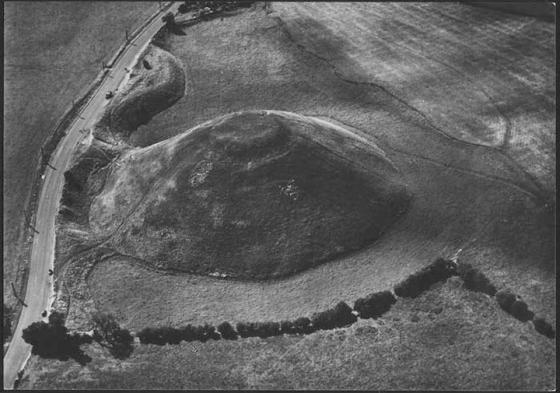
Silbury Hill 180
Image by Chance

To add to what you've said so clearly,VBB -

VBB, to add to what you say:

So far as preserving or learning about the two tunnels is concerned, the ICOMOS/Burra principle is relevant, since it would be what would need to be invoked:

"The traces of additions, alterations and earlier treatments to the fabric of a place are evidence of its history and uses. These will often be a major part of its significance. Conservation action should assist and not impede their understanding. "

To my mind, the application of this principle is a matter of judgement and balance, and boils down to case-by-case common sense. Perhaps Littlestone will elucidate how its equivalent is applied in his own field. But in the case of the Atkinson tunnel we have a fifty year old partly collapsed badly executed and poorly documented tunnel constructed in connection with a telly programme, in the heart of a 4,500 year old Neolithic mound. Whilst the Burra principle makes good sense in the case of the successive alterations to an Elizabethan Manor House, it makes little sense in relation to this tunnel. That alone ought to be a conclusive argument against spending money we don't have on it, I would have thought. But if one then adds the fact that it seems it can only be studied or preserved at the expense of vast additional losses to the original Neolithic archaeology then it becomes an absolute non-starter. Better to rip up the conservation manual, avoid philosophical navel-gazing and listen to what the untutored public, the true owners of the monument, will say: "don't be so ruddy daft."

If that's not persuasive, consider what our great grandchildren will say: "So you caused huge damage to the original, so you could leave us with knowledge of a twentieth century tunnel, did you?"

If the tunnel goes ahead on the basis of wanting to learn about or preserve twentieth century meddling it will be on the basis of grotesque misinterpretation of internationally recognised conservation principles. But that's already perfectly well known, of course.

With regard to the inner mound and Professor Bell's concern that grouting will destroy it, it's not as simple as that (or indeed as certain). Perhaps I can simply cut and paste HA's original comments concerning the suggested respective collateral losses from grouting and tunnelling:

"A potential future loss of 13% of the 'Silbury 1' primary (inner) deposit is suggested, [i.e from grouting] and this is indeed a shocking prospect. Converseley, the quoting of a potential future loss of 0.44% of 'Silbury 2 and 3' [i.e. from tunnelling] self-evidently seems far less concerning.

Yet is it? Should these figures be presented as percentages, when there are vast differences in the sizes of the respective areas of the hill? Had the potential losses been presented in simple volume terms, the reader might have gained a quite different perspective. Based on these percentages, the potential loss to 'Silbury 1' is 38 cubic metres. Whereas to 'Silbury 2 and 3' it is 1715 cubic metres! Needless to say, the latter may involve surface disfigurement.

English Heritage's interpretative comment, that the percentage figures show the impact "will be most significant on the poorly understood inner mound (Silbury 1), where biological preservation is exceptional" is questionable at the least, yet on the percentage basis provided this fact would escape many readers.

We believe that only if every relevant factor is highlighted can the wider community reach a rounded view of the issues. Thus, if we were acting as advocates for Silbury 2 and 3, we would point out that, so far as we know, the importance of the biological deposits in Silbury 1 was not mentioned or included as a factor in the planned programme until September 2003. By then, many interventions into them had been made and there are currently two plastic-lined boreholes into them. So the concerns that grouting may destabilise biological deposits by "introduction of air into otherwise well-sealed anaerobic environments" should be seen against this, not in isolation.

We must stress once again, we aren't taking sides. Grouting may not be the answer and may involve an unacceptable number of new boreholes – who yet knows? We simply say that everything must be given an equal public airing. The perfect preservation of the whole of the 'inner' biological deposits themselves may or may not be the proper main priority. We would strongly maintain that an ambition to study them certainly isn't. Only an open discussion of all the issues in a balanced fashion is likely to lead to a decision in which all can have confidence."

(To summarise: tell people the facts, plain and simple)