Poole Harbour is the second largest natural harbour in the world. Most of the harbour is very shallow meaning that ferries have to wriggle through specially dredged channels.
Image credit: Chris Bickerton

Poole Harbour is the second largest natural harbour in the world. Most of the harbour is very shallow meaning that ferries have to wriggle through specially dredged channels.


The way up, if you feel inclined.

Such wonderful colours, almost a mile from the sea it still has a very beachy feel with all the sand underfoot.

How nice, he’s helpfully signed his name.

Poole Harbour in the beyond, turn right ninety degrees and you can see the Needles on the Isle of White.


Behold the mighty boulder!


Panoramic sweep south-east to south.

With annoying climber (for scale)......

....and without annoying climber.

In its surrounding heathland with Poole Harbour, Brownsea Island and Bournemouth in the background.

In ‘A Royal Warren’ by C E Robinson (1882)
archive.org/stream/aroyalwarrenorp00dawsgoog#page/n165/mode/1up


December 2012

The Agglestone from Ulwell Barrow, with Poole harbour in the background.


The south west face, which is now green with lichen.

The tip of the Agglestone from the east.

The pure unadulterated and unmarked side of the Agglestone!


Even from a distance the Agglestone is an amazing sight. It holds a beauty in all angles and in any light. 27th December 2004


Lots of deer hereabouts. (to the right of the photo)

rockart!!


dec2002

27 dec 2002
The day was bright and having found a place to park up we set off over the wild heathland behind Studland and meandered our way through muddy lanes and low trees. We’d just stumbled on some of the best cep mushrooms we’d ever found when Mrs. C looked up and suddenly exclaimed “Is that it?” pointing through the undergrowth to a monstrous boulder on the horizon. And there it was, looking completely out of place and out of scale with its surroundings, more like Dartmoor than Dorset.
Having lived 3 years of my life in relatively close proximity to this amazing natural feature I was surprised that I’d never heard of it, let alone seen it and I’d been anticipating something much smaller like a gnarled old standing stone. As we got closer we noticed that we weren’t alone. There was a climber there, which slightly annoyed me, and for the first half an hour we had to endure this annoying twat doing the same clumsy climb over and over again. Well I guess that’s what sandwiches were invented for and eventually he got bored and fell off (or did I push him?) and we had the place to ourselves.
It really is awe-inspiring in its size and sheer strangeness and really looks otherworldly, like an organic UFO that’s crashed into a small hill. If you’d lived in this area thousands of years ago how could you not venerate it, there’s nothing like it for miles around and it’s set off with that glorious view over Poole Harbour and Brownsea Island. Even the hillock on which it stands doesn’t seem entirely natural, though to be fair there are other smaller hillocks thereabouts, some of them perhaps man-made.
[visited 24/12/02] Originally a Logan stone, this is a large natural rock outcrop that is impossible to miss. I came here after a long day out and it really is a delight. I for one wouldn?t have rocked it, as when you stand underneath it now it towers up as if it might fall at any moment.
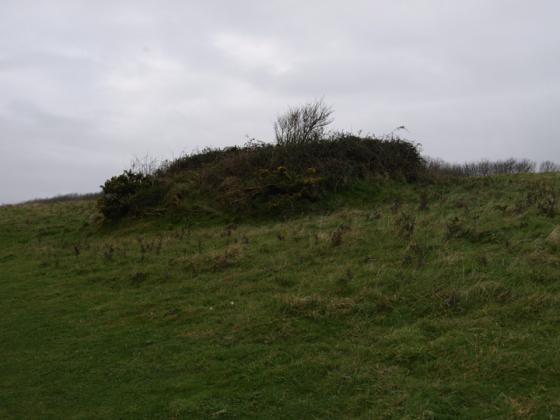
The Puckstone is visible as a mound to the North and the large mound very close by to the west is artificial.
Moist semi-oxygenated particles of iron, it is well known, have an agglutinating power; – the AGGLESTONE, therefore, which is composed of ferrugineous sand-stone, appears to me to have been formed on the spot, and there can be no necessity for supposing that the Druids (if it be true that it is a Druidical monument) would bring so enormous a mass from a distance. --
This extraordinary insulated rock, is situated on the heath, not far from Studland, and is about eighty feet in circumference, at a medium, the height being about twenty. It is somewhat in the shape of an inverted cone. The spot whereon it stands is raised like a barrow. This circumstance occasioned the conjecture that it was erected as a monument to some British chief, interred below. Whether it was intended for a sepulchral memorial, or whether the heap of earth was thrown up only to render the top of the rock accessible, the name Agglestone (from the Saxon halig-stand, i.e. holy stone) certainly seems to shew that it was erected for some superstitious purpose.
The country people call it the Devil’s night-cap, and there is a tradition that his Satanic Majesty threw it from the Isle of Wight, with an intent to demolish Corfe Castle, but that it dropped short here!
From volume 1 of “Observations relative chiefly to the natural history, picturesque scenery, and antiquities of the western counties of England, made in the years 1794 and 1796” by William Maton.

” A musing stroll across the heath from Studland, brings you to the Aggllestone, the holy stone (Helig – Anglo-Saxon for holy) hurled by the devil on to the crest of a hillock rising above the peaty waste. Fiends often do dress like angels, and it is certainly hard to detect anything of the devil when the Madonna-blue chalices of that visionary flower, Gentiana pneumonanthe, are open on the heath. But devils did traffic with holy stones in archaic England, for devils were once gods themselves fallen from heaven upon evil days, the days when the usurping Celts looked with dread upon the works of their predecessors. For the Agglestone is a menhir”.
Taken from
Downland Man by H.J. Massingham
Pub 1927 by Jonathan Cape

As is often the case, there are alternative versions of the tales below – other versions say the Devil was throwing it at Blindon Abbey or Salisbury Cathedral. Another name for it is the Devil’s Anvil.
Ian West’s site has a great photo showing the stone before it toppled.
(No wonder it doesn’t rock anymore!)