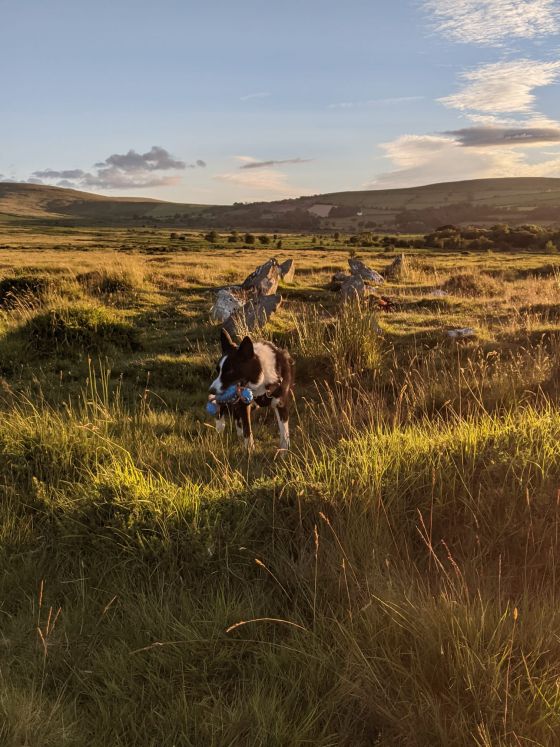
A May 2026 visit.
Image credit: David FLETCHER

A May 2026 visit.


Moon from underneath the capstone edge


Gwal y Filiast March 2018

Gwal y Filiast March 2018

Gwal y Filiast March 2018

Gwal y Filiast March 2018

Chocolate lab for size reference.
This Dolmen is further down the track than Postman’s directions suggest. It’s almost a mile from the tarmac road to where the footpath forks. At the fork (after a makeshift gate and fence) turn left and enjoy the view...


From The Reliquary and Illustrated Archaeologist, v12 (1906).
archive.org/stream/reliquaryillust00unkngoog#page/n62/mode/2up


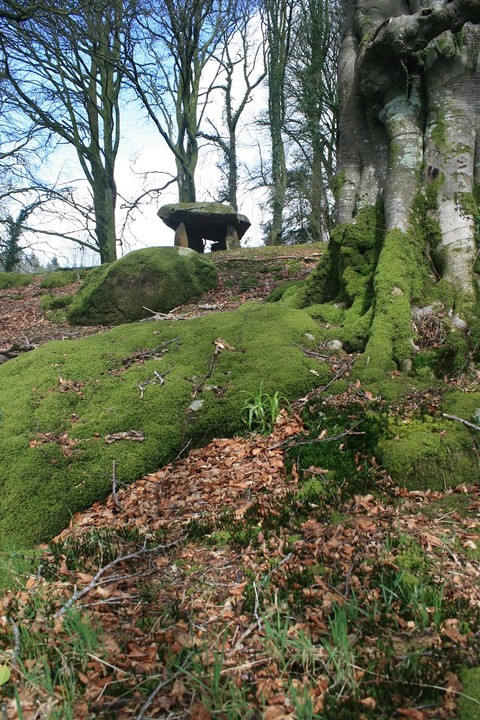


From SW
Easter 1995


From W
Easter 1995

From SE
Easter 1995
Video covering the folklore and legends of this site

Visited June ‘25
One of those sites that has always been high on my list to visit. We were vaguely in the area, and I really really needed to get to see it.
After heading south from Llanglydwen we parked on the verge of the track which runs down from the north side of the site. I had to manoeuvre carefully along the path which was muddy/skiddy but mostly covered in places by several fallen trees (in an earlier storm?). After perhaps 20 minutes or so I reached the clearing, with the dolmen coming into view.
A big smile crossed my face, as I realised this is going to be as good as I’d hoped. This one will stick in the memory – I’ll easily feel transported back to that clearing.
I walked around trying to take in the wider site – some outlying stones, the orientation of the chamber – but just wanted to sit and soak it up.
Such a visually pleasing monument in a beautifully isolated place.
Visited the dolmen on the frosty night of February 7th, not long after Imbolc and on a waxing moon. First time we have been there since Storm Darragh blew in. Unfortunately this has turned the route that most people use, the public footpath off the minor road to the south of Llanglydwen that goes past Pen-pontbren, into a Grade A assault course. Fallen pines and firs have come down like dominos all over the path, and as with many places, there has been no attempt to clear up. We had to go through the fields south of the path, and it looked like we had not been the first to do so. The path badly needs the council to get in there with chainsaws.
We were worried that the beech grove around the dolmen was going to be similarly battered, but storm damage has been thankfully minimal. A couple of split or uprooted trees nearby but the sylvan feel of this unique spot remains intact. There was a nice round chunk of quartz on the floor of the chamber that wasn’t there last time. The white water river section in the gorge below rumbling to itself, and easy to imagine the spirits of the woodland and the ancestors tickling the edges of perception.
I can’t believe I didn’t add any field notes from my last visit six years ago, even though that was more than half a lifetime ago for Eric he still said “oh I remember this one” and that was before we even got to it.
Heading south out of Llanglydwen, take your first right turn, then turn right into the track that leads to Penbontbren cottage, they let me park there last time but this time I leave it further up the track in the corner to one side, then walk down to the house and pass it by on it’s right hand side, through a red gate. Then take your left hand fork passing a standing stone/old gate post and in one minute the most beautiful of Preseli’s chromlechs is revealed.
Looking down over the river but not in site of it, is the greyhounds lair, what is it with greyhounds lairs in Wales? there is at least three that i’ve been to, is it the ancient name for it or a modern thing?
I walk around and around it, taking pictures from strange angles that I didn’t explore last time, but last time the whole family and the dog were here, this time it’s just Eric and me, and he’s got a new football, so i’m free to go this way and that. Some chalked/burnt stick graffiti is on the inside, including a spiral in black, it’s all old stuff that’s wearing away, it’ll be gone by autumn.
On the edge of the Preseli mountains but not in site of it, this is a must see dolmen, so many pictures of Coaten Arthur and Carreg Samson, this place is well under used, and little visited. A secret little gem, if i’d come a few weeks later there would have been bluebells too, so much beauty and wonder in one place would have made me quiver. Then again at work a bonus is coming my way soon, so I may come back in a few weeks, and I will be a lucky boy.
Ps.... the walk back was timed to more or less fifteen minutes, so there’s no excuses for not coming.
This is an intact cromlech in a beautiful and enchanting place.
Although built as a Preseli dolmen in the Carreg Samson style (smallish, enormous fat capstone), because of its location this feels unlike any other site I’ve been to. Megalithic sites tend to have such a grand sense of place, so clearly built into their landscape with the horizons and far contours in mind. This place, though, is secluded, standing near the top of a steep riverbank above the Afon Taf.
The sense of intimacy is not just to do with the relatively confined landscape, but in a large part it’s the woods too. It stands in a small clearing among old mixed woodland, in a possibly deliberate perfect circle of beech trees.
The builders worked among trees like those around it today, and all the construction and usage took place to a soundtrack of the riverflow, continuous from before they first came until after we leave.
This setting profoundly triggers the imagination because so many ancient monuments must have been built in woodland. West Kennett longbarrow was built in an oak forest, not the monoculture agri-desert we know today.
For so many Preseli cromlechs to be built with a seaward orientation, it’s got to be the river that is the focus of this one. The apparent entrance faces SSW down to the river.
The three side uprights are about 4 and a half feet high, the fourth, at the back, is smaller but even with the extra width of the capstone at that point there’s still a clear uptilt to the entrance.
A single outlier stone, presumably displaced from the cromlech, stands 3 ft high and 5 ft long about 5m to the north.
According to Children & Nash (1997), in 1872 Barnwell wrote that the chamber and capstone were still covered by a mound and at least 32 outer kerbstones were visible. However, given the scarcity of covered barrows in the region and the serious work that would’ve had to have taken place in the last 130 years to get it to its present bare state, I’m tempted to suggest Barnwell was either exaggerating or confused in his description.
This really is a beautiful mesmerising site, do make the effort to visit.
visited 17 Aug 04
This prehistoric monument sits below the village of Llanglydwen in Carmarthenshire. Situated on an ancient path in a secluded forest, its huge capstone points towards the nearby river Taf, which you can hear flowing below the trees.
An old Welsh tale set during the days of King Arthur tells of Ceridwen and Taleisin. Welsh poetry refers to the goddess of transformation, rebirth and inspiration – Ceridwen – as possessing the cauldron of “poetic inspiration”, called Awen.
This legendary story tells that Ceridwen set to brew in her magical cauldron, a mixture that would grant the gift of wisdom and poetic inspiration, Awen, for her son Morfran. The mixture was to be boiled for a year and a day. One day when the brew was almost finished, her young servant Gwion Bach was stirring the concoction and three drops of the liquid splashed onto his thumb. He instinctively put his thumb to his mouth and gained the wisdom and knowledge that Ceridwen had intended for her son. In his fear of Ceridwens anger, Gwion fled.. with Ceridwen chasing after him.
We have a video covering the folklore and history of this site and the name on our Youtube..
Below Gwal-y-Filiast the Afon Taf snakes through a wooded valley, and in the river is a naturally created hollow called Crochan Arthur (Arthur’s cauldron).
Wirt Sikes mentions it in ‘British Goblins’ (1880):
This [feature] is under a cromlech at Dolwillim, on the banks of the Tawe, and in the stream itself when the water is high; it is a circular hole of considerable depth, accurately bored in the stone by the action of the water. This hole is called Arthur’s Pot, and according to local belief was made by Merlin for the hero king to cook his dinner in.
Perhaps Arthur kept his dog in Gwal-y-Filiast (the lair of the greyhound bitch) to keep her out of the way while his dinner was stewing.
A collation of our research on Gwal-Y-Filiast, including all the earliest records of the site as well as legends associated with the name.
“I visited this gorgeous little cromlech in May 2010 during my 3 day tour of South West Wales. It’s a dramatic part of the country, with both mountainous regions and spectacular coastlines. It also just happens to have a concentration of prehistory equal to anywhere in the country. A burial chamber called Gwal-y-Filiast or ‘The Grayhound’s Kennel’ is one such place and a fine example to boot!”
Chris Brooks
Eight images and a brief description of this site.