A few hundred yards North of the 9 Ladies, follow the first stone wall you reach down to the right. The site is badly overgrown, but the banks and entrances can be seen.

stubob


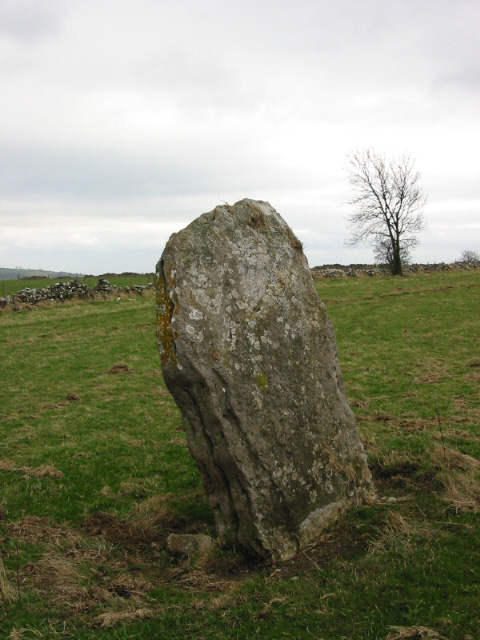
Big slab of limestone, clearly visible from road. O.S marked.
Located behind Staden industrial estate.
Often suggested to be the remains of a henge, the slight earthworks visible however were more than likely constructed in the Iron Age/Romano-British period. There is a large settlement site from the latter of the two periods only 100m or so away.
The ‘henges’ near circular banks can just be made out in the grass, a smaller more angular enclosure abutting this can also be seen (top left corner of the field in the photograph).

Located in the middle of Doveholes village, The Bull Ring Henge is very similar in design and size with Arbor Low, though not as well preserved, all the stones have been removed from the site.

Said to be the highest megalithic tomb in Britain.
Excellent place.. but catch the landfill site blowing the wrong way and it.....Certainly stinks to high heaven....
Does anyone know what these are about?
I think they mark the way of an ancient track (how ancient?), they appear in little groups stretching for 75yds or so. The path is linked to St Helens Church, Churchtown Darley Dale. The original Church was meant to have been built on an earthwork mound on the banks of the Derwent, the churchyard contains a 2000yr old Yew.
Any ideas?


Harland Edge in the East and views over much of the Peak District including Stanton Moor. Only 6 or 7 of the stones remain standing, the others lean severely. WNW of the circle are two stones, they seem too small to be useful outliers but are set vertically. The remains of a large cairn within the circle can be seen.
The tallest stone (now leaning inwards) was thought to have a cup mark near the top on one side...this has now been found to be a bullet hole from the moors Army training days.
Derbyshire’s biggest embanked circle and so tricky to find, well off the paths and well hidden in the heather. Keep a look out for sign planted in the stones of Eyam Moor Barrow, the circle is right behind it.
Burl mentions old reports of a supposed stone avenue in the SW, nothing has ever been found.
The circle has one of the best alignments in Derbyshire when the midsummer sun rises above Higgar Tor. The chair shaped stone mirrors the shape of the Tor on the horizon.

02/02. The top of the stone matches the shape of Higgar Tor on the horizon. The mid-summer sunrise alignment.

Just up the road from the Fox House Inn (1/2m), are 2 ring cairns.
Follow the wall by the ruined house on the heathered side half way up the wall, theres a stone on the floor with a ‘I’ painted on it, this lies on the Northern circles bank, unsure whether it belongs to the ring cairn.The large Northern ring can be made out in the heather.
A smaller circle is found just before the larger North circle, although very badly damaged by the wall and a sunken track that runs through it. No remaining stones.
The larger northern ring although covered in heather is very easy to make out.
Probably the most visible section of the smaller South circle, is just over the wall in the grassy field.


Just over the road from the Andle Stone, metal handles as well.
A 1789 document recorded that the Cork Stone had four other stones surrounding it, at a diameter of about 25ft, no longer there.

The site is also known as the Grey Ladies and on moonlit nights folklore says that ’ the stones spin and dance.‘
A Derbyshire Antiquarian writing in the 19th Century told of a farm labourer who while resting at the stones found an old clay pipe. He cleaned it out and began smoking his tobacco. ‘A peculiar and delicious scent’ came from his pipe, he then noticed by one of the stones that the ground had become transparent, and when he gazed into it he saw a beautiful world. More colourful than anything he had seen, with gaily dressed small people.
Fairies are mentioned in many of the local tales of the stones, from fairy dances to the playing of pipes.


Previous page1,651-1,681 of 1,681 posts