
An experiment in stone rowing by ‘the Stonehengineers’ takes place next to a Stonehenge replica, built for a channel 5 TV show.
Image credit: Nigel Swift

An experiment in stone rowing by ‘the Stonehengineers’ takes place next to a Stonehenge replica, built for a channel 5 TV show.

As you travel down the A303, this is the glimpse of the monument you’ll get.

Hippies enjoy the sunshine at Woodhenge on 21 June 2005


George Lambrick and Aubrey Burl ‘open’ the improved access facilities at the Rollrights on 19 June 2005.
From Heritage Action, 22 June 2005
Access to the three ancient monuments that make up the Rollright stones has been greatly improved. It is now easier than ever for wheelchair users and families with pushchairs to enjoy the spectacle of the The King’s men stone circle, the Whispering Knights burial chamber and the King Stone standing stone in the beautiful north Oxfordshire countryside.
The improvements were unveiled in a ceremony last weekend when George Lambrick, chair of trustees of The Rollright Trust who cares for the monuments welcomed visitors and guests to inspect the new facilities for themselves.
A portion of land to the south of the King’s Men stone circle has been acquired to allow visitors to enter the circle through the portal that the bronze age builders of the circle originally intended. An all-weather anti-mud path suitable for wheelchairs now leads down from the King’s men stone circle to the Whispering Knights burial chamber. Access to the King stone has been improved and information boards have been erected.
Continues here

‘Foamhenge’ – a temporary life-size polystyrene reconstruction for channel 5 programmes aired on 20 and 21 June 2005.
From BBCi, 16 June 2005
A New York-based conservation group has joined the battle to prevent further quarrying near an ancient monument known as the Stonehenge of the North.
The Landmarks Foundation said plans by Tarmac to extend its sand and gravel quarry close to Thornborough Henges, near Ripon, would be a “tragedy”.
North Yorkshire County Council is due to consider the application to extend the quarry later in the year.
The foundation said: “We strongly urge the council to reject the application.”
Tarmac already has a quarry at Nosterfield, close to the ancient henges.
The new site at Ladybridge Farm is also near the henges, which consist of three earthworks built in a line running north-south for about a mile.
Residents fear further quarrying could destroy clues about why the 5,000-year-old earthworks were built.
Their fears have come to the attention of the Landmarks Foundation, which says its mission is to conserve sacred sites and landscapes around the world.
Continues...
From PeterboroughNow 16 June 2005
In a clash between ancient history and new technology, fears have been raised that Peterborough’s renowned Flag Fen site could be forced to close if a giant waste plant is built.
Each year, more than 20,000 people visit the celebrated site in Fourth Drove, Fengate, which is recognised as one of the most important Bronze Age sites in Europe.
It was discovered by Dr Francis Pryor in 1982 when a piece of timber was spotted sticking out of the peat by archaeologists looking for a Roman road.
Since then, hundreds of relics have been discovered, including Britain’s oldest wheel, and Dr Pryor has gone on to find television fame as part of the BBC’s Time Team.
Today, the last day for public objections to be lodged, he said he had “serious reservations” about the controversial plans to build the Global Olivine energy-from-waste recycling site, which will cover 29 acres and dwarf Flag Fen.
He said: “The proposal as it currently stands gives me serious worries that it will adversely affect the undisturbed archaeological deposits on the site.
I also have concerns about the visual impact of the scheme and the way this will affect how visitors experience our Flag Fen.”
continues here...
A team of university archaeologists has uncovered the remains of an Iron Age settlement in the grounds of a Gloucestershire castle.
The group, from the University of Bristol, found fragments of human bones and prehistoric flint tools in the gardens of Berkeley castle.
The discoveries were made by students taking part in a training excavation.
Mark Horton, head of archaeology, said: “To find prehistoric remains is an exciting and unexpected discovery.”
Parts of a ring ditch, which may have circled a house, were also uncovered in an area below the castle’s Victorian flowerbeds and greenhouses.
Berkeley castle has been owned and inhabited by the same family since 1156, but little is known about the early history of the site.
“It is possible this settlement was located on a small ridge of high ground, to be visible from the River Severn, and might even had been located to help prehistoric navigation,” Dr Horton said.
The excavations are due to be filled in, but it is hoped the artefacts will be put on display for visitors to the castle.
From BBCi, 7 June 2005
news.bbc.co.uk/1/hi/england/gloucestershire/4614747.stm
A company which wants to quarry near an ancient monument has dismissed suggestions that the site contains items of archaeological importance.
Tarmac wants to extend its sand and gravel operations next to Thornborough Henges near Ripon, North Yorks.
Residents fear further quarrying could destroy clues about why the 5,000-year-old earthworks were built.
But archaeologists working for Tarmac say there is only “thin and scattered” evidence of prehistoric activity.
Tarmac commissioned York-based Mike Griffiths and Associates (MGA) to carry out a visual survey as part of its application to the county council to extend its present quarry at Nosterfield.
The new site at Ladybridge Farm would bring quarrying much nearer the henges which consist of three earthworks built in a line running north-south for about a mile.
Each henge consists of circular earth banks and ditches which may have been covered with gypsum.
Archaeologist Steve Timms from MGA said: “With the exception of just seven shallow pits which contained Neolithic finds, very little else has been found.
“Apart from two fragments of pottery we have no evidence for Roman or medieval activity at all and most of the prehistoric finds were collected from the surface of the fields during the field walking
“The evidence suggests that people were doing something on the site in the Neolithic period but there is not enough evidence to say what it was.”
North Yorkshire County Council is due to consider the application to extend the quarry later in the year.
Mike Sanders from Friends of Thornborough Henges said the MGA survey was “quite inadequate”.
“Less than 2% of the Ladybridge Farm site has been surveyed,” he claimed.
Mr Sanders added that advances in archaeological techniques in future years might turn up more evidence and destroying the landscape now meant that opportunity would be lost.
from bbc.co.uk, 24 May 2005
news.bbc.co.uk/1/hi/england/north_yorkshire/4577241.stm
From This is Richmond, 19 may 2005
A QUARRY firm’s own archaeologists said a site chosen for excavation should not be disturbed, according to campaigners.
Pressure group Timewatch said finds from an archaeological study paid for by Tarmac Northern meant no further quarrying should be allowed at Nosterfield Quarry, near Masham, North Yorkshire.
Quarry bosses said the study of Ladybridge Farm found “thin and scattered evidence of activity dating back to the Mesolithic period that had been dispersed by thousands of years of farming”.
But George Chaplin, chairman of Timewatch, said a site of even greater archaeological potential than even they had suspected had been uncovered.
Mr Chaplin said: “The little that is left must be protected from quarrying.”
The study was conducted to accompany a planning application to extend the quarry, which will be looked at by North Yorkshire County Council later this year.
Tarmac estates manager Bob Nisholson said: “The survey and report were produced by professional archaeologists. The report has been submitted to North Yorkshire County Council and the county council will evaluate it as part of the planning application process.”
A strategy document providing guidance for the care and protection of carved stones has been unveiled by Tourism Minister Patricia Ferguson.
Carved stones provide a very real link to more than 5000 years of human activity in Scotland and are an important and significantly large proportion of the monuments and artefacts that survive from past times. Carved stones help to define the character of our environment and present-day identities, both local and national.
Emphasising the cultural importance of carved stones, Ms Ferguson said:
Scotland’s rich and varied resource of carved stones is an important cultural asset; they are a tangible connection to a very human element of our past. Carved stones have enormous and largely untapped potential, particularly for sustainable tourism and educational initiatives, but they require active conservation.
Effective protection of carved stones will continue to be achieved most effectively through better understanding of the issues involved and collective effort to address them. I hope that, with this policy and guidance, Historic Scotland and everyone else involved will be encouraged, and better placed, to identify priorities and implement strategies and action plans to respond to the needs of individual sites and categories of our important carved stones.
Read more here
from www.scotland.gov.uk
An article by Ben Kendall of the Eastern Daily Press online, 26th April 2005:
One of the biggest hauls of Bronze Age artefacts ever found in Norfolk has been uncovered in a garden – but it very nearly ended up in a skip.
The 145 items dating from circa 800BC were discovered in Norwich by gardener Simon Francis as he landscaped the grounds of a house on Poplar Avenue, near Newmarket Road.
Norfolk County Council archaeologists have described the haul as one of the largest and most significant they have known, providing a vital insight into the era.
But yesterday Mr Francis admitted he had not initially appreciated the importance of the find. He said: “I have been working as a gardener for years and I’ve often come across bits of pottery.
“At first I just thought these were bits of gate posts from Victorian times or something so I suppose I could have easily thrown them away. Fortunately there were some items like axe and spear heads which stood out.”
Property owner Shane Target said he had delighted such a find had been made. He said: “I know a bit about archaeology and I am fascinated by it.
“When Simon told me what he had found I came down to the garden and we both realised we had found something pretty special.”
Since the initial discovery of 135 items on Friday, archaeologists have revisited the site and found more items including a Viking broach.
The haul included axe heads, spear-heads, sword parts, tools and ingots.
Curator of archaeology Alan West said: “This is one of the biggest finds in Norfolk and as such is very significant.
“The items are in good condition and the more items we find the better knowledge we can develop of the era.
“It seems the items had been buried in a shallow pit. I would have thought the items we buried there as it was a safe area and they planned to return to recover them at a later date but, for whatever reason, that never happened.
“Finding the Viking broach is particularly unusual. It is rare to find items from two completely different eras all on one site.”
Fellow curator Tim Pestell said he hoped the items would eventually be displayed at Norwich Castle. “The coroner will have to decide if this qualifies as treasure which it almost certainly does,” he said. “Then we will look to put it on public display.”
He added: “I got the call about this at the end of the day on Friday when I was about to go home. It was one of those moments when you think ‘should I answer the phone’. Obviously now I’m glad I did.”
Very little is known about the origins of the name of the village of Sarsden but down the centuries Churchill has had several names, such as, Cercelle, Churchell. Cherchell and finally, by 1537, Churchill. It is thought that it may be derived from the Old English ‘cyrc’, which means a hill, burying ground or barrow.


The quoit now forms the terminus of a broken field wall.


Christ-on-a-bike it’s a long hike up there!

Original purpose? Who knows... Today’s purpose? Jackdaw landing strip!

Looking down towards the Irish sea


... with Great Orme copper mine in the background

Hard to imagine that such a giant construction could so easily get ‘lost’. I bet most walkers on this path through the trees don’t even recognise it as an ancient monument.

That mighty capstone 3 feet thick, reduced to part of a fence.

The great flat slabs were reminiscent of Orcadian stalled cairns.

treaclechops and Moth consider the ‘real’ side entrance passage way


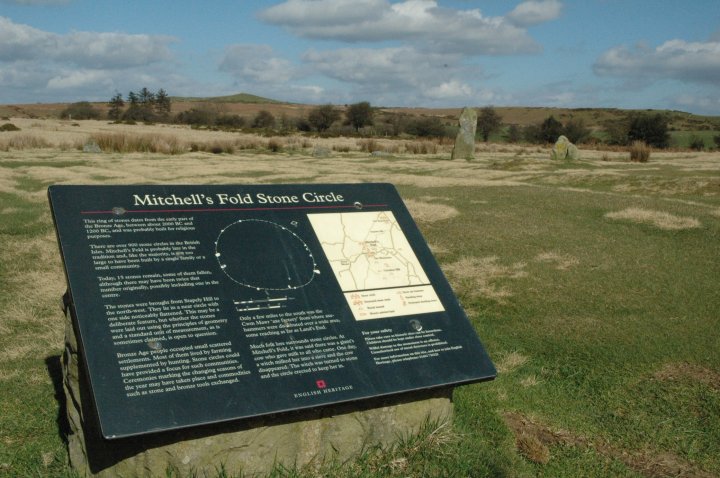
Easy to find, clearly signposted and just a short walk from the nearest place to park Mitchell’s Fold is a cracking stone circle up on some heathland with glorious views all round.
Overlooked by the very close Corndon Hill, itself the site of a whole bunch of bronze age burial sites, most of the stones are just small stumps now, but one of two larger, taller stones remain. Here it definitely is a case of the sum being greater than the parts. We spent two hours here without even trying, just looking, enjoying the sunshine, lying in the grass, drinking in the tranquility.
Under the crackle of a very nearby pylon, this tiny, fragile circle has somehow survived in this sacred Tal-Y-Fantastic landscape. The fourteen small stones are all very loose and wobbly, and close investigation revealed that many of them were not set into the earth at all, but placed into rubble sockets. One of the taller stones had fallen over. So treaclechops and I carefully stood it upright again into its rubble socket. No doubt the next time a sheep farts within five metres of it, it’ll be over again.
Not as picturesque as it’s neighbour Maen-y-Bardd Rhiw Burial Chamber, also known as the Greyhounds’ Kennel, is dug into the hillside rather than standing above it. With big flat capstone and large flanking uprights lining the chamber, this has plenty of remnants of its larger shape lying about the place, some kerbstones and a distinct mound of barrow. Lots to unravel and think about. I loved it!
