


Moth clears ivy and moss to expose the stones. (It’s the closest he’ll ever get to gardening.)
Note that there are standingstones on both sides of the driveway and the proximity to the church, outside of which lie the Churchill village stones.


‘September sunset, Avebury’ watercolour by (c) Jane Tomlinson, 2004
Following on from this painting, themodernantiquarian.com/post/21576, I wanted to have another crack at this view, to increase the sense of ‘something else’, something unknown going on to do with the land itself, related to the stones, but not actually the stones themselves.
So I have raised the horizon and emphasised the foreground shadows; the stones which cast them are unseen.


With the big trees on the top not in leaf, its easier to see the shape and height of the mound and to make sense of its spiral construction.

Adam’s Grave lies on the peak to the far right of the image. This view taken from Alton Barnes. The white horse on the left was cut in 1812.

The sky seemed to be bearing down upon the long barrow.


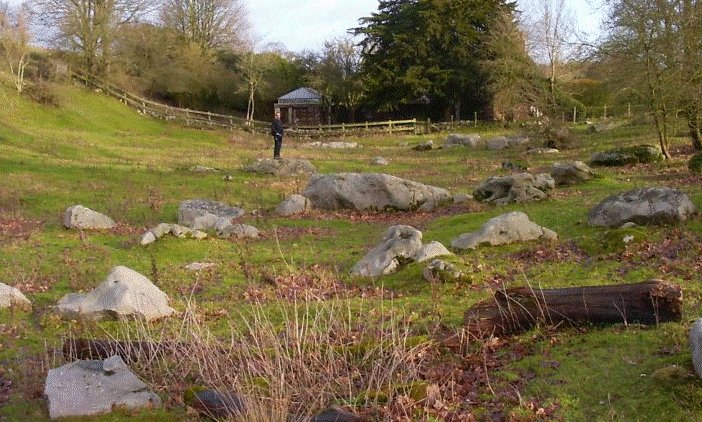


How it looks in the landscape, with Moth for scale.


Moth, for scale, purposes, obviously.


Moth and Joan stand in the lane which neatly runs through the middle of the long barrow...


‘One way‘
Building on the ideas about the Ridgeway and the landscape through which it passes which I developed in ‘Hannah’s Ridgeway walk’, in this watercolour painting I have tried push further the ideas of ‘what is the right way to go?’, right and wrong, straight lines versus curves and a lot more besides. See what you make of it.
Send it as an e-card from here: Http://www.janetomlinson.com/earthmagic.asp

‘Lengthening shadows, Avebury‘
Watercolour, (c) JCTomlinson, 2003