Mid-afternoon sunlight streams in to the chamber.
Image credit: M. Thornton

Mid-afternoon sunlight streams in to the chamber.


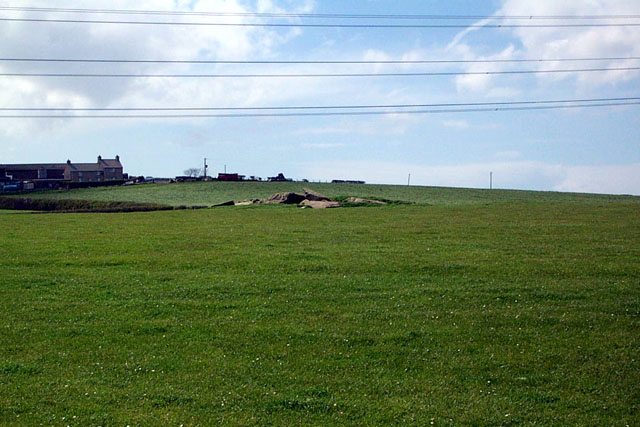
This site isn’t easy to find, the roads round here are very confusing. We asked a friendly local for directions and he got straight in his car and led us to the spot – what a dude. The site is a disappointment, very little is left, and what there is lies overgrown. The location however is good, with a view stretching from the Snowdonian mountains right out to sea.


Inside the chamber. It is still possible to crawl under the partially collapsed capstone.
This site sits in an excellent location above the mouth of the Conwy. Two large standing stones, which may have marked the entrance, now double up as fence posts, unnecessary amounts of rusted barbed wire surround them. The chamber itself is partially collapsed, and there have been no attempts at the usual brick and cement repair – a major plus point. The capstone is a massive bulk, much thicker than many I’ve seen. It is still possible to climb inside the chamber (just) and the bulk of the capstone, from this position, is overwhelming. Off the beaten track, and presumably rarely visited, this site is well worth the effort.
Address and contact details for this service.
The burial of three children along with amber beads, bone & antler tools and animal bones were found here.
Translates as ‘Vale of the Carpenter’ – this burial chamber is built over a pit cut into rock. Over forty people were found interred here.
Scroll down to the bottom of the page for images and a description of this site.
Details of all the sites around Great Orme.
Official site for the Great Orme Mine visitors centre.
A brief description and images of this site and Maen Y Bardd (scroll down the page for Hendre Waelod).
The Glebe House, lies directly beside Dowth, and offers accomodation at the more expensive end of acceptable B&B rates (it worked out at about £25.00 per night when we stayed). The large front bedroom looks out directly to the Dowth monument. From the entrance gates the view stretches out across the Boyne valley to Newgrange – which looks stunning from here.
The Glebe House,
Dowth,
Drogheda,
Co. Meath
Tel 041-9836101
Fax 041-9843469
It is reported that in the 18th century the existing chamber was used by a family of squatters. They must have been a very small family of very small people!
A tranquil, calm spot for this site. The capstone of the standing chamber is supported by a wooden structure, which whilst not the most beautiful thing is a slight improvement on the brick and mortar solution used at Ty Newydd. The walk to the site was made all the more rewarding by a small wood with a floor covered in bluebells.

Do not pay to visit this site!
As already mentioned, entry to the grounds of Plas Newydd, does not allow access to the site. Park up on the visitors car park, ignore the ticket office, and walk down to the picnic bench beside the fence. The site is visible over the fence. To gain access, I presume it’s a case of ringing/writing for permission OR going on one of the guided archaeological tours. It’s £3.00 and takes two hours, so some of the walk probably takes in the gardens, which may or may not be of much interest!
A great setting for these two enigmatic standing stones. The view out to sea, and of Snowdonia, is only partially obstructed by the nearby farmhouse. If only the other sites (Trefignath & Ty Mawr) were in such unspoilt locations. As I was leaving the stones four horses, one very young, came from the farmhouse to play. They ran wildly round the stones a few times, jumping and kicking, then finally stopped at the stones to rub against one another.


This fine stone, 3m high and over 2m wide, stands in a field close to the road on the edge of the village.
To reach the stones do not be put off by the lack of a signed footpath. We struggled with our bearings at first, the OS map clearly showing a path by the side of a house. A guy was out cleaning his car and he kindly pointed out the path – it runs by the side of his garage and was partly obstructed by some planks of wood which he promised to remove. The stiles leading to the site are also partly obstructed by barbed wire.
It is worth the hassle as the site is in a great position, and cannot get many visitors – so privacy is almost guaranteed.
This fallen burial site lies in the middle of a field adjacent to Cromlech Farm, and as far as I could tell there is no right of way, so the site must be viewed over the wall.

Just round the corner from Meini Hirion standing stones lies Cromlech Farm. The monument lies further up the track.
A cumbersome, partly subterranean site. From the outside the huge bulky capstone appears to have pushed it’s low kerbstones down into the ground – this isn’t the case as the interior is hollowed out. To gain entrance to the sites chamber requires a vault over the fence – be warned it has large, sharp spikes and the glossy green paint can be quite slippery!
Trefignath is a great site, spoilt by the view to the aluminium works. The site was built in three stages, and these are still clearly discernible, the latest stage being the large chamber, which it is possible to crawl inside. One of the two stones marking this entrance shows signs of quite a large fire being lit there recently, causing some damage to the stone – blackening from the fire and worse a chip out of it’s surface.
Worth visiting en-route to Trefignath. This standing stone is signposted from the road and can be clearly seen in it’s field. The stone is surrounded by a series of wooden posts holding up a damaged wire fence. The purpose of the fence, it would seem, is to keep the sheep away from the stone – the fact that the fence is damaged makes it pointless and so just adds to the ugly intrusions all around.

The largest chamber, thought to be the final stage in the building of the monument.