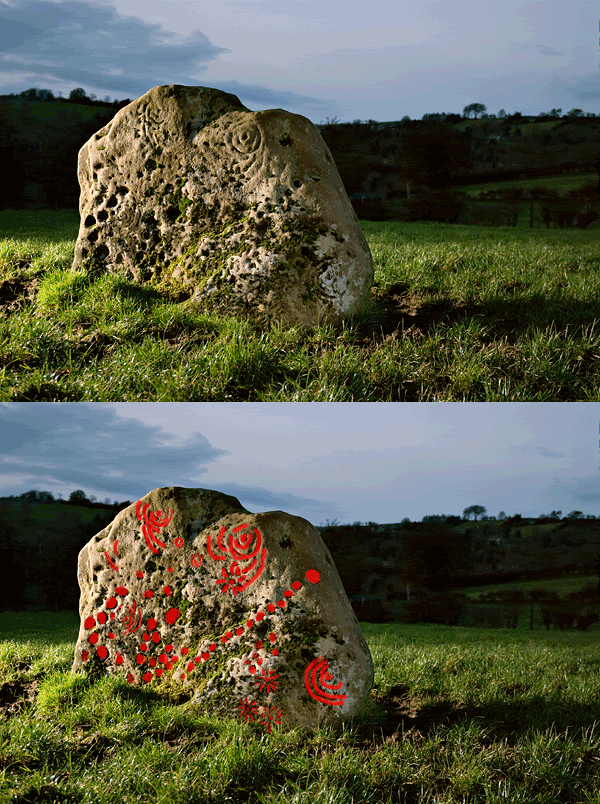
A .pdf file detailing four cup marked stones.
By A. Marshall
From the Transactions of the Bristol and Gloucestershire Archaeological Society 1986, Vol. 104, 220-225
Courtesy of the University of Gloucestershire website.
A .pdf file detailing four cup marked stones.
By A. Marshall
From the Transactions of the Bristol and Gloucestershire Archaeological Society 1986, Vol. 104, 220-225
Courtesy of the University of Gloucestershire website.
What a remarkable thing!
A cup and ring marked stone? In Gloucestershire? Written up by that stalwart of the Scots CnR fraternity R.W.B. Morris? In 1983?
Apparently so.
A tidy account of this OOPPRA* provided courstesy of the Bristol and Gloucestershire Archaeological Society. Via the University of Gloucestershire website.
(*out-of-place-portable-rock-art. I just made that term up. It’s utter tosh really, as the stone found was made of local oolite, so it’s not out of place. Which actually makes it seem all the more remarkable as you do not get CnRs down south. everyone knows that...)
A dozing horse from the past at Avebury, next to a very large stone, which Pete G tells me is the Devil’s Chair (stone 98).
Photo taken by the eminent Alvin Langdon Coburn.
A number of photos taken in the first half of the 20th century by Alvin Langdon Coburn (they are about half-way down the list).
Ty Newydd without its preposterous brick additions, taken by Alvin Langdon Coburn.
The stones look in pretty much the same places. It makes you feel (from afar at least) that the bricks are sheer paranoia. But the capstone is broken?
Photo by Alvin Langdon Coburn: interestingly, of the barrow in its pre-restored state.
Another at
geh.org/ar/strip27/htmlsrc/m197926730002_ful.html#topofimage
and scroll down on this ‘Clonehenge’ page for another pre-’restored’ photo, which purports to be of WKLB too.
replicahenge.wordpress.com/tag/pete-glastonbury/
Photo taken by Alvin Langdon Coburn.
Photos taken by Alvin Langdon Coburn, apparently during excavations:
geh.org/ar/strip27/htmlsrc/m197926660003_ful.html#topofimage
geh.org/ar/strip27/htmlsrc/m197926660004_ful.html#topofimage
“Scenes and Stories Little Known – Chiefly in North Wales” is now available to read online. It seems that it wasn’t written by the vicar, but his wife(?), Margaret Butler Clough. What’s more, the stories are in verse. The profits went to the Repairing Fund for Bistre church, you’ll be pleased to hear. The relevant chapter is called “The Field of the Golden Corselet” in which she describes “A mist-robed form stood with imperial mien” of which none saw the face, and “sometimes low sweet music stole around.”
Interestingly, in the notes to the poem, she says:
An old man, commonly called “old Hugh of the Pentre,” used to tell children so about 25 years ago. He called the appearance “Brenhin yr Allt,” literally the Ancient King.
- this adds weight to the idea that the story existed before the discovery of the cape? Though the sightings in the verses do not actually mention a gold cape, the hay field was “ever called the Field of Gold” (according to the poem, at least).
The bones found were said to be “those of a man of great stature, and the skull of gigantic proportions; but they crumbled almost immediately to dust.” MBC connects this with stories of “Benlli Gawr, or the Giant, [who] lived at Mold, then called Wydd Grug, in the 5th century. He was lord of an extensive district around, and had a camp or fortress on Moel Benlli.”
The owners of Rosemerryn currently offer bed and breakfast, and a self-catering cottage. On visiting the fogou, their website says:
We would like guests staying at Rosemerryn to feel free to explore the Fogou as often and whenever they wish, and ask only that people are respectful of the site and considerate of each other. We would be grateful if non-resident visitors could phone in advance to arrange a convenient time to visit the site.
Tel: 01736 810530
The Rock Art and a -now lost- ‘moon-marking’ stump, excavated in 1973 by Gerald S. Hawkins
For more information on Tongue Croft please contact me
A photo of Wilbury Hill (the scheduled area of the fort is actually just behind these trees).
The St Piran Trust is “a non-profit-making charitable Trust which is committed to the development, protection and good administration of the historic sites on Gear Sands connected with St Piran” – and that includes looking after St Perran’s Round. This page contains lots of information on the site’s use over the last few centuries.
Drawing of a Stone-With-A-Hole in the main Rollrights circle, through which can be spied the Whispering Knights.
This animated GIF indicates where you can find some of the carvings, its not meant to be accurate or even close, its just to give your eyes a target to hunt for!