
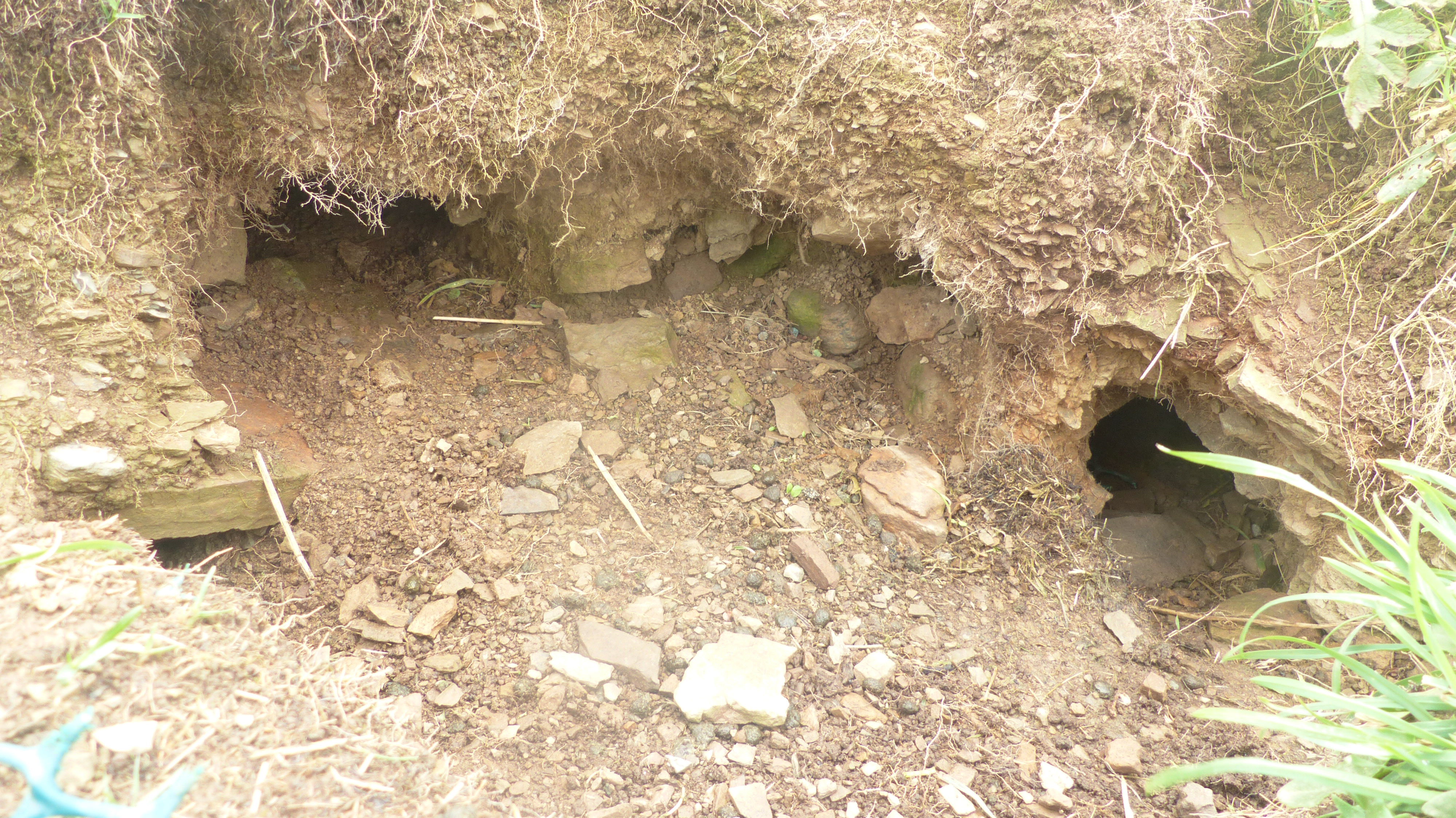
2016 inside one of the burrows a modern artefact looks like someone was digging illegally. August 13th
Image credit: wideford

2016 inside one of the burrows a modern artefact looks like someone was digging illegally. August 13th

The Spittal Broch in Watten is to be preserved when the quarry is extended johnogroat-journal.co.uk/news/will-the-spittal-quarry-extension-destroy-an-ancient-broch-366079/?fbclid=IwY2xjawGoSwtleHRuA2FlbQIxMQABHT6gG62i4oxDUPtQPisS0u68QZhigPDOEOFGivPTE874CPqysV3L-AS9zw_aem_wRE0m3xn93AAQz4cQjYApw
Spittal Farm aka Spittal 2 survives to 1.7m but has been damaged by ploughing canmore.org.uk/site/8336/spittal-farm

derived from aerial photo, dig end at top left


The Pict’s House/Fort” on Howe Hill, aka the ‘hillock Of Howe’ – RCAHMS record no. HY51NW 5 on Howe Farm – was an amorphous mound prior to first excavation sometime before 1880. What can be seen of the knoll is roughly 50 by 40 yards and reaches 11’ 6” at the higher end.
Excavation at the top revealed curving drystane walls, After excavation the structure was filled in, but there were still ruins visible in 1923. The Pict’s House structure is thought to be a broch, though a more recent opinion has it as more like an unenclosed settlement, A solstitial alignment to the Mor Stein to my mind indicates an earlier origin or purpose to the whole
I could get to within a field of it all around and only saw a grassy mound. Having a large circular walk to finish I left it in peace.
John Bews says “from the mound at Howe the sun rises on the longest day, I think, directly over this stone. Moor Stone may have been quarried some distance south-east of Castle Bloody...” Howe Hill canmore.org.uk/site/3097/shapinsay-hillock-of-howe as distinct from the Hillock of Howe
Discovered this week in Onziebist tomb during UHI visit archaeologyorkney.com/2023/06/08/onziebist-rock-art/?fbclid=IwAR1ovcs1PTrrFKdwMDu_EUrUgoLcXpr-VU783UjpmCjHLzyF4Mca-q3KDBw
but other avenues to be looked at for the future facebook.com/TomboftheEagles/posts/pfbid0ASDnb2oBjnVJfbgdZsV2kdtd2hyBbJC5TAaPrXUoR5V6MW1DKfYTdFb1Rt2vX4aZl?__cft__[0]=AZVp7M7sXrIc8tmt8Z5WSLRBX908ZbNR7q-wV9nHEF-XtyefAfQBb6nd41oIh1rmJ6o_gcHMJJ9vPZzF1NyXuoIa6z6xsg2M1MV2gdFzpPAUDZM2fnQuXFdG-FRoMdqiMhOwlYxJ_uymIK494-rPnjAdSOJLFNXNkBShO3YHCvgb5A&__tn__=%2CO%2CP-R

Bing Satellite with ? 19th century trenches (when a quern, knocking-stone and mace-head discovered)


mound from main road – there is a short arc of material between the front and back fieldwalls.

view with shore structure

coursed masonry walls with ?chamber

N end of mound, kirk site is behind sea wall right


LH side; flag wall coming out of mound at right-angle, perhaps marking end of site

view from above of flag wall etc

from above looking along cliff-face with Gairsay in the distance (site is opposite Holm of Rendall, nothing apparent there)

another view of cell

looking into cell’s open end

coursed masonry including 2 contiguous walls

edges of two adjacent structures ?

mound and structural remains in the shore

looking down on structural remains in the shore
NMRS record no. HY 42SW 12. The way I went to the site requires low tide. By the Hall of Rendall the millburn enters the sea and you follow the shore from there. Some general features are apparent with a variety of construction techniques. It feels like the cliff isn’t natural but all mound material, and this appears to be born out by the rise to a low promontory at the N end close to the kirk site. Antiquarians deemed it a broch, though nowadays the more generic term of Atlantean roundhouse is preferred (“2 main sections of massive walling” with “coursed masonry and vertical slabs” seen as intra-mural). An alternative conjecture specifically related it to the Knowe of Nesthouse chambered mound, though the similarities strike me as superficial from a distance. From the main road you can make out the short arc feature between the field walls at the south end that shows on Canmap. If this were a roundhouse settlement you would expect more of these even with what is left of the site. If it is all we have of a broch tower perhaps the promontory is the outer bank for the outworks. We needn’t stick with any of the above, seeing it instead as a sequence of various Iron Age settlement types rendered higgledy-piggledy by time and erosion


As you leave the broch take the road up until you see a large hut on your right Facing this open the gate to your right and then the gate beyond that, closing both behind you. Look left to the ruined croft and the settlement mound is just in front. The pre-broch settlement or ‘homestead’ covers some 28x18m and is up to 1.5m high, and was originally at least 10m more inland than the present 15m. A modern wall crosses the site, obscuring the interior. Wide turf-covered banks up to 3m ht. surround a 13mD central structure with an uneven dished sub-circular interior where loose stones indicate a later insertion (Viking fortlet or a planticrû ?). On the S side entry to the structure is by a 3m passage though the enclosing banks. At the NNW a semi-subterranean passage or intra-mural gallery has become blocked by stones in recent decades [I know this because a fellow Brochaholic got in once]. On site it feels to me like Castle House in East Holm, where, near to the broch site at St Nicholas Church, a square building (likely Viking) has been placed within an earlier circular structure
NMRS record no..ND49SW 2
Traditionally a passage connects the Little Howe of Hoxa to the Howe of Hoxa, but Petrie found no traces.- Wainright’s avenue is declared to be one of several linear stone clearance heaps. When Petrie investigated (through partial excavation) the already disturbed mound he found a central structure within two curvilinear concentric walls having a passage approx.. 2’ high and 12-16” wide at the base increasing a little in width at the top. The wall combo was ~21’ wide either side of the entrance then decreased to 13’ wide, and enclosed an irregular central chamber of 20’D. Inside a gallery extended behind the wall. As well as a southern ‘doorway’ cut down to the bedrock there was another passage opposite connecting to the ‘inner court’. Both entrance passage and gallery passages were lintelled.