The Modern Antiquarian. Ancient Sites, Stone Circles, Neolithic Monuments, Ancient Monuments, Prehistoric Sites, Megalithic Mysteries

Miscellaneous Posts by GLADMAN

Latest Posts
Previous 20 | Showing 21-40 of 135 miscellaneous posts. Most recent first | Next 20

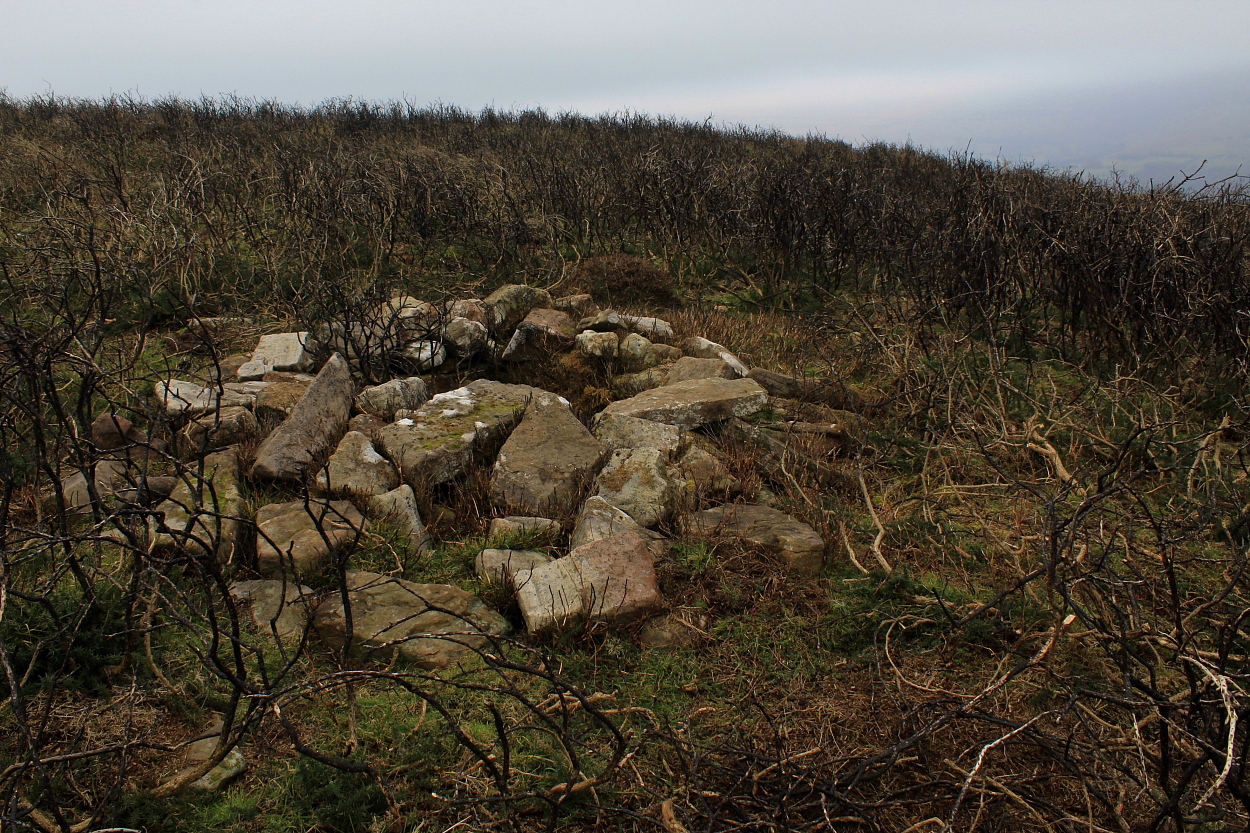
Arenig Fach (Cairn(s))

The Gwynedd Archaeological Trust has the following to say about Carnedd y Bachgen - the great cairn surmounting Arenig Fach - under PRN4727:

1) 'A circle of stones about 33ft in diameter represents all that is left of Carnedd y Bachgen. The material of the cairn has probably been taken to construct an ordnance cairn about 100ft to the W.

2) A flat topped cairn 11m in diameter and up to 1.4m high. The top portion may well have been removed to form an old trig station some 37m to the WSW. This in turn has been superceded by a modern trig-pillar immediately beyond it and now forms a windbreak....

3) The structure cannot be a hut circle, in view of the altitude (880m OD), its very exposed position and the very rough interior space, which is composed of large slabs of rock and bedrock. In addition the NW edge of the wall is at a lower level, below a small scarp of rock.'

[Sources: Merionethshire , Royal Commission on Ancient and Historic Monuments (1921); SH84SW 2 , Ordnance Survey (1974); Prehistoric Funerary and Ritual Sites Survey: Meirionnydd , Smith, G. (2001); Archaeology in Wales , Crew, P. (1985)]

Llys-y-Cawr, Allt Dolanog (Hillfort)

The 'Giant's Hall' is a pretty obscure hillfort offering panaromic views over the magnificent Mid Walian countryside... worth the short, but very steep climb from the road for those alone, in my opinion. The relatively well preserved defences protecting the easiest approach are a bonus, so to speak.

According to Coflein:

'A roughly oval enclosure, set in a saddle towards the summit of Allt Dolanog, c.164m by 86m, defined by an irregular plot of bank & ditch, facing rising ground, with a possible inner circuit, resting on steep natural scarps on the S. An annex is defined by a bank extending c.90m to the E. The site of a holy well lies immediately to the W (Nprn32421). The surrounding area shows traces of plough-cultivation.(source Os495card; SJ01SE2) - J.Wiles 07.01.04'.

Hmm... a holy well, too.

Afon Y Dolau Gwynion Chambered Round Cairn (Chambered Cairn)

Very obscure one, this.... doesn't feature upon any OS map I've seen and Coflein (currently) have no details either.... However CPAT (PRN 7820) have this to say:

'Discovered during rapid upland survey in 1993. Roughly rectangular chamber with 3 orthostats on the NE seeming to form a constricted entrance. Capstones missing. Chamber surrounded by low stony bank probably the result of digging out the chamber from its covering mound and augmented by modern dumping. Most closely resembles a passage grave but other exemplars of that group are distant. The upland situation is unusual for chambered tombs in N Wales (Gibson, 2002, pp2-4).'

So there you are. One of Wales' great lost tombs, perhaps?

Carnedd Gerrig (Cairn(s))

I stumbled across this fortuitously since the fenceline to the wonderful Afon Y Dolau Gwynion chambered cairn bisects the monument. Not a great deal left, but bonus sites are always welcome. Great position, too.

No doubt as to 'authenticity' since, according to our friends at Coflein, the site is:

'A much ruined round cairn, 9.0-11.5m in diameter, a cist was observed and an urn recovered, c.1830.(source Os495card; SJ02SW9)
J.Wiles 25.09.02'.

Ring Hill (Hillfort)

Essex HER (SMR 151) quotes the following summary of this fine hillfort (as mentioned in my fieldnotes I was very taken with the site in a 'Wallbury' sort of way. However I must reiterate that there is currently no public access to the site. Far from it):

'Oval hillfort of uncertain date but typologically it is thought to belong to the Early Iron Age. The defences, which are considerably strengthened by the lie of the ground, consist of a wide ditch with intermittent traces of an internal rampart. There are four gaps in the defences, but the original entrance cannot now be identified. The ditch varies in size, but is c.15.25m wide and 4.5m deep from the summit of the scarp and 1m from the summit of the counterscarp. The total area enclosed is about six and a half hectares and the whole site is thickly planted.'

Seaford Head Bowl Barrow (Round Barrow(s))

Incredibly... this denuded bowl barrow, standing within the north-western arc of the hillfort, has a golf bunker cut into its easten flank. Yeah, you really, really couldn't make it up, particularly since this is supposedly a scheduled ancient monument (no. 27025).

One wonders if General Pitt Rivers, who excavated the barrow in 1876, played golf? I would hope not. Whatever, the game and its adherents have had - and continue to have - a very detrimental effect upon our national heritage. And for what? Shame on them.

According to HER (ref MES1704) the general found '....pottery fragments, broken and polished flint celts, flint saws and some charcoal' in two holes near the centre of the barrow. HER also notes that 'Other flints, including a barbed and tanged arrowhead were found in other parts of the barrow. The finds are in the British Museum. There was no trace of a burial'.

Dinas [Beddgelert] (Hillfort)

Far less well known than the enigmatic Dinas Emrys sited a little way further up the course of the nascent Afon Glaslyn to the approx east, this fortified hilltop nevertheless looks well worth a visit, despite an apparent paucity of visible remains.... particularly when viewed from Moel Hebog in vibrant Autumn light.

According to the local Gwynedd Archaeological Trust:

'small precipitous hill with a fairly level top measuring c.110m NW-SE by 5.5m. Parts of the circumference not naturally impregnable are protected by a single wall of roughly laid dry masonry now barely traceable. The entrance was from the NW. The interior contains no certain dwellings, but one or two slight hollows may be hut sites. Condition: almost destroyed'.

'the wall is visible as a low scarp for a length of 40.0m on the N side of Dinas. The entrance could not be identified......'

Pen-y-Gurnos (Round Barrow(s))

Coflein is pretty succinct regarding the summit mound of this small peak, standing sentinel overlooking the fabulous valley of the Afon Doethie in wildest Mid Wales:

'Sitting under trig point. Prominent barrow, c. 14 paces dia. Good circular kerb to SE. (TA and HJ James visited 1998.11.29).'

Tor Beag (Hillfort)

According to Canmore:

'On Tor Beag, a rocky promontory, is a once strong stone-walled fort measuring internally about 220' by 80' within a ruinous wall enclosing the summit. Some 20' below summit level is a second line of defence mostly represented by a terrace. At the approach to the fort, along a narrow neck, is an outer wall of massive boulders (Feachem 1963). Many flint arrowheads have been found in the neighbourhood (Grant 1885). A Grant 1885; C G Cash 1910; R W Feachem 1963.'

Balnacraig (Long Cairn)

According to Canmore records Dr J Kenworthy (6 May 1974) had (unspecified) reservations about this being a bona-fide prehistoric long cairn....

'A possible long cairn of bare, tumbled stone with many disturbances, 2.5m in maximum height by 35.0m long including horns, 4.0m long, at the E end. The sides are straight. The forecourt between the horns is c. 16.0m across and appears to have been blocked by boulders in front of where the facade would be expected to lie. The S horn shows disturbance and later walling. The W end is 4.0m - 6.0m wide and 1.35m in maxiumum height. At a point 21.5m from the W end, the cairn narrows and there is a 5.0m x 3.0m bite out of the S side; then there is a minor rise to c. 1.5m and a steep fall to the forecourt. The plan and prrofile (sic) of the cairn suggest two phases of construction.'

For what it's worth, I've never seen a long clearance cairn with horns (incidentally there is a prominent 'bite' taken out of the southern flank, presumably the result of quarrying) so must, on balance of the visual evidence, concur with the OS who (on the latest 1:50K map) have no reservations about Balnacraig's authenticity. Not to mention Drewbhoy.

Crugiau Cemmaes Defended Enclosure (Hillfort)

According to Coflein a 'Defended Enclosure' - or hillfort, if you prefer - once stood beside the Bronze Age round barrows to the north of the road:

'Cropmarks recorded during RCAHMW aerial reconnaissance on 27th July 2006 show the remarkable traces of a large oval, bivallate defended enclosure measuring approximately 216m NW/SE by 126m SW/NE, enclosing some 2.02 hectares. This joins a wider complex which includes a banjo enclosure to the south-east (NPRN 410167) and a summit cemetery of Bronze Age round barrows.

T. Driver, RCAHMW, 26 Jan 2010.'

Crugiau Cemmaes (Round Barrow(s))

This grouping of Bronze Age round barrows would appear to have been reused during Roman times - if reported finds are anything to go by - which, of course they probably are. According to Coflein, the southern most round barrow is:

'A sub-circular barrow, 25m E-W by 23m, one of a group of at least four, said to rise 1.7m to 3.0m high: digging into one of these barrows, reported in 1695, produced five 'urns'& a great quantity of burnt bones & ashes; five coins, including an issue (possibly gold) of Otho, are said to have been found here.'

Carsegownie (Cist)

Unfortunately wasn't aware of this at the time of my recent visit to Finavon - that just being a 'stop-off' en route to Aberdeen - or else I would have taken a look. Seems worth the effort. According to Canmore:

'A cist found before 1842 is preserved in its original site in the middle of a sub-circular "artificial hillock", composed of stones and earth, about 30 paces in diameter, from 8 to 10ft high, and called the Roundie. "The bottom of the grave is about 3ft below the surface, and was composed of six separate flags of freestone, all of which remain except the top. It is about 4ft long, by 2ft broad, and lies due north and south. A stone urn was found in the SE corner and two stone dishes with handles or ears, resembling those of 'luggies'. No bones, weapons, or personal ornaments were to be seen, but the urn was about half full of black ashes." The urn and "dishes" were given to the late Mr Charles Gray of Carse Gray.
A Jervise 1859; New Statistical Account (NSA) 1845.

A round cairn 30m in diameter and 1m high surrounded by a retaining wall. The cist cavity, 1.3m by 0.6m by 0.3m deep remains but no slabs were noted. It is possible that these are obscured by the vegetation which covers the cairn. A few large stones lie around.
Visited by OS (JLD) 21 August 1958.'

Greens Moor (Cairn(s))

One of two relatively substantial round cairns located to the south of the Greens Moor long cairn [along with numerous other small (clearance?) cairns], this tall, well defined monument is described by Canmore thus:

' This well-preserved cairn now appears as a heather-covered mound, composed of small to medium sized boulders. Circular on plan, it measures 11.3m in diameter and 1.7m high, exhibiting a fairly regular, bowl-shaped profile on all sides except the S, where severe stone- robbing has taken place. RCAHMS 1978, visited 1975'

Another lower, less well preserved round cairn is to be found nearby. Unfortunately I was unable to get any images during my visit due to ever-worsening weather conditions, although the Canmore database has some worth checking out.

Scaut Hill (Cairn(s))

This hill, a 586m eastern outlier of Tinto, is also crowned by an ancient cairn, although - at c1.2m high and 13m diameter (according to Canmore) - it is much less substantial than Tinto's extraordinary c6m high monument. But then since Tinto is quite possibly Scotland's largest upland cairn, of course it would be, wouldn't it?

Deerleap Wood Barrow (Round Barrow(s))

Searching The Heritage Gateway I found the following concerning the fine bell barrow situated within Deerleap Wood, part of the private Wotton Estate:

"Name: Bell barrow in Deerleap Wood
List Entry Number: 1007878

The monument includes a bell barrow situated on the rise of a gentle north-facing slope in an area of greensand. The barrow survives as a centralmound 25m in diameter and 2m high, surrounded by a flat platform, or berm, up
to 6.5m wide. This area is contained by a ditch 4m wide and 0.5m deep from which material was quarried during the construction of the monument. Beyond the ditch is an external bank 4.5m wide and 0.4m high. The overall diameter of
the monument is 55m. The barrow was partially excavated in 1960 when the construction of the mound was found to include an inner mound of turf erected over an inhumation burial. No skeletal evidence however was preserved due to the acidic soil conditions. The turf was then covered by stone capping over which sand was piled. Two artefacts contemporary with the construction of the monument were found, a whetstone and a flint tool. Additionally over a thousand Mesolithic worked flints were found, showing that the barrow had been constructed on a much earlier flint working site.

Book Reference - Author: Corcoran, J X W P - Title: Excavations of a bell barrow in Deerleap Wood, Wotton - Date: 1963 - Journal Title: Surrey Archaeological Collections - Volume: 58 - Page References: 1-18 - Type: DESC TEXT"

Loxidge Tump, Black Mountains (Cairn(s))

Another of a series of Bronze Age funerary cairns which surmount the most easterly ridge of The Black Mountains, this also doubling as the England/Wales border.

The Loxidge Tump cairn, well sited overlooking Cwm Siarpal and the beautiful Vale of Ewyas, is most directly reached via a popular path ascending from Llanthony Priory to the Offa's Dyke Long Distance route, the latter following the aforementioned ridge. As such, the Mam C and I have walked right by the monument without realising what is was. Doh!

According to Coflein it is 'A cairn, 6.5m in diameter and 0.7m high. (source Os495card; SO22NE8) J.Wiles 03.09.02'.

Not much to go on, then.

Wiral Cairn, Black Mountains (Cairn(s))

I make this denuded monument to be fractionally across the English border... although, to be honest, lines upon maps mean nothing up here. The Offa's Dyke Long Distance Path runs right past the western flank.

Nevertheless, Coflein have the cairn recorded as:

'A centrally disturbed cairn, 14m by 12m and 1.4m high. (source Os495card; SO22NE13)J.Wiles 03.09.02'

Beacon Hill (Round Barrow(s))

Although not marked upon either the 1:50k or 1:25k OS map, the denuded mound at the northern extremity of Beacon Hill apparently represents the remains of a round barrow... according to Buckinghamshire HER:

"Late prehistoric round barrow excavated in the nineteenth century and re-used as a beacon and Second World War gun emplacement.... Length 0600 cm Width 0350 Height 0091....Excavated by B Burgess. Found bone fragments, a horse's tooth, a lttle charcoal & coarse brown & black pottery (B1)...." HER Number: 0091000000.

Carn-y-Geifr, Drum Ddu (Round Cairn)

The 'Cairn of the Goats' represents the remains of a Bronze Age round cairn - presumably funerary in nature - surmounting Drum Ddu (The Black Ridge) which rises a little to the south of the village of Llanwrthwl, near Rhayader.

According to the Clwyd-Powys Archaeological Trust (record PRN897) it is:

'15.9 m long N.-S. by 13.1 m wide and 0.9 m high, attaining a height of 1.5 m on the N. owing to the fall of ground in that direction. On the W. side of the cairn is a projecting platform of partly-turfed stones, extending 5.5 m from the perimeter, 4 m wide and 0.1 m high. The centre is much disturbed and a rectangular sheepfold 4 m square, 1 m high. entrance to the S. has been erected upon it. O.S.Card SN 96 SE 11'.

Although clearly not having survived the millennia that well, the cairn is nevertheless well placed and thus a fabulous viewpoint... particularly looking north along the course of the River Wye towards Rhayader. Consequently an ascent is recommended via the fine cairn cemetery of Carnau Cefn-y-Ffordd, below to the west. Note that there are numerous other Bronze Age cairns in the vicinity, in particular upon Y Gamriw across the valley and further east.
Previous 20 | Showing 21-40 of 135 miscellaneous posts. Most recent first | Next 20
Citizen Cairn'd....... every monument blows me away... but in particular those highland piles of stone. Visiting them, I think, helps ensure those ancient Bronze Age pilgrimages remain relevant, even in this so called 'modern age'. And hell, it makes me feel good, truly alive, on top of the world in the most literal sense... at one with Nature. If this sounds trite, perhaps it is. But nonetheless there are occasions I concur with Elizabeth I's last words... 'All my possessions for a moment of time'.

Suffice to say mine is therefore not an exercise in dryly cataloguing sites for the benefit of future generations - as much as I might try I haven't yet been able to embrace altruism to that extent - but rather an attempt to try and reconcile why I am so incredibly moved by these constructions of stone and/or earth representing a time when everything was, by all accounts, literally a matter of life and death. Yeah, just as an empty house appears to retain echoes of past humanity... the raw emotion that apparently sets us apart as a species... so does the stone circle, the chambered cairn, the long barrow and the mountain top funerary cairn. We may be able to only guess what forms the human interaction may have took - but clearly it mattered. A lot.

I make no special claim for my contributions, particularly since the majority of my earlier images are (variable quality) scans of archive prints.... and my opinions are, well... those of an enthusiastic amateur with a bog-standard education. Consequently I'd recommend visitors to TMA refrain from taking my - or anyone else's - word for anything... go see for yourself and post what you think / experienced. Yeah, make up your own mind. Be inspired, be inspiring, be magnificent (as Ian Dury once said) ... but most of all, my friends, be you! There can be only one.

In a society of computer generated fantasy, however, a word (or two) of caution. Please be aware that reaching some of the more remote upland sites in the British Isles can be potentially dangerous - even life threatening - for the unprepared. Yeah, this is not a drill. Treat the landscape and weather with the respect they deserve and you won't go far wrong. If in doubt, pop a question in the Forum. That's why Mr Cope puts up the readies to run TMA.... Thank you Julian.

So cheers... to Mr Cope for being his inspirational, confrontational self, showing that field archaeology can be FUN! - hey, who'd have thought it? ...to my sister (Mam Cymru) for using her female 'macro' vision to help me see the detail throughout an ongoing re-exploration of the South Walian uplands, albeit upon dodgy ankles etc... to my own mam for insisting 'young men should have adventures'.... and my Dad for unwittingly inspiring a profound love of high places. Oh, and to Aubrey Burl for simply being 'The Man' by blazing that trail.

Some of Gladman's other inspirations include (in no particular order.. except for Darwin):

Charles Darwin (for his peerless humanity... amongst other things...); George Orwell (the strength to change one's mind in light of new evidence); Michael Collins; Winston Churchill (for all his faults); Martin L. Gore; Richard Dawkins (much maligned, yet - by and large - helping to carry the torch of reason during an age of apathetic resignation); Shane MacGowan; Sophie Scholl; W A Mozart; Manic Street Preachers; Pat Jennings; Stuart Adamson; Will Shakespeare; Harry Hill (there's only one way to find out!); Mr Beethoven; Claudia Brucken (so Germans don't have passion?); the (Allied) generation of WW2 for making all this possible; Marc Almond (what does it take to be a man?); Stan Laurel and Oliver Hardy; Christopher Hitchens; Harvey Milk; John Le Mesurier (do you think that's wise, sir?); Ralf Hutter and Florian Schneider.... not to mention anyone who has ever asked 'Why?' - the true legacy of punk. Last but not least, Gaelic beauty Karen Matheson... 'the call is unspoken, never unheard'.

George Orwell - '...during times of universal deceit, telling the truth becomes a revolutionary act'....

Martin L. Gore - 'Like a pawn on the eternal board; Who's never quite sure what he's moved toward; I walk blindly on....'

Truman Capote - 'Failure is the condiment that gives success its flavour'.

Mark Twain - 'Why shouldn't truth be stranger than fiction? Fiction, after all, has to make sense'.

Frank Zappa - 'The mind is like a parachute. It doesn't work if it's not open'.

My TMA Content: