The Modern Antiquarian. Ancient Sites, Stone Circles, Neolithic Monuments, Ancient Monuments, Prehistoric Sites, Megalithic Mysteries

Previous 5 | Showing 6-10 of 702 posts. Most recent first | Next 5

Circles, monuments, crashes, and floods.

It's five in the morning and the day is just dawning and once more the A55 takes me to the place that an ancestor called home, a million miles from all my problems, it is where my heart lies, it is called Snowdonia.
I wasn't totally sure where to go, one thought was Tre'r Cieri, but low funds and a late night made my decision for me, it was to be an Equinox sunrise at the Druids circle above Penmaenmawr.

I decided to save time and take the car up the track as far as it would go, passing the twin pillars the track gets rutted and pitted, so much so that I decide this is the one and only time I shall take it up this far.
Coat on, camera over the shoulder and I'm off up the path, rounding a small hill the wind hits me like a mad Yeti, cripes that's cold, for a fleeting moment I think this is far too cold I'm going back, but that's not the postal way either so I quicken my pace, keep my head down and keep moving.
I pass Red Farm remnant stone circle and Maen Crwn with barely a glance, time for that on the return trip. Out of the damning cold wind I reach Brian, otherwise known as Circle 275, I say "alright Bri" and turn to check on the suns progress, bugger, it's already risen, so I run the rest of the way up to the circle of the Druids.

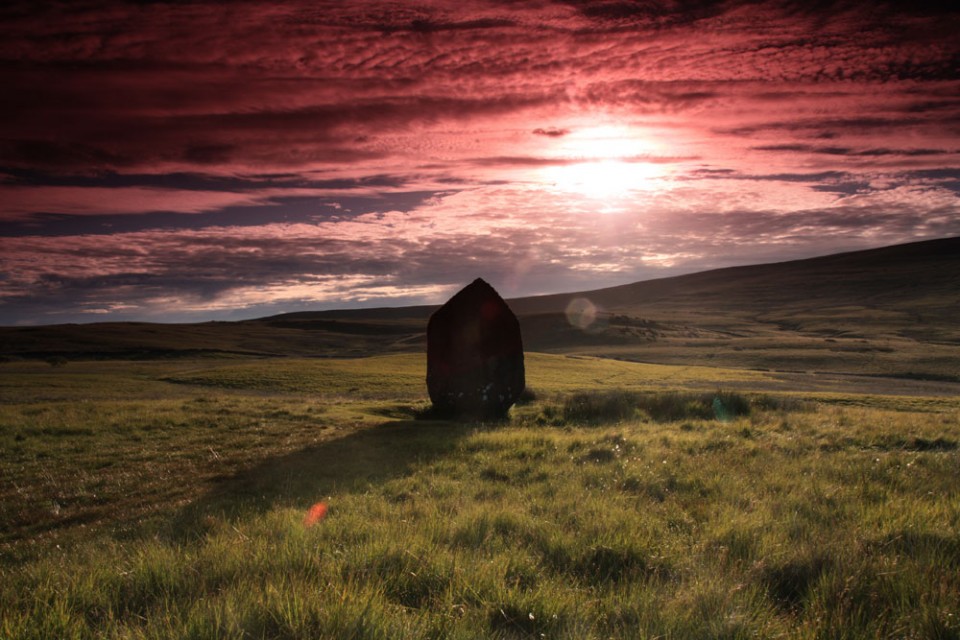
It's as perfect a day for a sunrise as ive yet seen, and ive been watching the sun on the solstices and equinox's for over a decade. The sun rises probably not fortuitously over the highest part of the hills Cefn Maen Amor on the near horizon, this is not perfectly east, but if the land was totally flat it would be too far north of the highest point, but because the sun has had time to move through the sky a bit, it does rise above the highest point of Cefn Maen Amor.
On the other side of the circle from the sun I am standing on a small mound, for a moment I wonder if it's man made, perhaps for people to stand upon whilst watching the equinox sunrise from, I look over to my left and note another mound, almost perfect for watching a winter solstice sunrise. There is no mound for the summer solstice. Was it perhaps not deemed as important as the other two ? Are they actually natural mounds, but the stone circle was placed there because of them. Between the two mounds an ancient track passes by. Ive always wondered why the circle is sited right on the edge of the land before it falls steeply down to Penmaenmawr. In between the big hills (Tal y Fan) and the steep down hill fall there is plenty of room to put a stone circle, granted most of it is pretty boggy , but why right the way over here on the edge. I feel I could be onto something, but it could be just a feeling. On the east side of the circle is another mound possibly in just the right place to see the sun set on the winter solstice, it should also be said that from the sun rise mounds the sun rises right across the middle of the circle. Oh for a central tall megalith..

This is easily the best stone circle in Wales.

From there I take the short walk to the conundrum that Ive called Thora, less enthusiastic folk call it Monument 280, where are the other 279. Just to the north is Kevin, a ring cairn called Circle 278. Both of them would have brought me here on there own, but there is so much more up here. I then walk up to the top of Moelfre, a small hill with big views and a much denuded cairn, but it seems less denuded than before somehow. I sit here for a while watching clouds drift over the snow topped mountains to my south, resisting the urge to run over and climb one. That'll happen soon enough.
I run down the hill, always a fun thing to do, but less fun than with Eric pulling me, urging me to go faster.

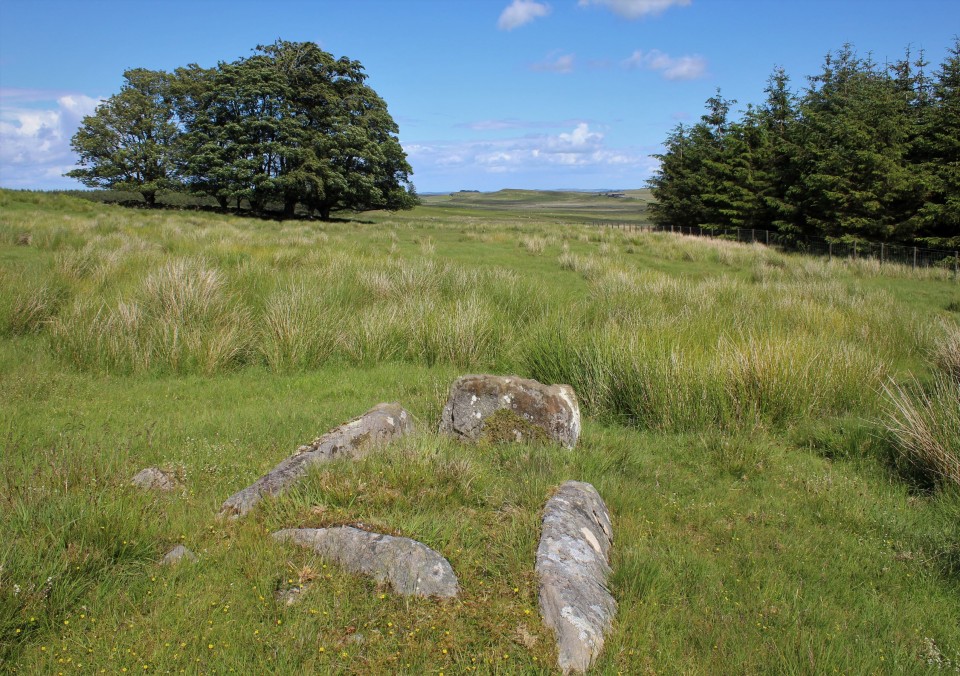
Cors y Carneddau is my next port of call, a large barrow with a scooped out interior, a very decent kerb cairn , a less decent ring cairn and a fairly knackered hard to discern stone circle, the kerb cairn and the barrow are in my opinion wonderful to behold , second only to the Druids Circle, and the views of the mountains, which are almost overpowering.


From Cefn Coch barrow I skirt around the base of becairned Moelfre following the path towards two cairns called Bryniau Bugeilydd. Passing the site of crashed WWII bomber " Bachelors baby " a B24 Liberator, they were probably looking for stone circles and never saw the hill coming.
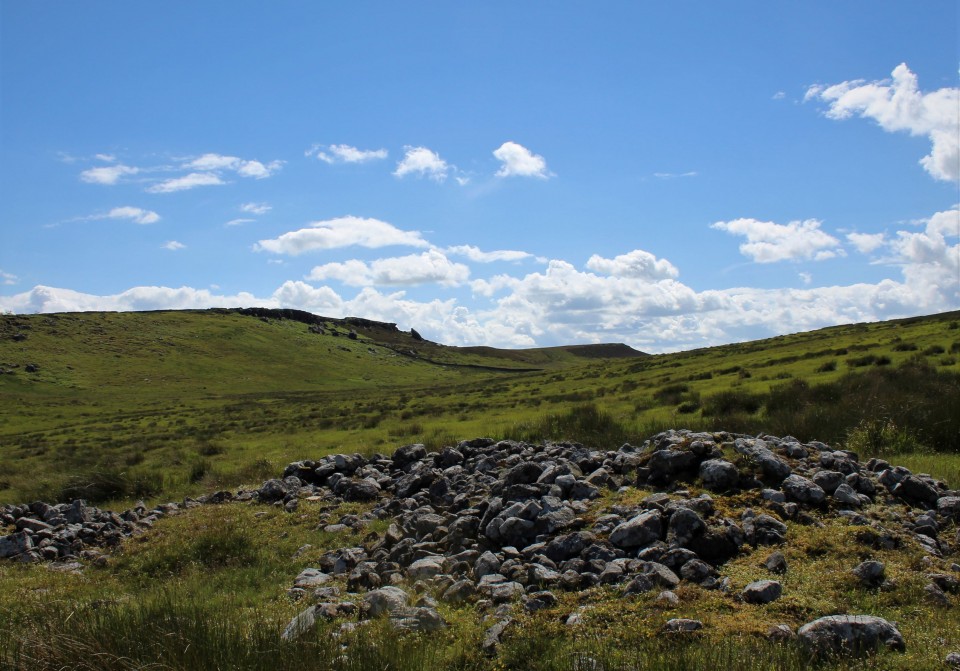
Coflein still isn't co-operating, so I didn't know what to expect, if anything. But I was pleasantly surprised to find the remains of a substantial kerb cairn. Half the kerbing has gone but those that remain are quite large, the interior of the cairn has a slight rise in ground level .
About fifty yards up the hill back in the direction of the Druids circle, is what I presumed must be the other cairn. It is heather covered and is either situated upon a rocky knoll or the whole thing is the rocky knoll, there was nothing else in the vicinity so I clicked the camera and moved on.

From there it's a second visit to Cerrig Gwynion, a cairn with a cist. Coflein state that the cairn is four meters high, it isn't, its barely one meter high
My second visit, but as i'm approaching from a different direction it's as hard to find as the first time.
then quickly back to the Druids, then a longer look at Brian, circle 275.
It's now time to go and get out of this biting wind, but just before I do there's just one more new site to see.
A mere fifty yards from Brian is this massively overlooked barrow/cairn, somewhat unfortunately named Fridd Wanc, with so many megalithic wonders here about it's almost understandable. About a meter tall and maybe five across this heather and grass covered mound melts seamlessly into it's surroundings, look for the telegraph pole uncaringly stuck right on top of it, blighters.

Back at the car I'm glad to be out of the cold, which I'm glad to say didn't affect me too much. I leave the vicinity and head away.

I planned on looking for and hopefully finding Porth Llwyd portal dolmen. I knew from George Nash that it may not be findable as it is now descheduled by the Office of works and described as " Presumed destroyed by flood "
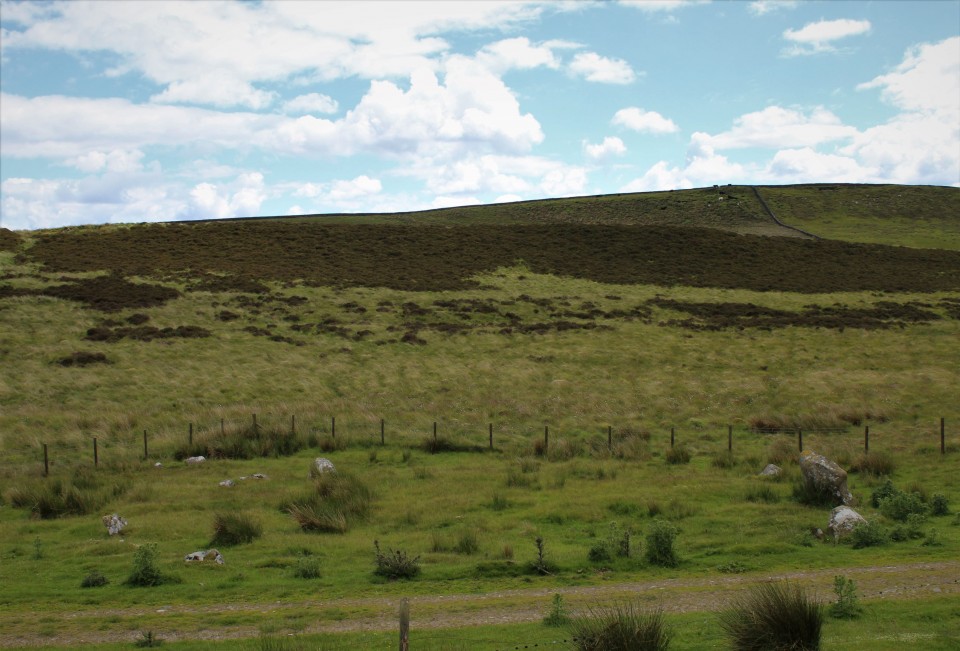
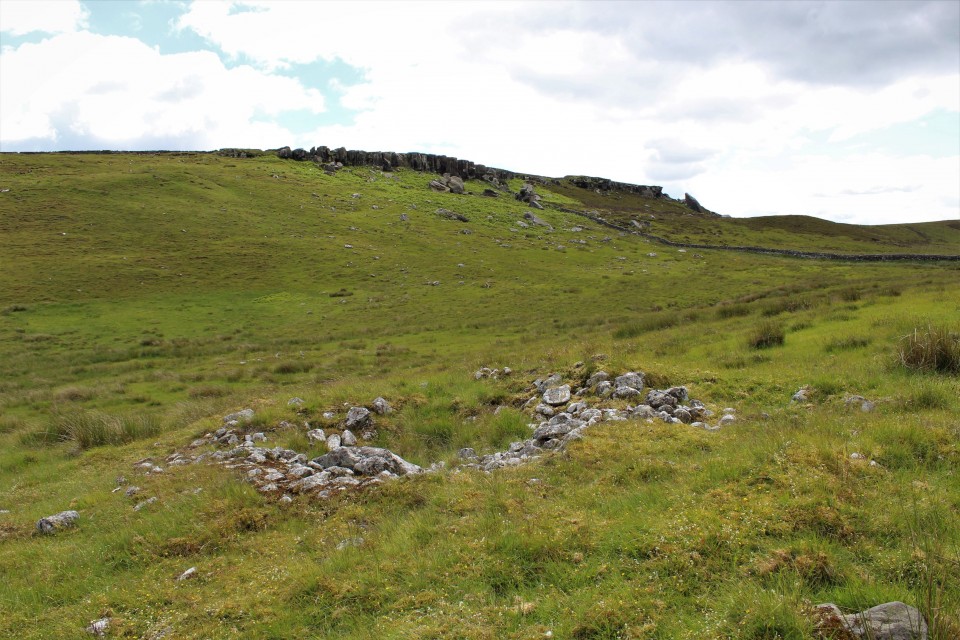
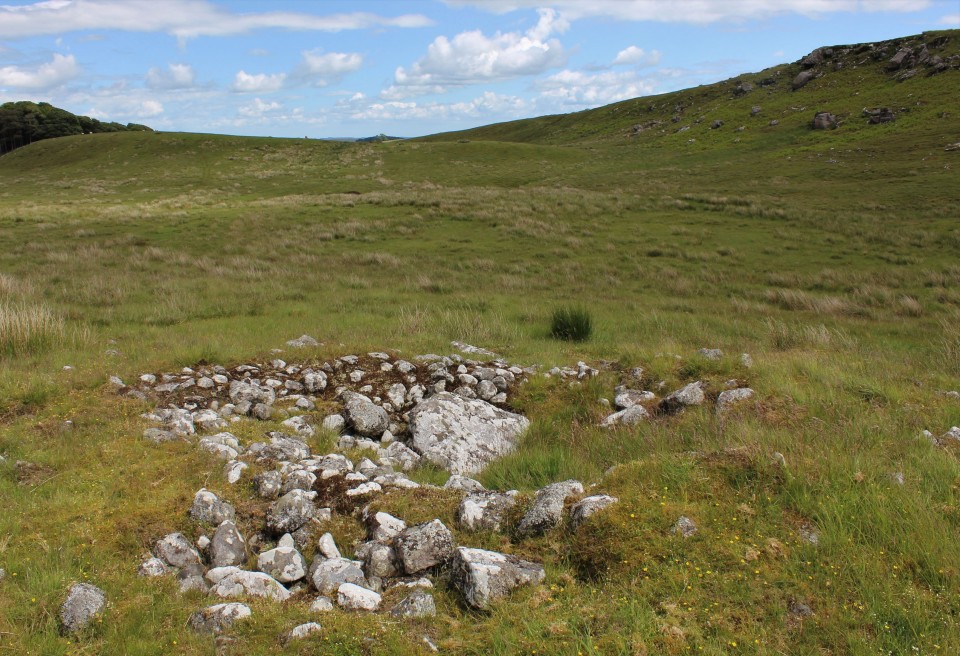
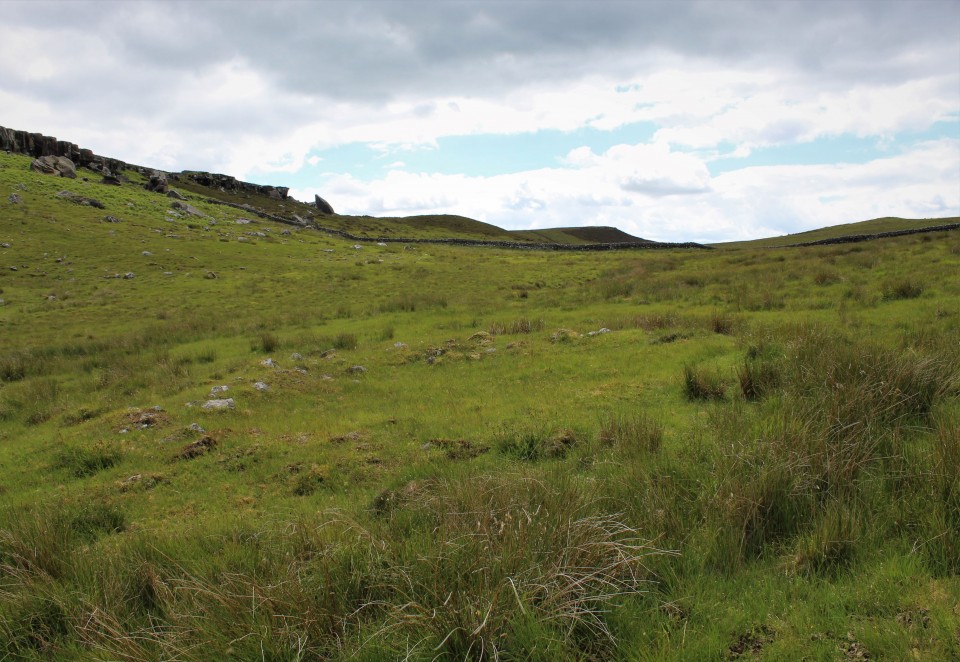
But I still hoped to at least locate the capstone, and one or two uprights could still be in place, but alas it was not to be, two hours of digging, scratching, going round in circles and wading through brambles all on what I supposed to be private property. I could find no trace of it, the Dolgarrog flood disaster (of which i include a photo of from the information board, not the actual flood, just a description of it) has taken it all away.

Only more hours spent searching round in circles can prove its destruction.
Any information about it's location would be greatly appreciated, it is not at the grid ref supplied by me here. (Taken from Nash)
postman Posted by postman
13th April 2013ce
Edited 14th April 2013ce

Evie to Rousay May 30th 2012

EVIE

Set off from Orkney Blide Trust on the minibus on a lovely bright day. Arrived at Tingwall, that is thing-völlr 'thing-field'. The long mound has two peaks, the first the top of the broch that was used as the assembly place (with stonework exposed in various places top to base) and the second where a mill once stood. Walking between the houses the millstream ends in a culvert beneath a high drystane wall bridging the banks. There are various ruined buildings. At the cliff edge one of these is an old boathouse, just about distinguishable from the rest. Since this visit one of the other buildings has been renovated and dolled up as Betty's Reading Room, with an old mangle and a large mounted grinding-wheel outside. This was done by locals after the sudden death of Betty, and to commemorate her there are masses of shelves full of books - something to do whilst waiting for transport. Looking to my right towards Banks a shadowed heron could be made out on the shore in the distance.

As the ferry left Tingwall I trained my binoculars on the mounds between Tingwall and Woodwick. The Knowe of Midgarth settlement (HY32SE 6 at HY39812361) is comprised of two sites - a long hillock that is a chambered mound (though thought by some to be a variation on a souterrain) adjacent to a circular mound. From the ferry at high magnification the disparity is plain to see, even clearer than from the farmroad to Tingwall. Previously I have seen similarities with the Howe of Hoxa, where a broch sits on the far end of a long mound (traditionally a Viking burial site), but if it isn't a settlement might it not be like the Head of Work where a circular cairn has been plonked on a long cairn later ?? The cairns are right at the edge of the low cliffs and from the ferry the material of the long cairn clearly extends down to the cliff base (or at least sea-level on the day).

BRINIAN

On arrival the first business of the day was a delivery of leaflets to the Rousay surgery, heading east and then down a steep short road to Brinian House. A fine two-storey house with pale lemon limewash walls below two pitched roofs (or a bayed roof). At least that is how the walls looked from the sea, where it resembles a rather tall kirk of the ordinary kind with a peedie pitch roofed portico centrally placed. There is an actual kirk close at hand. In fact there are two kirks, one no longer in use only a stone's throw away. You would think that the active kirk is the older one going by the arched windows but you can see from the tops that these are set into a rectangular space. Both are of the late kind, no great age to them, both with those [what I would call] porticos facing the sea [session houses ??] but with chimneys. The slightly older one has the graveyard behind it. This kirk took over the duties of the Swandro kirk when St Mary's Church became abandoned in 1815.

Our first real stop is Trumland House. From May to September all of the grounds and gardens can be seen by the public, and part of the buildings. Near the entrance is an information point where you also pay for admittance, though this is unmanned and you pay how much you want to. The vista is magnificent, with a magnificent sweep of road taking you round to the grand mansion house. It is half-hidden by trees from here and there is a small woodland/copse right of the road, eventually giving way to heath and gorse at the edge of Green Hill. The next point of interest is the boundary wall, with a gateway sans gate. The gatepillars are square and of mortared stone. They are topped with concrete capped tall pyramids, the whole distinctly out of proportion. To the left is a devil's gate, three staggered slabs set into the wall.

Raising your eyes there is a tomb under Historic Scotland's care on the horizon. In May 1898 workmen digging out a mound on Flag-Staff Hill, 300 yards west of Trumbland (sic) House, to make a summer seat found a 'vault' with bones etcetera (said to be similar to to a discovery near Hunclett farm described as unexcavated at the time, more than likely the Knowe of Hunclett). When the circle was almost done they came upon a well-finished wall and thin edgeset stones where the remains were found under a stone at the foot of one of these slabs along with rough pottery. Two more small 'kists' were found before they made the major discovery of the main body of the tomb under a 10" thick fallen lintel. This split-level tomb is now called Taversoe Tuick (HY42NW 2 at HY42572761). It dates to 2130~1740 BC. In the early 1990s the mid-morning sun was observed coming along the passage to the lower chamber on December 18th. Trevor Garnham thinks there may be an alignment involving the lower passage viz. burial cairn at top of Gairsay (HY42SW 15 at HY44112233) > the passage at HY42572761 > Holm of Huip cairn (HY63SW 4 at HY62823116) > Eday Church cairn (HY53SE 5 at HY56043344).

At the house the first thing you see is a small museum and picture gallery attached to the side of the main building. Light and airy. What I love is the agricultural machinery, most especially the wood and metal wonder that is the ~1880 combined corn and seed-dressing machine. Actually, the first thing to greet us is the family pet, a white and light tan hound. The house has been given crow-stepped ends to the end of almost every roof. Its front is chock full of big bright windows. Of note are a bay window at ground level and two pedimented windows on the first floor on the left and on the right a narrow corner window with a curved projection a little distance above. The cluster of small buildings already mentioned make for a more cluttered east side, these entered by an 'archway' pointed on top but ogival beneath. Compared to the front the back of the house is not so imposing. Appearances deceive me as this is really the front of the house with a studded wooden door held by massive black hinges which sits inside a round arched decorative stone doorway edged with a rope effect. In an horizontal cartouche above this sits the original owner's initials in monogram form, the date 1873 and other letters. A steeped line, part of a horizontal stone one going across the whole face of the house, sits over it. Touching the top of that is the bottom of a window, and I have only just spotted that above the window is a vertical stone cartouche about the same size, with what appears to be a shield inside (sadly eroding). Centrally place in a large space on the right-hand side is the piece-de-resistance, a much larger stone cartouche containing Burrough's coat-of-arms with flourishes and a rectangular plaque with his medals in stone form. The west end is the east sans additions. Now I can see another of those corner windows, except at the actual corner of the house, and the 'cornice' above. Still cannot divine a purpose for that - all that I am reminded of is the same feature at e.g. the Clay Loan end of Victoria Street and Neukatineuks in Kirkwall, but those are (they say) designed for carriages to pass safely round and are at ground level, not two floors up !! Later, on leaving the natural wonderland behind and coming back round to the south side of the house, re-reading my photos taken from the north elucidates my former error as to the mansion house's orientation. What I like about this place is the almost unadulterated symmetry of it, not being a hostage to sterile balance. It certainly looks like the house only went as far as the two corner windows. But even within that the left is dominated by the two-storey bay window with two narrow windows below two triangles the same width topped by roses whilst the right is dominated by a twin-peaked crow-stepped roof that does not touch the upper windows. The right-hand side is what ordinarily would be a main entrance slap-bang centre. Two sets of stone steps lead from the stone path around the chief lawn up to the centre of its facade only to bring you up abruptly at the window - no sign a door had ever been intended even ! Of course the lower steps do take you to a similar path across in front of the house as if on a gallery with views down.

Back to the day, and from the gallery we started for the gardens. Entry is under an arch set on pillars, the whole made from red sandstone now parti-coloured with pale lichen. Around Trumland House there are many items constructed from old ruins re-used. Whether this piece has been gathered together from scattered parts or is a (literally) monumental objet trouve I cannot tell. What first came to mind is the mediaeval St Olaf gateway sitting seulement in Kirkwall (transposed from its original setting). Yet it is nothing like, as I realised when I came back home. Oddly enough the remains of the Swandro kirk are amongst those used about the place. Secondly the arch struck me as a realisation of a whale's rib in stone. Nice curves carved along it. A few of the top stones supporting it are moulded and some with have horizontal grooves that may instead might be löwenkratzen 'lion-scratchings' similar to those att St Magnus Cathedral and at St Nicholas Chapel in Holm (kirk stone as medical treatment).

There are some huge gunnera inside and a woolly-leaved plant with a gorgeous long lamb's-tail spike, flowers I assume. Another leguminous plant on steroids has rings of yellow flower at intervals up the stem. Then there's an IIRC shorter plant with pink flowers apparently composed only of overgrown pink stamens with no petals looking like a motion-stop photo of milk splashing up. Opposite the orchard where a lone gardener is working black-and-yellow liveried insects coat the flowers in a border. Amongst them are more hornets than I have ever seen, so busy that I can only mage to snap one breaking into the top of what I take to be an ornamental thistle's closed apical bud. The air hums. From here we move on to Burnside Walk to walk amidst and under shading trees. I now know that the path to Taversoe Tuick trails out of this woodland. Oh I would want to spend hours here with the dryades and naides inspiring me. One enticing spot is a shady pool. The furthest away sides have rocky faces and a streamlet trickles over in the corner, watering micro plants as it flows down them. At another more open place a wooden footbridge passes over the burn. This is comparatively modern I'm sure. It is a light brown symphony of diamond trellis and spiky posts. There are straight and smoothly curved top rails to trail the fingers behind you. This is quite a mature copse for a 'modern' creation, with long bare branches creating patterns below the sun-searching leaves. All too soon for me the time comes when our party must peradventure to pastures new - though I do take time out on my way back to join the rest to see the final side of the garden.

WASBISTER

Everyone gathered up again we returned whence we came and made a weodorshins circuit of the island, round below Cubbie Roo's Burden up into Sourin and the (slightly) lower slopes of Faraclett Head, then down the long steady incline of Leeon to the east end of Saviskaill Bay. We then turned down by the east side of the Loch of Wasbister for our next stop lay on the low cliffs east of Saviskaill farm. By the fieldwall are several single-storey ruins. These are the Saviskaill structures (HY43SW 40 at HY40123340) about which the NMRS relates that on the 1st 6" map attached to the wall are 3 roofless structures but only one on the 1977 1:10,000. Really they are both right, as you can tell not only from the first 25" map but also by drilling down through RCAHMS own CANMAP ! In fact there may be another shown yet or the three includes this. At present it is a bit of a jumble. The definite single structure's doorway faces the end of the road. It looks fairly obvious that though they appear seperate stuctures the three are actually compartments, as it were, of one long continuous building. I think this started off with the central piece as this has the curving walls you normally associate with Orkney's late Viking / early Mediaeval period. This would probably go well with the Saviskaill settlement (HY43SW 24 from HY40153342 to 40133358). That the head of this shingle bay is called Nousty Sand, indicating a number of nausts for drawing boats up into, makes me hazard that this used to be a hope 'sheltered bay'.

Leaving the others to their repast I walked along the clifftop with a stupendous view of Faraclett Head looming up in the distance. After the sands come the hard rocks of the Riff of Wasbister. At the sea's edge large boulders shone white in the sun. These showed themselves to be seals basking in a line on the edge of a finger pointing into the waters.. It is the same on the Loch of Stenness where near the Stones of Stenness circle, where the distinction between seal and rock is so blurred visually that those not in the know will insist against you that one is the other unless movement visibly happens ! In getting a little closer I wandered over rocky plates amid pools left behind by the tide. Turning back I walked the shore the rest of the way back to rejoin the others. Where the minibus stood there is a jumble of rocks and slabs that seemed like archaeology to me. I did put it down to modern JCB activity, only realising weeks later that this must be one of the places where the Saviskaill settlement shows in the low shore banks even if it doesn't appear to be on NMRS record no. HY43SW 24 (from HY40153342 to 40133358), tentatively assigned to Norse times too. Mr Yorston of Trumland Cottage first brought it to the attention of officialdom. In 1972 Ordnance Survey noted drystane walling traces under present-day structures, along with some kitchen midden material. Came 1979 and high under the banks of the farm buildings some more walling had [?become] exposed, this time made up of very large beach stones (bringing to my mind the Lamb Holm settlement, now [IIRC] swept away). In the same year both these remains and the drystane walling are briefly described again, but with the additional info that the latter lay exposed for 28m - not sure if that stretches to the piece I saw [and I'm crap judging distances] but the SMR reports the former at the shingly bay's southern end with the farm itself on the north end !

Saviskaill 'sea-Hall' itself is a large complex of big farm buildings shining a golden yellow because the farm is almost entirely covered by lichen. It seems abandoned, or at least uninhabited, but is the kind o' place you could see being an attraction or mebbe a museum if someone threw a ton o' money at it ! Part of it at least has been a mill at one point (the one building with no lichen) because there is a sluice shown on a large-scale map by the wall nearest to me and I can see a rusty millwheel resting against the wall, a frame that I think is a bucket-type wheel (there is another such leaning against a building on the south side of the Lyde Road near Stenso). It is just such a magnificent place I would surely go into raptures if left to peruse up close for any length of time. And again a monument with no monument record as with that mansion house on Damsay. A visit to the Orkney Room comes up with no new information.

Returning to the party most of them decided to take a look for themselves, and I decided I would try and see if I could complete the foursquare circuit of road around the Loch of Wasbister 'loch-farm' before they finished and decided to move on. So I set off along the eastern side. About half-way along this side of the square-ish road surrounding the loch a tongue of land points into the water. The gently mounded promontory is called Bretta Ness, by tradition the site of a kirk - the 1880 Name Book says the stones from it were removed to the loch margins. It is almost completely artificial (though this is under dispute) but to my mind the rises in water levels make it unlikely to have been an isolated crannog as the neck would have been even more prominent in prehistory. A now underwater dump of stone is overlain by a masonry platform and then the whole covered by a mound 1.7m in height and ~30mD. This site has been used since at least Pictish times, possibly metalworking from what I've read (I'm minded on the Knowe of Verron in Sandwick). Exploratory digs found an E/W line of wall-footings with building rubble and lime plaster that could be taken for chapel remains. Over at the W end the site's first use may be signified by thick circular walls (aerial photography has also revealed a weed-covered feature in the loch west of Bretta Ness). Then there were what sound like beehive cells,. Subsequent buildings left very scant remains because of frequent robbing, but due to later re-use as part of a kiln setup a flagged floor and walls built into the earlier rubble did survive. Out in the water near the far side is what is thought to be a crannog (a large artificial island settlement), The Burrian, though the 1880 Namebook confusingly also gives this as the loch's chapel site, with finds of deer remains and coins and reference to possible earlier building. In 1912 "The Orcadian" tells us that this site (HY33SE 13 at HY39493338) was still connected to the west shoreline by the remains of a bridge (then a foot underwater) with a fault half-way. Later underwater features were observed where it met the shore but these are apparently buried now. A 1972 report tells us that the stepping stones start midway along the north-west side of a ?modern wall on the island and continued visibly in that direction for some thirty metres. This wall running around the island is sub-divided into two unequal enclosures, but salmonberry hides any internal remains there might be. There may be traces of sections of an earlier wall a metre or two outside this, and just above the waterline walling has been noted. The combination of an island, The Burrian, and a promontory, Bretta Ness, is highly reminiscent of the Loch of Wasdale in Firth where these features were seen as a kirk and its burial ground [the latter also shown on some earlier maps as an island].

A little futher along the loch meets the road. On the other side of the road here a 'drain' in an E/W aligned earthwork strikes off. Near where this ends at a field boundary there is a well/wellspring immediately south and a burnt mound no much further along but immediately to the north. The latter is called Everhaud (HY43SW 3 at HY40203310). This conical mound, also aligned E/W, is some fourteen metres by twelve metres and stands to a height of 1.1m. Projecting the line of the 'drain' brings you to the traditional site of St. Colm's Kirk (HY43SW 10 at HY40553307), by the shore near the NE corner of a field bearing the number 33 on the 1:25,000 map. All that can now be seen of this is a low rise on the shoreline beneath rubble placed to combat erosion, hiding the ?paving slabs and edgeset stones still visible as recently as 1972. One cannot but wonder if the worshipper left this kirk following the E/W line until they came to the Loch of Wasbister before finally taking a boat to The Burrian.

Looking over to my left above the Loch of Wasbister there is a large graveyard (now with an extension) that in 1880 was still attached to the ruins of Corse Kirk (HY33SE 14 3948 3361), all traces of which are now gone. Left again, by the main road, is the old Cogar school. North of this there is (though I didn't see it myself) on the south shore modern dumping over an irregular shaped rise covered in vegetation called The Bleaching Knowe (HY33SE 6 at HY39573316). Already in 1935 little remained of the 'burnt mound' apart from edge-set slabs in box arrangements at the water's edge. In 1972 there was little left of even these structures, and ten years later these too were out of sight. I phrase it thus because it is possible these still survive buried by trash or submerged by further loch encroachment.

Second leg of the road is the main road. Not enough time to check the knowe for myself, so I forged ahead in my bid to return to the party by the sea. Above this southern side of the road there is an old complex of farm buildings alongside the burn like a much reduced stature Saviskaill but without the lichen. I am especially taken by a long building, one half slightly taller than the other, with the two roofs formed purely from long flags (in an unusually good state for their age). This is Quoys. I had hoped to visit the graveyard just in case there is still something that relates to Corse Kirk (archaeologists can get 'hung up' on searching too tightly in a set locality). Before I could turn the next corner the Blide bus came haring along. Reluctantly I hopped aboard and we set off on the last part of our circuit of Rousay, heading off around the Mansemass and Ward Hills into Westness.

STANDING STONES

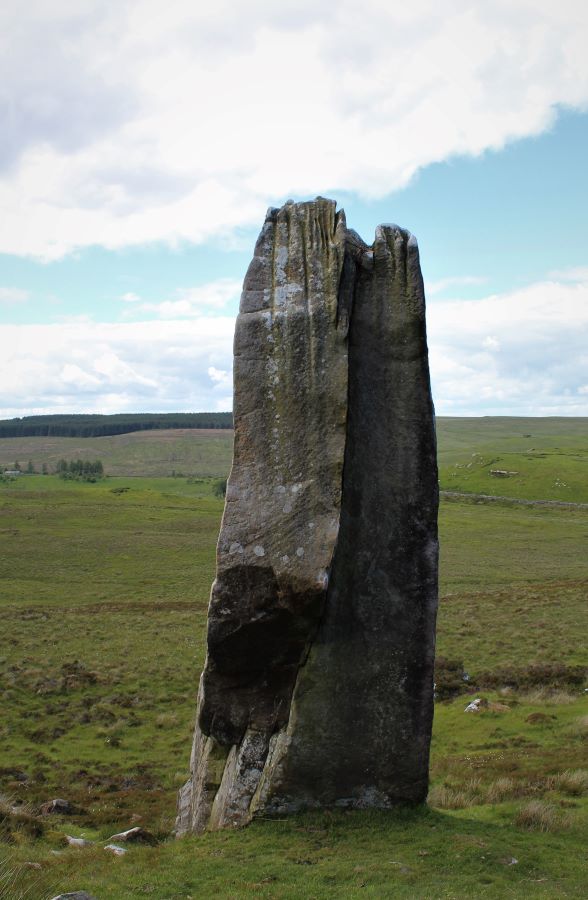
Rushing like the wind we left a line of houses bordering the road and I only just had time to glimpse of the Long Stone (Frotoft) above the road. I know that the Langsteen (HY42NW 7 at HY 40412750) is described as close to the road but it's real close ! At some time it lay broken (or ? had been deliberately smashed like the Stone Of Odin in Stenness) but has since been 'fixed'. And so the height of this NW/SE aligned stone can only be given as nearly 7'6". Also it may be one of those where the ground is eroding or building up about the setting. There it is 2'6" broad and a foot thick, reducing a little to under two foot at the top. There is a bit of a hollow five foot up and this is likely to have been seen as a giant's fingerprint, which makes it the Cubbierow/ Kubbie Row's Stone/ Cubbie Roo's Stone thrown from Fitty Hill in Westray to Lyra. Other such on Rousay are the Clet of Westness (according to the 1884 "Anderson's Guide to Orkney" above "the little water" - Peerie Water I assume), about which I can find no more, and Finger Steen or Byasteen (which is [or was] on a cliff near Wasbister shore). Which standing stones we officially remember, and identify as such, and which we 'lose' sometimes seems potluck.

BLACKHAMMER

Our final stopping point before journey's end on Rousay at the roadside took us to where we went a little uphill to the Blackhammer tomb (HY42NW 3 at HY41422761), named for a farm that once stood on the terrace above - the steading can be easily made out from the air but has not survived as well (though on the ground my eyes could still trace where it once stood). It is highly likely that the farm buildings were where material from the upper part of the cairn went. Prior to excavation the chambered mound itself (a grass and heather covered oblong 78'x34'x5') had been thought merely the ruins of another peedie farmhouse. Eventually the stone cairn stood revealed as a sub-rectangle with sides incurving a little, aligned NW/SE and measuring 72'6" by 27' at its broadest. The eastern end still stood above ground to 1'8" the western end from 2' to 2'3, the northern side mostly 1'6" high (though falling to 6" at a point near the eastern end) and the southern side 2' to 2'6" rising to 3'6" by the west end. Its outer wall's foundation course formed a plinth like that of the Knowe of Yarso a kilometre west of here. For the first time antiquarians found walls fashioned to look like Unstan ware decoration, with sides built of slabs face down obliquely and set alternately slanting left-right and right-left to form hatched triangles. For the second time on Rousay they found a tomb's mouth deliberately closed, in this case blocked by well-built masonry whose outer face was flush with the cairn's outer wall. Animal bones were found throughout the debris inside the tomb, mostly with signs of burning. In the upper levels This included not only sheep, cattle and deer but also the remains of pink-footed geese and cormorant. Much of the bone lay in the first cell. In the bottom layer the birds were gannet, perhaps indicating a different season. Two very fragmented men's skeletons were found at the lowest level along with most of a carinated bowl and a splintered leaf-shaped flint knife burnt white, with only the upper face dressed. Low says one skeleton came from the passage and the other from the compartment furthest west. In cells 1 and 3 at the lowest level two scrapers and five flint splinters were found. One of the scrapers and a partly-worked splinter came from behind the walling sealing the entrance passage mouth under a step. At this same level a foot from cell 1's SW corner a fine-grained grey-green polished stone axe came to light, sealed by animal bones above and below it. Sometime after the tomb was built two large chucks of masonry were placed inside for purposes unknown. One stands in the angle between the 2nd-3rd stall partition and the chamber's north wall. The second, much cruder in appearance, makes an ogee across the chamber and starts in the south wall a little to the west of the entrance. Some folk object to the concrete capping given in 1955 to protect the tomb - perhaps we should shroud the inside with moss and lichen ;-) Really unless you filled the remains in and so kept everyone out this is the kind of compromise one has to come to. Nowadays the way into the tomb is topside, uphill, but at the front is a window that allows you to see down onto the original original [sic] entrance. Except today the sun shone straight down and all was glare. Or perhaps if I had been given a little more time…

On the coast below is the Knowe of Hunclett, HY42NW 15 at HY41442722. This site or its predecessor would, I imagine, lay strong claim to being the settlement that went with the tomb. This is a ten-foot high turf-covered broch mound, apparently excavated (slight depression on summit), with extensive outbuildings to the south showing as many areas of exposed stonework. Thirty metres from the tower there is a shingle beach rather than the usual rocky Rousay shore, with further archaeology in the shore banks themselves . A rough, unploughable section of the next field west continues the five-foot high broad platform on which the broch sits. An exposed inner broch wall-section a yard long and a foot high has been extrapolated to give a diameter of 30-33' (with walls at least 10-12' thick) and its platform extends about two-hundred feet from the fieldwall. The whole broch is bounded at the west by a curving ditch 3-4m wide by 2.2m deep, on whose inner lip a possible fortification is indicated by a stone wall. And an outer wall can be read from more stonework west of the ditch itself.

BRINIAN 2

Coming back to the pier I had a pootle around and the others whiled away their time outside the tearoom with refreshments. In the small harbour were two catamarans, a peedie one and a muckle one, comparatively speaking that is ! Side by side I believe they belonged to the same person. The Speedbird was large, white and modern, with a proper size cabin. Its yellow companion directly alongside looked more the original type i.e. twa small boats lashed together and definitely unpowered. I enjoyed the view over to Trumland Home Farm as I wandered over to the small museum, a cosy intimate place with enough to whet the appetite. Home Farm is a jumble of styles. With buildings of contrasting form it is as if someone had had the same idea as the fella who cobbled together the Hall of Tankerness but used a much later starting period for his design. The latest, and tallest, bit feels vaguely like a castle and also puts me in mind of an Italian hillside. Quaint. Soon enough the ferry came.

On board and looking back towards Brinian Kirk my eye was caught again by Ivy Cottage to the right, a bonnie wee hoose dating back to1878 and minding me on a country cottage plonked on a hillside. There's a garden with lines of low 'bushes' and a low drystane wall. The central wooden door is a faded green, pale anyway, with a split window above the same and then the inscribed date on a shallow arched stone. It has been very sympathetically updated with small symmetrical skylights and below them twa narrow door-height windows.

OTHER ISLANDS IN VIEW

Took a few shots of Egilsay at maximum telephoto (520mm equivalent). Amazing how knobbly the hill's skyline looks, as if peppered with cairns or mounds. Time for a final view of Wyre. North of the pier, over at Rus Ness, there are what appear to be drystane seawalls. In a ?broken' section there are much heftier stones at the base and loose ones in an exposure behind. If they were part of structures they are definitely un-mortared. Part is now used for sewage discharge with a couple of large stone-lined tanks behind on the cliff-top. At the top of the island you can just make out the dark shape of Cubbie Roo's Castle and its surrounding banks. Though this had been built for the Viking called Kolbein Hruga the author Gregor Lamb has shown that the giant Cubbie Roo /Cuppierow must have been before the 12thC chieftain i.e. the giant assimilated the man, the Wyre man did not beget the Orkney-wide tales. As the ship passes the Bay of Whelkmulli (surely a cognate of Waulkmill Bay in Orphir - waulkr 'fuller of cloth', with Walkerhouses in both Evie and Birsay) there are no Wyre Skerries above water for the seals now as there were on the forward leg.

EVIE AGAIN

Trained my binoculars on the Evie coastline, around to Eynhallow [which I usually confuse with Egilsay !] and then Rousay, and took photos in a sequence in the hope that I would see more sites popping out, and idenifiably so, when I returned home. From the ferry looking north of the Woodwick woods the remains of the Ness of Woodwick broch in Evie (NMRS record no. HY42SW 9 at HY40072487) loomed large in my binoculars. Hedges notes that the rocky outcrops and sand below would be a good place to haul up a boat. This site is between the Loch of Vastray, a freshwater lochan, and the Rendall-Evie parish boundary at Woodwick's sea inlet. Though the site is called the Ness of Woodwick, after the headland, this is very obviously the Craig of Ritten. The 'crag' is an impressive mound with dimensions estimated as 50-60 feet with an inner diameter about half that - in 1946 at the seaward side to the NE about 20' of outer wall (thought to be the outer wall-face) could be observed. No midden was seen. Twenty years later most of this outer wall was overgrown like the rest of the mound. On a wider view there are two stone-walled enclosures running south of the mound that feel old, though post-broch they are in the right situation to replace outbuildings if this were a broch settlement like Gurness. I wonder if ritten could possibly be an error for pitten to give us a name Pict's Crag but a ret is an enclosure used during sheep-shearing and fits those enclosures equally well (Vikings are fond of giving placenames a double meaning too). An aerial Google image shows the broch's outer wall and others besides equally plainly.
wideford Posted by wideford
2nd April 2013ce

The Cotswold Way II – Broadway – Winchcombe 23 March 2013

“The winter that keeps on giving”. That’s how the weatherman describes this weekend’s prospects. Last Saturday’s rain has been replaced by imminent heavy snowfall, a week before Easter. Not the weather to go too far afield, so instead I make a sooner than expected return to my new side project, the Cotswold Way. Snow is falling as I leave the house, but it’s not until the bus makes its slow way around the flanks of Cleeve Hill that I see the full scale of the winter terrain ahead.

The village of Broadway is dusted lightly, with the snow falling steadily at a sufficiently shallow angle to plaster the eastern face of the war memorial’s column. I’m in some luck, as the snowfall will be hitting my back as the route mainly heads southwest along the Cotwolds escarpment. The sky is grey in all directions, with little prospect of brighter skies ahead today.

Burhill Farm — Fieldnotes

24.03.13ce
Leaving the village, the route crosses muddy and wet fields, in what is becoming the noticeable feature of the Way so far. I’m soon climbing up more steeply, into deeper snow above the 100m mark. Broadway is disappearing into the gloom below. Once through the winter wonderland of Broadway Coppice, it’s time for my first – minor – diversion of the day. Leaving the Cotswold Way, a footpath skirts the southwestern edge of the field. The rampart of the fort comes into view once the crown of the hill has been rounded.

Carl notes that there isn’t much to see here, apart from a single rampart. All true, but this is a fairly typical promontory site, with three sides defended by the natural scarp of the hill and only one rampart needed across the dip slope of the “neck”. The single rampart isn’t the most impressive you might see, topped with very mature trees and no doubt eroded from its original height. It no longer extends across the full length of the field, presumably a victim of ploughing. There is a ditch on the outer, northeastern, side. The footpath crosses the rampart at its northwestern end, and then runs directly across the featureless interior – especially featureless in the snow today! Once at the south of the fort, the ground drops away steeply and there is a good view of Buckland village below.

I walk back around the southwestern and northern perimeter. There’s little evidence of any counterscarping and the site is not the most obviously defensible. However, various recorded finds of pottery, flints and a saddle quern suggest occupation over a long period, perhaps at times where defensive capability was not the primary focus. Certainly worth the minimal effort of the diversion today.

Burhill Farm — Images

24.03.13ce
<b>Burhill Farm</b>Posted by thesweetcheat<b>Burhill Farm</b>Posted by thesweetcheat<b>Burhill Farm</b>Posted by thesweetcheat<b>Burhill Farm</b>Posted by thesweetcheat<b>Burhill Farm</b>Posted by thesweetcheat<b>Burhill Farm</b>Posted by thesweetcheat

Back on the Cotswold Way, the route follows a farm track to the muddy yard of Manor Farm. The ascent to day’s highest point ( a modest 295m) now lies ahead, a steady climb of 100 vertical metres or so, not steep but increasingly difficult in the deepening snow. My dodgy leg is starting to protest now and as I make my way past Laverton Hill Barn I’m beginning to wonder if I should consider curtailing the planned distance. I had considered a further detour to Snowshill barrows, but reluctantly decide that today isn’t the best day to see them. Instead I carry on south, along a track filled with shin deep drifts of snow, pristine and untrodden. And blooming hard work.

Shenberrow Hill Camp — Fieldnotes

24.03.13ce
Nearing the top of the hill, the northeast wind takes on an additional biting edge, driving snow in almost horizontally, over the edge of the escarpment. Shenberrow Hill Camp is another promontory fort, like its neighbour at Burhill Farm. Unlike that site though, the ramparts of Shenberrow are rather more powerful, with two banks protecting the approach from gentler slope to the north. On the west and south sides the steep scarp provides natural defences. I walk some way along a bridleway that follows the curve of the northern rampart, but the wind is doing its best to knock me over and I’m quite relieved to retrace my steps and enter the fort. The interior is crossed by the Cotswold Way itself, and an area below the west and south sides are access land, making it possible to get a good look at the earthworks without needing any permission. The southeastern section of rampart has unfortunately been destroyed by the construction of the farmhouse. As the strong wind and drifted snow attests, this is an exposed place and life here in the Iron Age must have been very tough, even snug under thatch behind the ramparts.

The Way exits the fort through what appears to be an original entrance at the south, from which the ground drops steeply to a wooded valley. Rather than following the path, I head onto the access land to the west of the fort, for a look at the sloping flanks below. The deep snow has the advantage of making a fairly sharp descent over thorny shrubs back to the path easier than it would be at other times.

Shenberrow Hill Camp — Images

25.03.13ce
<b>Shenberrow Hill Camp</b>Posted by thesweetcheat<b>Shenberrow Hill Camp</b>Posted by thesweetcheat<b>Shenberrow Hill Camp</b>Posted by thesweetcheat<b>Shenberrow Hill Camp</b>Posted by thesweetcheat<b>Shenberrow Hill Camp</b>Posted by thesweetcheat<b>Shenberrow Hill Camp</b>Posted by thesweetcheat<b>Shenberrow Hill Camp</b>Posted by thesweetcheat<b>Shenberrow Hill Camp</b>Posted by thesweetcheat<b>Shenberrow Hill Camp</b>Posted by thesweetcheat

From here the route drops quickly to the village of Stanton, another of the chocolate box places that make the Cotswolds such a tourist honey trap. Here my route nearly intersects that of the almost-due bus, and for a few minutes my aching leg tells me I should call it quits here. But there’s a stupid stubbornness at work that keeps me walking, heading out of the village and onto a path crossing two of the muddiest fields it’s ever been my displeasure to have to cross. I’m below the snowline here, and the mud is deep enough to cover my boots. Squelch.

As I make my way south across more muddy fields, the whistle of a steam train on the nearby Cotswolds railway echoes, ghostly, across the flatlands to my west. Not for the first time, I wish that the designers of the Way had routed it up on the edge of the escarpment, rather than down here in the mud. I can only assume a mud-loving lunatic had a hand in the choice. Reaching Stanway, the snow is falling more heavily, sending the neighbourhood rooks cawing and flapping. I take shelter in the church to rest my leg and eat some lunch. The stop does me good and I re-emerge into slackening snow feeling more up for the second part of the walk.

Stumps Cross — Fieldnotes

24.03.13ce
After the hamlet of Wood Stanway, where a passing farmer greets me with laughter and a disbelieving “you must be mad”, the route reaches its steepest climb, up to Stumps Cross. I take the ascent rather gingerly, but it’s not a huge climb and I reach the bench at the top without any major problems, despite the mud at the bottom and drifted snow on the slopes. From here, there are expansive views across the vale to the west on a good day, but sadly little to be seen under the low cloud today.

I visited the two round barrows a little over a year ago, but neglected to write any fieldnotes. Aside from the view from the escarpment edge, which is now obscured by trees from here, there is little recommend these barrows. They have been ploughed within an inch of their lives and unless you knew they were there, you probably wouldn’t notice them at all. However, if positioning is everything, they would have been impressive in their day and can be compared with the Saintbury Barrow a few miles away along the escarpment edge. Incidentally, Stumps Cross takes its name from the base of a now otherwise gone medieval cross alongside the road junction below the barrows.

Stumps Cross — Images

28.03.13ce
<b>Stumps Cross</b>Posted by thesweetcheat

Beckbury — Fieldnotes

24.03.13ce
Leaving the junction, the Cotswold Way follows a straight track up to the top of the hill. The wind is keen, blowing the sculpted snow into flurries of spindrift. The walking is hard work, the shin-deep snow a plague for tired legs. Beckbury is another site visited last year, with overdue field notes. On that occasion, I approached from the southwest, up the steep escarpment. Today I have it easier, crossing the gentle slopes from the east. Like the other forts visited today, Beckbury is a promontory fort, with the west and northern sides relying on the escarpment for protection. Here the length of single rampart is rather longer, the curving bank on the east and south sides enclosing an area approx. 160 x 130 m.

The eastern bank is rather damaged, with a gap halfway along its length that is not original but has been broken through in recent times. This has exposed some big chunks of the limestone that make up the rampart’s construction. The southern curve of the bank is topped by a drystone wall, but remains fairly well-preserved. Apart from a short section at the northern end, there is little sign of a ditch, although on today’s visit it would be filled with snow anyway!

Last time I came here there were quite a few people out for a stroll. Today it’s deserted, the howling wind the only company apart from the sheep sheltering in the lee of the escarpment. The western slopes have developed cornices of snow that wouldn’t be out of place in the Cairngorms, although obviously without the life-threatening drop below. At the northwestern corner is an enigmatic limestone monument, graffiti scratched but naming no names as to whom it commemorates. Ozymandias, perhaps?

Beckbury — Images

28.03.13ce
<b>Beckbury</b>Posted by thesweetcheat<b>Beckbury</b>Posted by thesweetcheat<b>Beckbury</b>Posted by thesweetcheat<b>Beckbury</b>Posted by thesweetcheat<b>Beckbury</b>Posted by thesweetcheat<b>Beckbury</b>Posted by thesweetcheat

It’s a steep descent over slippery roots off the ramparts, then something of a pell-mell downward hurry through startled sheep across the fields to the southwest. The path meets a track running into Hailes Wood, where the spun snow clings to the branches but all at once is gone from underfoot, as once more I’m below the snow line. I don’t pause to revisit Hailes Wood Camp this time (more AWOL fieldnotes) but carry on down to the ruins of the Abbey, a relic of Henry VII and Thomas Cromwell’s dismantling.

I’d love to say it was an easy stroll from here to the finish at Winchcombe, but that would be a lie. Instead, it’s yet more saturated mud and by the time I reach the intriguingly named Puck Pit Lane, I’m caked in the stuff. Luckily a fast-flowing culvert allows me to get the worst off my boots, and I can peel the splattered waterproofs off once I reach the safety of the town.

It’s been another good section, though my leg may not easily forgive me for it. The three forts seen today are all worthy of a visit and the solitude of the snowy hills never fails to lift the spirits. To the woman at Wood Stanway, mad I may be, but reminded that I’m alive as well. That’s what it’s all about, isn’t it?

Now, let’s have some sunshine please.
thesweetcheat Posted by thesweetcheat
24th March 2013ce
Edited 28th March 2013ce

The Cotswold Way I – Chipping Campden – Broadway 16 March 2013

After ending my recent trip to Meon Hill in the pretty town of Chipping Campden, I thought it about time that I made a bit more effort with the Cotswolds again. Despite living below the edge of yellow escarpment for almost 7 years now, my gaze has tended to be drawn away to the west. Part of the reason has been the constant fascination of Wales, but it’s also partly due to the effects of farming on much of the Cotswolds’ prehistory, from access difficulties to endlessly ploughed barrows and earthworks. But there is also much to enjoy and so I thought I’d have a go at the Cotswold Way, 102 miles along the Cotswold edge from Chipping Campden to Bath. The Way passes close to a large number of prehistoric sites, some familiar to me, some not. While the Wales Coast Path is the main objective for G/F and I over the next few years, this can be my experimental side project, to dabble in occasionally. Hopefully more enjoyable than a drum opera or earnest acoustic set at least. The promise of an unsettled weekend with heavy showers sounds like a good time to get on with it.

Getting to the start is a bit of a faff involving two buses, and heavy rain all the way to Moreton in Marsh. By the time the second bus drops me in the centre of Chipping Campden, it’s clearing and the sun is threatening to break cover. Chipping Campden has plenty of amenities and makes for a good start (or end) point for a walk, but I don’t linger today, hoping to make the most of the good weather while it lasts. Out of the town it’s a steady climb along a rather muddy lane to Dover’s Hill. Dover’s Hill enjoyed fame in the early 17th century when the enterprising Robert Dover instituted an annual games here, called the Olimpicks, a couple of hundred years before the better-known Much Wenlock version. There’s no games going on up here today, but there is a superb view. To the northeast, the flat-topped Meon Hill, to the west the bulk of Bredon Hill, with the unmistakeable ridge of the Malverns beyond, all topped with hillforts. To the north, the Vale of Evesham stretches away as far as the eye can see on this rather gloomy morning. There’s a handy toposcope on the highest point of the hill and a cute little limestone seat that reminds me of a miniature chambered tomb. It’s nice to back in the hills, as ever.

Kiftsgate Stone — Fieldnotes

17.03.13ce
After drinking in the views for a while, I carry on off the hilltop. Here the Cotswold Way follows a busier road and has been moved off the verge and slightly down the slope, out of sight of the road. But I choose to stick to the verge instead, because my first stop-off of the day beckons. I remember Carl having trouble finding this stone, and as I pass a locked and chicken-wired gate I wonder if it’s going to be particularly accessible. I’m therefore very pleased to see it from the road, through a little gap into the trees. Access is as easy as can be, the stone is only yards from the road (it’s quite a way northeast of the layby that Carl refers to).

I didn’t really know what to expect from this “disputed antiquity”. It turns out to be a dinky little irregular limestone slab, heavily moss-covered and orientated with the long side SW-NE, parallel with the road. As reported, it has a (blocked) hole through it. On the NW face of the stone, the hole has the appearance of being counter-sunk, although whether this was intentional or caused by something inserted into the hole being turned and causing wear I can’t say. Apart from the hole, it’s not obviously worked, but the thick moss and the years of wear could easily mask any signs that might be there. I really like it, hidden away and passed by lots of unsuspecting drivers every day. I wouldn’t want to commit to its antiquity, but it’s worth paying your respects if you come this way. A promising start to the day, anyway.

Kiftsgate Stone — Images

17.03.13ce
<b>Kiftsgate Stone</b>Posted by thesweetcheat<b>Kiftsgate Stone</b>Posted by thesweetcheat<b>Kiftsgate Stone</b>Posted by thesweetcheat<b>Kiftsgate Stone</b>Posted by thesweetcheat<b>Kiftsgate Stone</b>Posted by thesweetcheat

Willersey Camp — Fieldnotes

17.03.13ce
Leaving Kiftsgate Stone, the Way follows the Mile Drive, a broad, grassy path that would make for easy walking if less wet underfoot. At the end there are two fields of mud to cross (lovely), after which I take my main detour of the day, heading north alongside the Roman Buckle Street. My next site is one that I am not by any means hopeful about. Despite being a very decent-sized fort, Willersey Camp has had the misfortune of having a golf course dumped onto it, the construction of which, according to Pastscape, caused “considerable damage” to the fort. Approaching from the south, any views are obstructed by a thick screen of leylandii, that well-known native Cotswold species. A bit further along the road is the Dormy Hotel, built right on the SE corner of the fort. I walk up the drive towards the reception, hoping to get a bit of rampart action. The drive cuts through the bank and I manage to get a picture in. However, the CCTV signs don’t lie and it’s barely a minute before a uniformed functionary emerges to ask me if I need any “help”. I get the impression that the response “I’d like to have a look at the hillfort” would be as well-received as “I’ve come to steal your silver teaspoons”, so decline the offer and return to the road.

The road follows the old line of the eastern rampart, but apart from a bit of “rough” (in the golfing sense) there’s nothing to see here. A low mound can be seen silhouetted on the skyline in the middle of the course and I think this is probably the poor remains of the long barrow. Having been accosted once, I’m not keen to have another go, so I don’t follow Carl’s admirable example. In any case, I’m not acceptably attired for the course, wearing neither a turtleneck shirt, tailored shorts, or golf shoes. I imagine there would be a scene at such a blatant breach of the dress code. I carry on past the clubhouse.

As Carl said, the wooded area alongside the road is the place to come. There is indeed quite a bit of litter (tut) but the ramparts here are very impressive. The outer rampart is several metres high, with a slighter, inner rampart that hasn’t been encroached upon by the golf course. It’s a shame the rest of the fort has been so badly treated in comparison, because it must have been a fine site.

Willersey Camp — Images

17.03.13ce
<b>Willersey Camp</b>Posted by thesweetcheat<b>Willersey Camp</b>Posted by thesweetcheat<b>Willersey Camp</b>Posted by thesweetcheat<b>Willersey Camp</b>Posted by thesweetcheat<b>Willersey Camp</b>Posted by thesweetcheat<b>Willersey Camp</b>Posted by thesweetcheat<b>Willersey Camp</b>Posted by thesweetcheat<b>Willersey Camp</b>Posted by thesweetcheat

Willersey Long Barrow — Images

17.03.13ce
<b>Willersey Long Barrow</b>Posted by thesweetcheat

Meon Hill — Images

17.03.13ce
<b>Meon Hill</b>Posted by thesweetcheat

Saintbury Barrow — Fieldnotes

17.03.13ce
Continuing north, I take a left (west) at the crossroads. A few yards on, a metal right of way sign points south for a bridleway and north for a footpath. I take the latter, for this leads very conveniently to the Saintbury round barrow. This could easily be overlooked as just another ploughed down barrow in the Cotswolds, but Carl’s previous notes indicate that it’s worthy of attention. He climbed up from Saintbury to the north, whereas my route takes me northwards downhill to the barrow. It’s very muddy and the hill seems to teem with springs, so I’m glad to be wearing my waterproofs, even as the sun has now come out.

The barrow is quite a way down the sloping field, and is not visible until I’m practically on top of it. Before it comes into view, there is the rather surreal sight of the top of the lofty (ha) spire of Saintbury church appearing below me. The barrow itself is small, but quite well preserved for these parts, with the possible remains of an infilled ditch around it. As Carl notes, the positioning is terrific. Perched just above the steeper part of the scarp, the views are wonderful indeed. To the northeast, trees block Meon Hill fort, but otherwise there is an expansive panorama, from Bredon Hill, the distant Malverns, across into Mid-Wales and at the furthest limit of my sight, Titterstone Clee and Brown Clee, maybe 60 miles away and near where I grew up. The darker, wooded hills in front of them possibly even include Croft Ambrey, the fort I used to visit on Boxing Day walks. Breathtaking.

Saintbury Barrow — Images

17.03.13ce
<b>Saintbury Barrow</b>Posted by thesweetcheat<b>Saintbury Barrow</b>Posted by thesweetcheat<b>Saintbury Barrow</b>Posted by thesweetcheat<b>Saintbury Barrow</b>Posted by thesweetcheat<b>Saintbury Barrow</b>Posted by thesweetcheat

Heading back up the slippery slope, I manage to fall over as the mud takes my feet from under me. Luckily it’s all very soft and squidgy, so only my dignity is bruised.

Back at the road, I cross over and take the bridleway, which runs parallel with the northern rampart of the fort. Unfortunately, a screen of vegetation and yet more golf fairways block access to this part of the fort. The bridleway is also incredibly muddy and after a while I turn back, caked in mud and feeling a bit deflated. Retracing my steps past the clubhouse, I head south again to rejoin the Cotswold Way. The trip to Saintbury barrow has provided reward enough to justify the detour, so the relative disappointment of the fort doesn’t detract too much.

It’s now clouded over again, and back on the footpath across yet more mud, the rain starts again in earnest. I stop off at the Fish Hill picnic area (tables, toilets, car park, weird arrangements of upright limestone) where there is a particularly fine toposcope, carved with a relief map of the Cotswolds and I learn that aligned with Tewkesbury (15 miles away) is New York (3370 miles away). Some ley-line that. From here the path crosses the busy A44 before climbing gently up through woods towards the highest point of today’s walk, at Broadway Tower.

The weather doesn’t lend my visit to the tower quite the views it deserves, but I do learn that there is a decommissioned nuclear bunker up here. Hopefully not something that will be needed again! From the tower it’s a very steep descent off the escarpment down to Broadway, with good views of the western flank of Willersey Camp to be had from the path. I’m quite wet and very muddy by the time I emerge onto the streets of Broadway, but nothing coffee and caramel shortbread can’t cure. It’s been a fine start to the Cotswold Way, with a good variety of sites for the TMA-er on the way. I’m looking forward to my next side project dabble.
thesweetcheat Posted by thesweetcheat
17th March 2013ce

Wonders of Whimble (and Bache again) 2 March 2013

The promise of some much-needed sunshine centred on Mid-Wales, together with tentative confidence that my leg would stand up to something of a challenge, has led me to focus my sights on a return to the Radnor Forest.

Bache Hill and the Whimble — Fieldnotes

03.03.13ce
Like Gladman before me, my previous trip to the summits of Radnor mountains had neglected the shapely, but sub-2,000ft Whimble. In truth, my previous trip in thick, dank mist had been something of a nightmare of zero-visibility and soaking wet feet. I’m hoping for a contrast today, so I’m relieved that as the bus drops me in New Radnor, the skies are blue if rather hazy.

The lack of car precludes me from following Gladman’s advice and so I have to start off with the steep “road-bashing” of his warning, taking a minor road north out of the town. In truth, the firm surface provides a nice easy way to gain some rapid height. I pass a couple of walkers on the road, as they stop to remove outer layers – despite the single-figure temperature, it’s soon warm once you get going on the uphill. At the gate where the road stops, I pause to do the same and shed my coat.

The long months since I discovered that I had torn my hamstring badly on Moel Eilio last year have been seriously frustrating, even climbing a couple of flights of stairs had been a strain. As such, I feel immensely relieved to have made the first couple of hundred metres of ascent without problem. From the gate, a bridleway continues the climb, more gently now, around the western edge of the forestry that clothes the southern slopes of the Whimble.

Sheep and Spring lambs are the only company and pretty soon a fine view has opened up along the steep-sided valley of Summergill Brook to the southwest. Rank after rank of hills line up to the horizon, fading gently into blue on this hazy day. I realise that the views won’t be extensive in a haze more reminiscent of a summer’s outing, but to be out in the sunshine on these hills provides more than ample pleasure.

The bridleway is easy walking and after a while a flat-topped expanse appears to the northwest – this is Great Rhos, the highest part of the mountains and a top that I had to navigate across by relying on compass and contour alone. No such trouble today, it’s nice to finally see what I missed before. Directly ahead of me is Great Creigiau, the southern part of Black Mixen, underpinned by steep cliffs falling away into the valley below. It’s quiet enough to hear the tumbling water down in that narrow channel. This is what I’ve been missing these last months, away from the solitude of the lonely hillside.

Then, through the thinning trees to my right, as if conjured from nowhere by powerful magic, the conical shape of the Whimble appears. The path continues northwest, but a smaller, much-used trail heads off to the foot of the hill. I’m suddenly overawed by the steepness of the climb ahead, although it’s less than 100m of vertical ascent from where I am now. I briefly weigh up how my leg feels against the steep hillside, but this is what I’ve come for and the urge to go on far outweighs any concern now. I take the climb steadily, one foot in front (above) the other. When the summit approach comes, a deep sense of joy comes too. I’ve made it! It’s not the biggest hill in the world, but after a winter wondering if I’d get up in the mountains again, the feeling of relief is overwhelming.

Also overwhelming is the view from the top, even with the haze. The hill drops away steeply on all sides. Away to the southeast is Hergest Ridge and on a clearer day the Black Mountains would be visible to the south. To the west and north the higher, flat-topped summits of the range cut off the longer view, but the intervening valleys are far below and steep-sided, providing plenty of visual interest. To the northeast, Bache Hill is the focal point, topped irresistibly with a line of prominent round barrows that I will hopefully visit later.

And then there’s the summit barrow, a fine, turfed-over specimen with a flat top. About half a metre below the top, the sides of the barrow are stepped-in. Coflein states this to be a later cairn placed on top of the round barrow, although it doesn’t say how much later. But for all the world, this wonderful, conical proto-Silbury seems topped with its own mini-Silbury barrow.

To all those people who cause endless debate by climbing Silbury, why bother? Come here, to quiet of the Radnor Mountains and climb a proper sacred hill instead. Sky gods, earth goddess, if such beings exist, then this is the place to commune with them. No man-made vanity project striving and failing to reach up to the heavens, this beautiful, shapely hill is the real thing, the focal point of Radnor’s sleeping goddess. It has the power to remind me how small I am, a tiny speck of dust in the infinity of nature, yet so alive and ecstatic too. I live for places like this, days like this, when mundane cares are so far below and there’s only the sky, the wind, the hills.

***

I stay as long as my body temperature allows, for it’s cold up here in March, even in the sunshine. My route onwards is to the east, where the hill is at its most gentle, sloping down a wide grass strip to the bwlch below. Here I meet two riders, the last people I will see in the hills today, apart from distant stick figures on Black Mixen. A bridleway heads northwards. Neatly bisecting the twin summits of Bache Hill, the path crosses the saddle between the two. To the northeast is the main summit, where I went in the mist last time I was up here, together with the low remains of an intervening barrow. But I have unfinished business with the south-western summit, above Whinyard Rocks, to get better acquainted with the two prominent barrows here.

A narrow sheep track winds in the general direction, so I take that to avoid the worst of the heather that clothes this hillside. The Whimble comes into view straight ahead, a reminder of the shapeliness of its curves. But the track doesn’t head to the barrows and I’m forced to take to the heather after all. A summer visit would be tough and my dodgy leg doesn’t enjoy the motion of stepping over the vegetation very much. But the barrows are worth it, especially the fine south-western example (Winyard Rocks I), placed perfectly for views of the Whimble and of the other Bache Hill barrows to the northeast. The other barrow (Whinyard Rocks II) is smaller, or more reduced, but placed so that nearly all of the barrows in the group are visible from it.

Back across the tiresome heather to the saddle. The next barrow (Bache Hill III) is visible in the grassy field beyond, it appears to have been much-reduced by erosion (ploughing?) and has no cover of heather to keep it warm. Of all the barrows in the group it is the least impressive, but still boasts a wonderful location. The Bache Hill summit barrows are not visible from it, but the Whimble and the Whinyard Rocks barrows all are. [Incidentally, this is the only barrow of the five on Bache Hill that is not on access land, although a stile gives easy entrance into the field from the bridleway to the southwest.]

The final walk to the summit of Bache Hill is easy from here, and I’m elated to be back on top of a mountain after such a long absence. Previous fieldnotes extol the virtues of the summit barrow, so I’ll just add that this is one of the finest round barrows I’ve visited in Mid-Wales – if not the finest. Good spot for lunch too, with back against the trig point and Radnorshire spread out in patchwork below.

After a quick revisit of the final barrow, at the eastern end of the arcing group, I bid farewell and start the long descent off the hills via Stanlo Tump. The last time I was here, I was pleased and surprised to see Titterstone Clee away to the northeast. Today the haze prevents any such revelations, but in the interim G/F and I have walked close by along Offa’s Dyke, so now I have the pleasure of recognising Castle Ring, Beggar’s Bush, the approximate position of the Cwmade Barrow and the wonderful Burfa Bank hillfort. Another bit of jigsaw slots into place.

Bache Hill and the Whimble — Images

03.03.13ce
<b>Bache Hill and the Whimble</b>Posted by thesweetcheat<b>Bache Hill and the Whimble</b>Posted by thesweetcheat<b>Bache Hill and the Whimble</b>Posted by thesweetcheat<b>Bache Hill and the Whimble</b>Posted by thesweetcheat<b>Bache Hill and the Whimble</b>Posted by thesweetcheat<b>Bache Hill and the Whimble</b>Posted by thesweetcheat<b>Bache Hill and the Whimble</b>Posted by thesweetcheat<b>Bache Hill and the Whimble</b>Posted by thesweetcheat<b>Bache Hill and the Whimble</b>Posted by thesweetcheat<b>Bache Hill and the Whimble</b>Posted by thesweetcheat<b>Bache Hill and the Whimble</b>Posted by thesweetcheat<b>Bache Hill and the Whimble</b>Posted by thesweetcheat<b>Bache Hill and the Whimble</b>Posted by thesweetcheat<b>Bache Hill and the Whimble</b>Posted by thesweetcheat

At Kinnerton I pop into the lovely little church, its yard carpeted with snowdrops. I’m very taken with a fine stained glass window depicting a hare. Moving on, a quick stop reveals Kinnerton Court Stone II to be much clearer of vegetation than on my last visit, and I say hello to the lovely Kinnerton Court Stone I, with its fantastic view back to the Radnor mountains.

Kinnerton Court Stone II — Images

05.03.13ce
<b>Kinnerton Court Stone II</b>Posted by thesweetcheat<b>Kinnerton Court Stone II</b>Posted by thesweetcheat

Kinnerton Court Stone I — Images

05.03.13ce
<b>Kinnerton Court Stone I</b>Posted by thesweetcheat<b>Kinnerton Court Stone I</b>Posted by thesweetcheat
Crossfield Lane barrow is as flattened as it was before (hardly going to grow back, was it) although I manage to find an angle from the south where it appears a bit more prominent.

Crossfield Lane barrow — Images

05.03.13ce
<b>Crossfield Lane barrow</b>Posted by thesweetcheat

The Four Stones — Fieldnotes

03.03.13ce
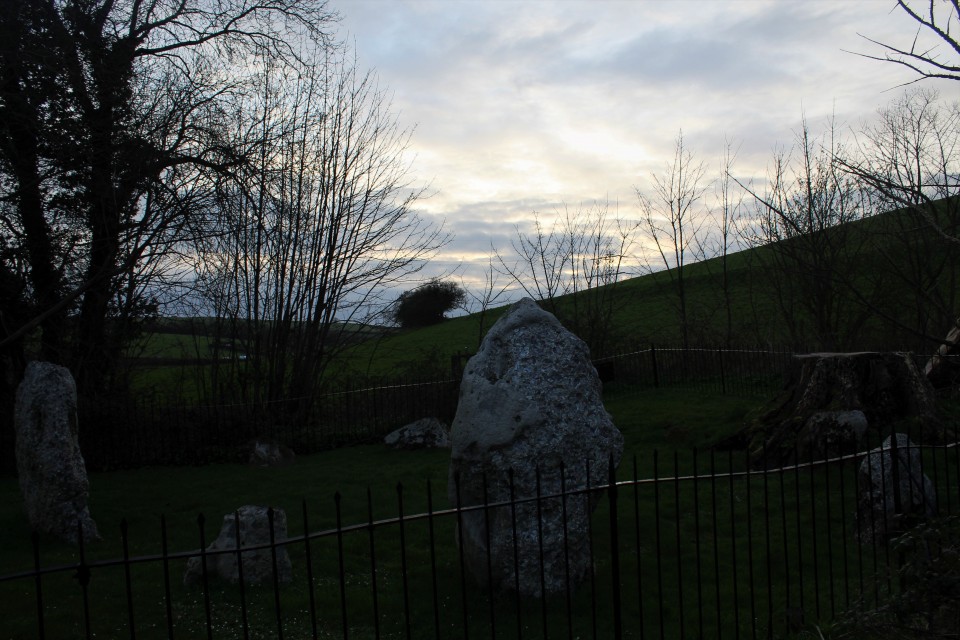
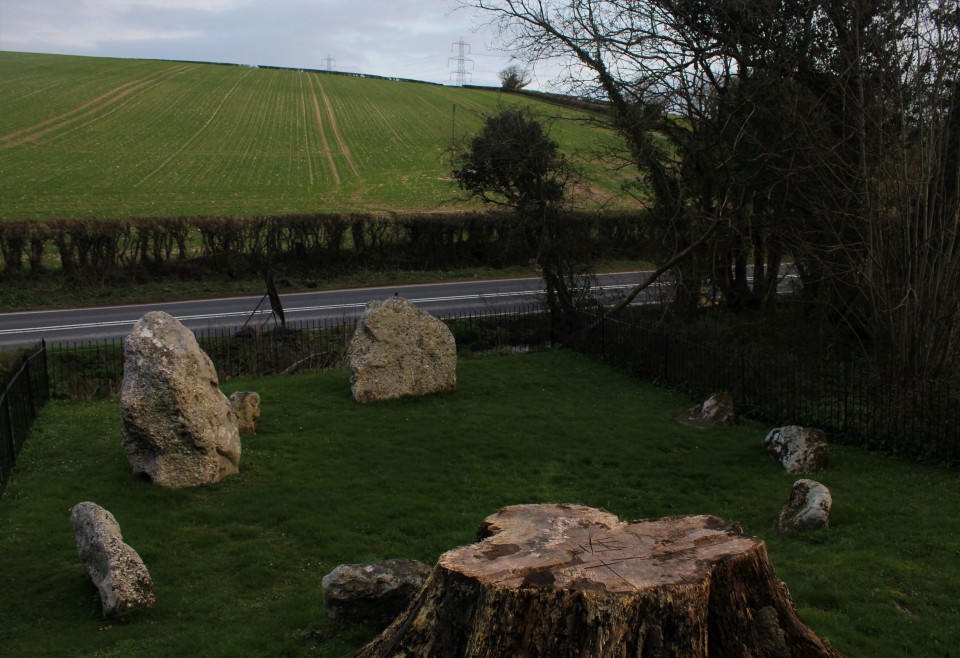
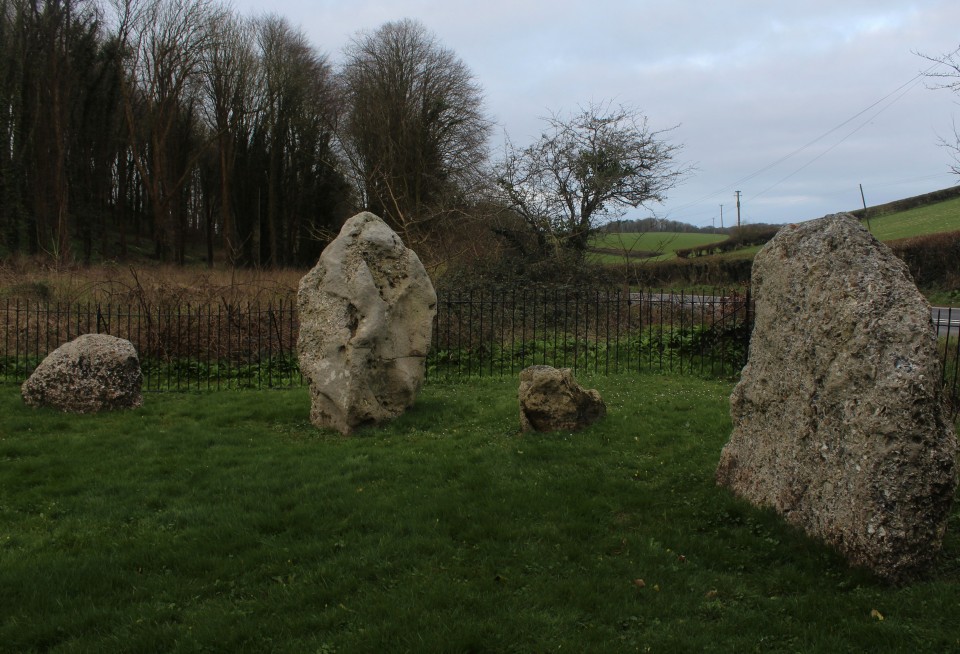
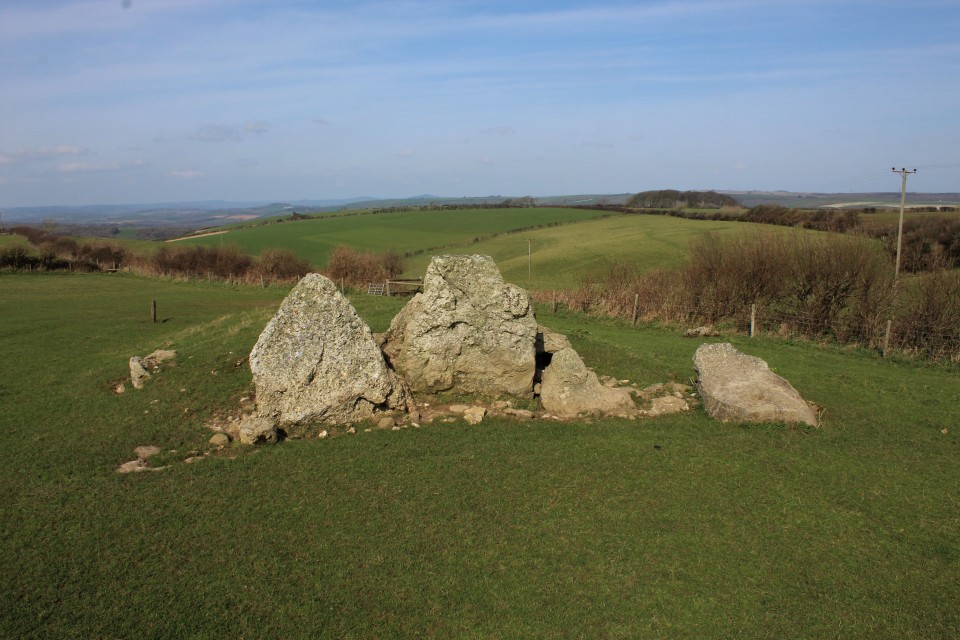
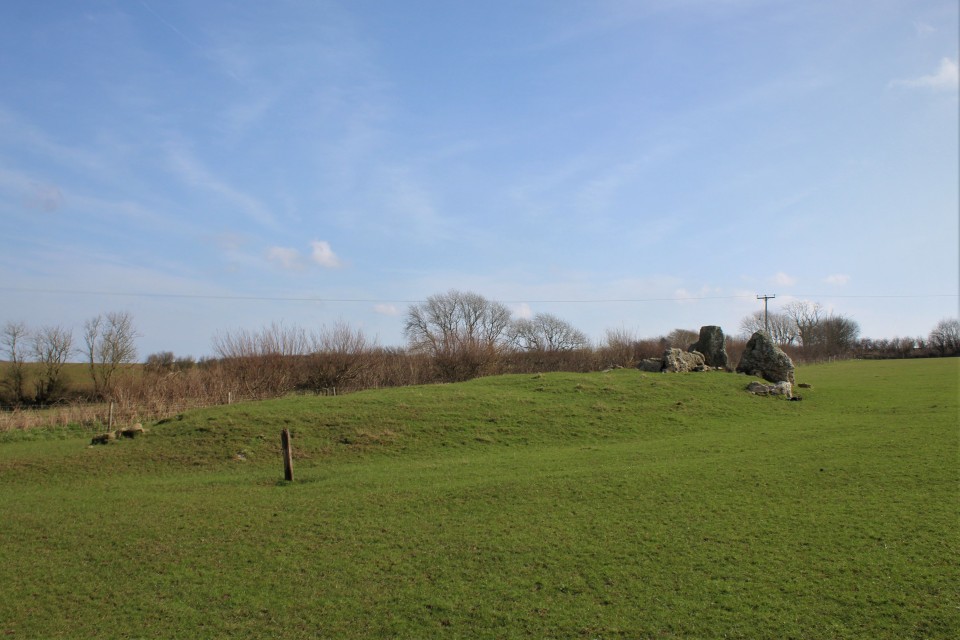
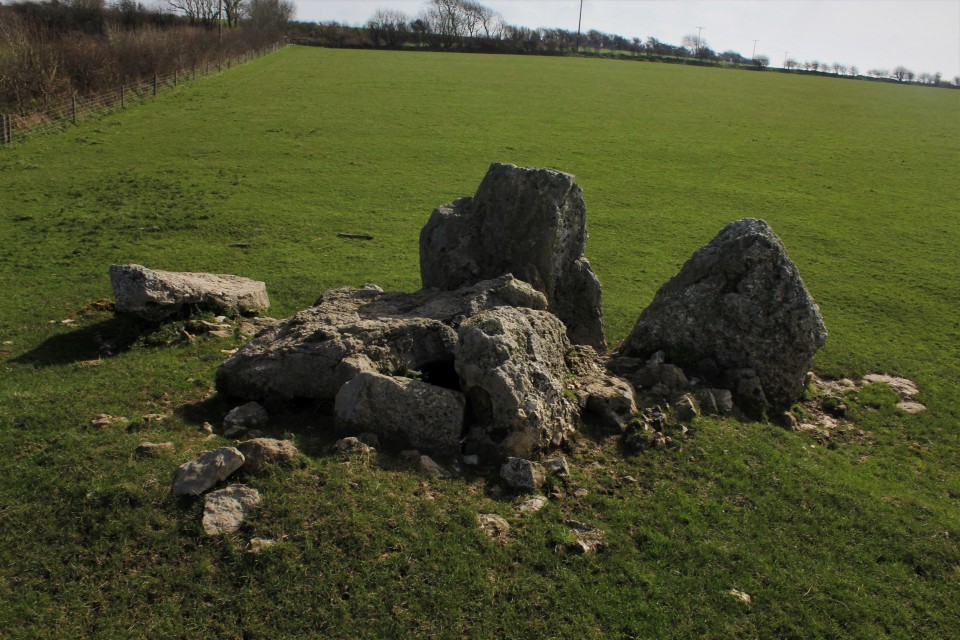
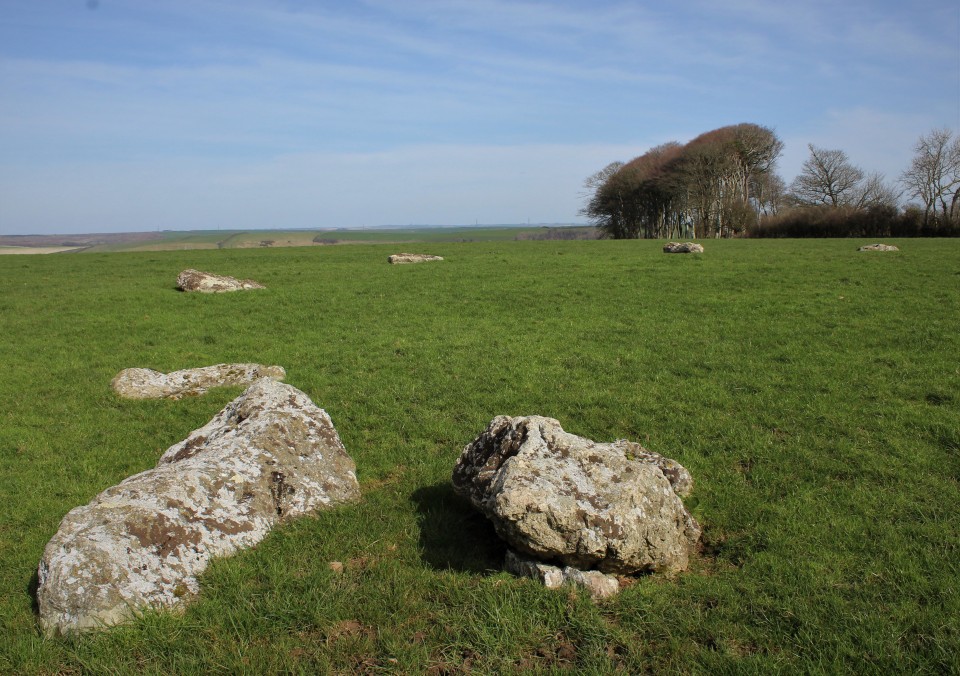
Then I’m back at Four Stones, in my Dad’s countryside. Last time, I was hit with a wave of emotion I hadn’t foreseen, but this time I’m prepared and enjoy the site for itself more. It would have been his birthday in two days’ time though, so it seems more than fitting to be here and raise a metaphorical toast.

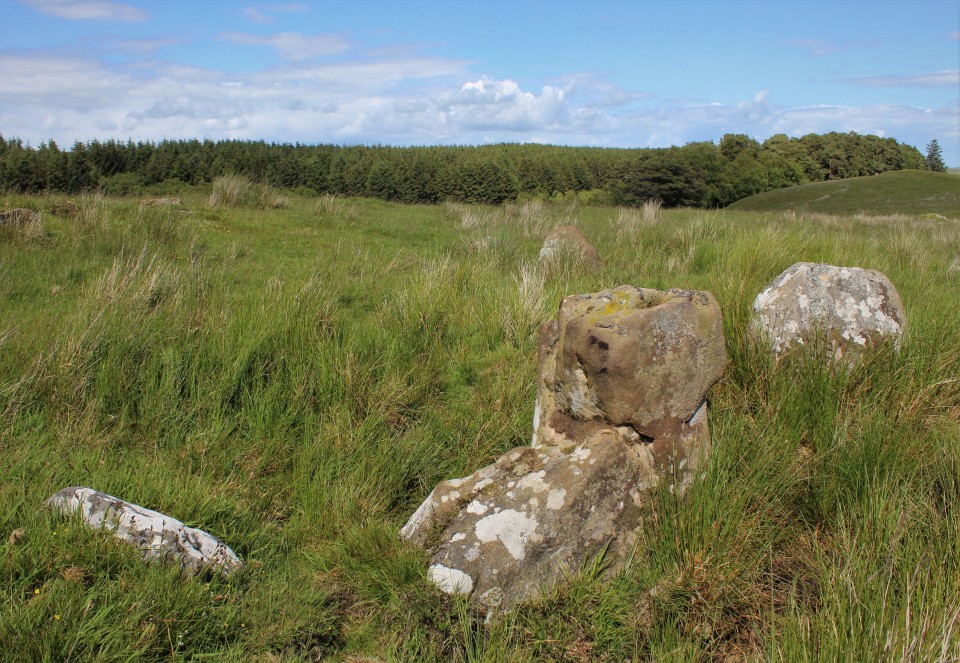
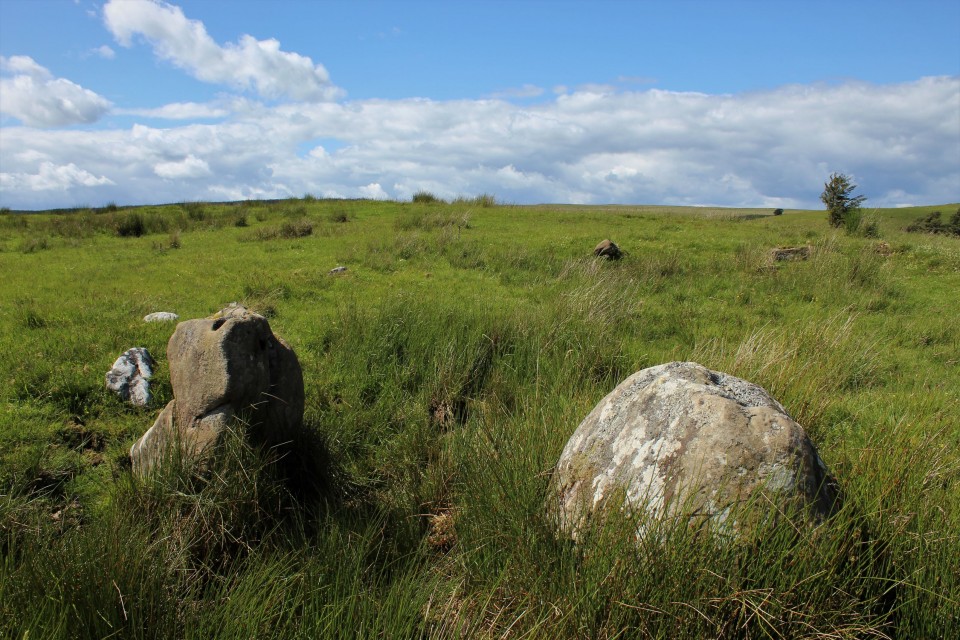
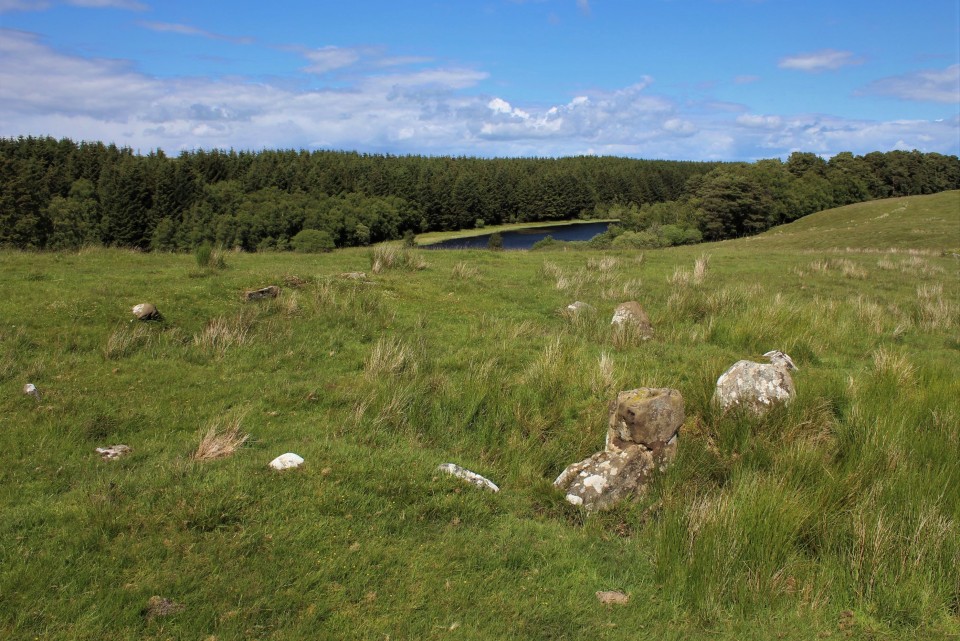
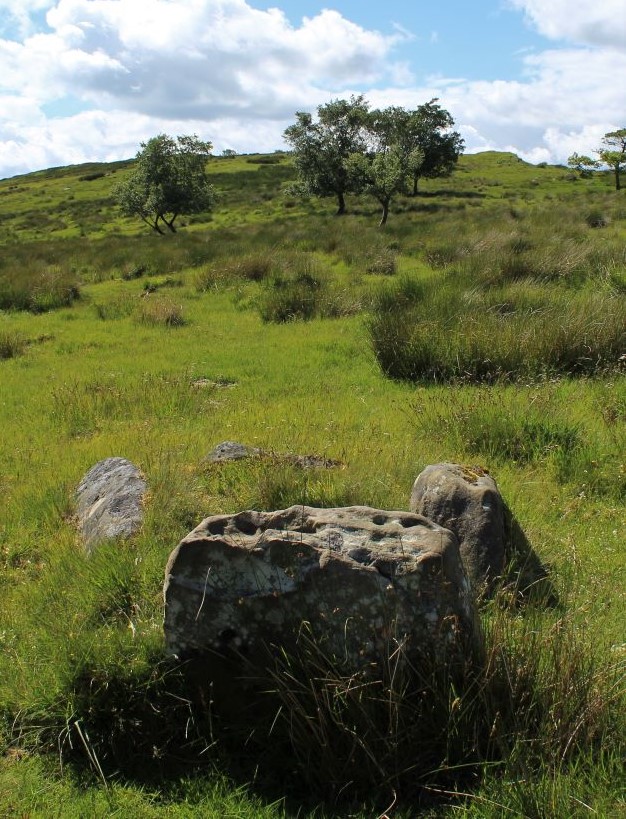
It is a wonderful site. The proximity of the house, road and telegraph wires perhaps just enough to keep it from the front rank of circles for the modern visitor, but otherwise the setting, and the stones themselves, are exquisite, the cupmarks on the south-western stone a little bit of icing on the cake. A site to be savoured. Time passes as it often does.

The Four Stones — Images

05.03.13ce
<b>The Four Stones</b>Posted by thesweetcheat<b>The Four Stones</b>Posted by thesweetcheat<b>The Four Stones</b>Posted by thesweetcheat<b>The Four Stones</b>Posted by thesweetcheat<b>The Four Stones</b>Posted by thesweetcheat

***
At length I’m off, to see about some of the other sites crammed into this little corner of Wales. Heading east from the circle, the quiet lane points directly at Burfa Bank and I toy fleetingly with a visit. But I think my legs have had enough excitement today and the approaches to the fort are very unforgiving. Instead, I make my first visit to the Hindwell Stone.

Hindwell Stone — Fieldnotes

03.03.13ce
Unmarked on the OS map, even Coflein have a “?” after its standing stone attribution. I like it very much, in its field of lambs and with the ubiquitous great views of the mountains. It certainly seems all of a piece with the other stones of the area, both in composition and shape. Deserving of attention anyway.

Hindwell Stone — Images

07.03.13ce
<b>Hindwell Stone</b>Posted by thesweetcheat<b>Hindwell Stone</b>Posted by thesweetcheat<b>Hindwell Stone</b>Posted by thesweetcheat

Hindwell round barrow group — Fieldnotes

03.03.13ce
Not much further down the road a footpath gives access to a field boasting two round barrows, Hindwell Farm I and II. Sadly, neither is exactly well-preserved, having been ploughed to within an inch of their (considerable) lives. But when viewed in the context of the other sites nearby, they should not be overlooked. The views to Bache Hill and The Whimble are inevitably fabulous.

Passing Hindwell Farm, a further barrow (Hindwell Ash) is visible in a field to the north, on the left (west) side of the round. An OS trig pillar has been inserted and the barrow proves to be in a poor state, crumbling away under the pillar on its northern flank. The fourth barrow in the group, Upper Ninepence (great name) is not visible from here.

Hindwell round barrow group — Images

08.03.13ce
<b>Hindwell round barrow group</b>Posted by thesweetcheat<b>Hindwell round barrow group</b>Posted by thesweetcheat<b>Hindwell round barrow group</b>Posted by thesweetcheat<b>Hindwell round barrow group</b>Posted by thesweetcheat<b>Hindwell round barrow group</b>Posted by thesweetcheat

Hindwell Pool — Images

08.03.13ce
<b>Hindwell Pool</b>Posted by thesweetcheat

I make an aborted effort to see Knobley standing stone, but an apparently imprenetrable hedge, a quad-biking farmer and far-too-close-for-comfort shotgun soundings, together with increasing lack of energy after the efforts of the day, finally conspire to persuade me to leave it for another day. I get to see it from a distance, a similar stone to the others in the area with an apparent split in it.

Knobley — Images

08.03.13ce
<b>Knobley</b>Posted by thesweetcheat<b>Knobley</b>Posted by thesweetcheat


Despite this final failure, it’s been a terrific day in this quiet part of Wales and I come away with renewed confidence after months of doubt. The little death of Winter seems over, the burgeoning life of Spring is here.
thesweetcheat Posted by thesweetcheat
3rd March 2013ce
Previous 5 | Showing 6-10 of 702 posts. Most recent first | Next 5