Showing 1-50 of 344 posts. Most recent first | Next 50 
 
|
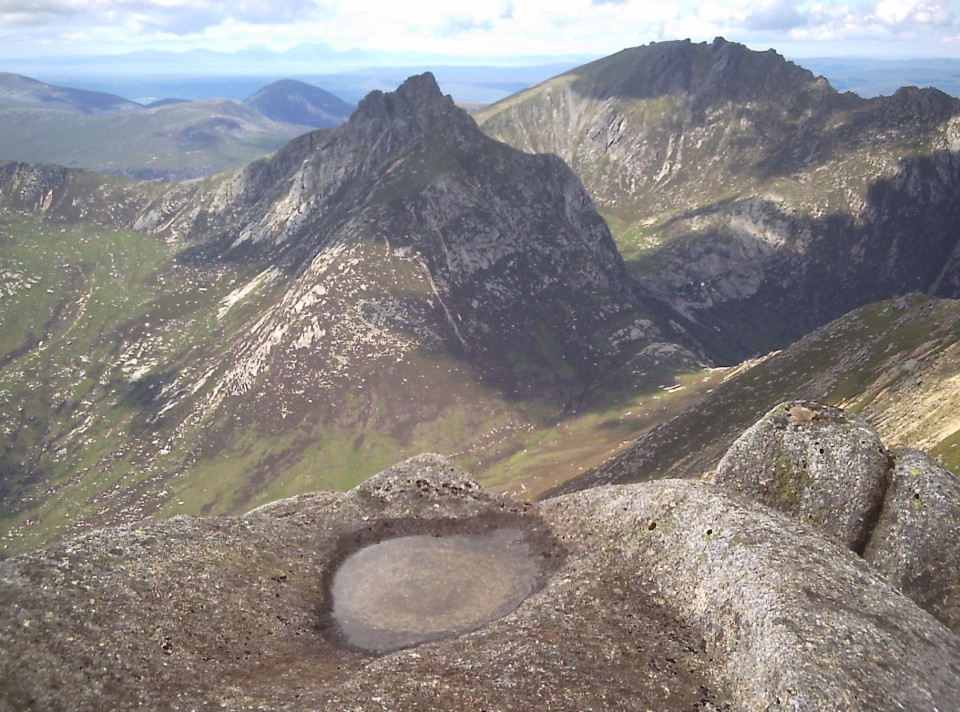
Ascent of Bienn an Oir, Jura.
|
|
|
|
|
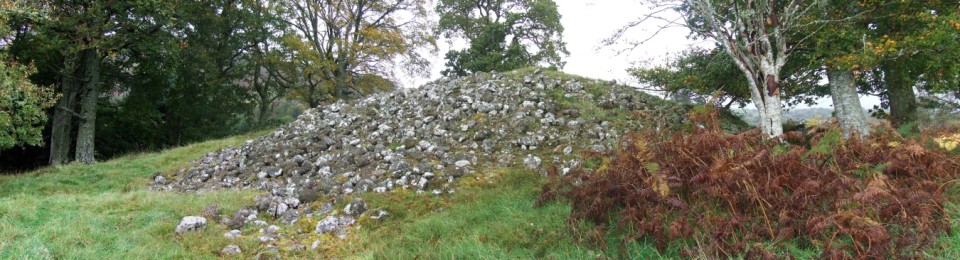
NG 6018 2337 On the summit of Beinn na Caillich, the conspicuous hill rising to a height of 2403' about 2 1/2 miles west of Broadford, is a cairn of stones measuring some 50' in diameter. The body of the cairn measures 8' in height, but seems to have been originally higher, as the top is surmounted by a cone of stones rising another 6' in height, doubtless of late construction. Although local tradition says that it was erected over the grave of a Norwegian Princess, without excavation it is impossible to say if it is a prehistoric monument. Hill top cairns of large dimensions and at considerable altitudes are found in many parts of Scotland.
RCAHMS 1928.
A cairn as described by RCAHMS.
Visited by OS (A C) 27 June 1961.
|

|
Stronach Wood I had added this strange little news item a week or son ago but it has disappeared. Perhaps it was thought to be of little interest, but I feel this is important.
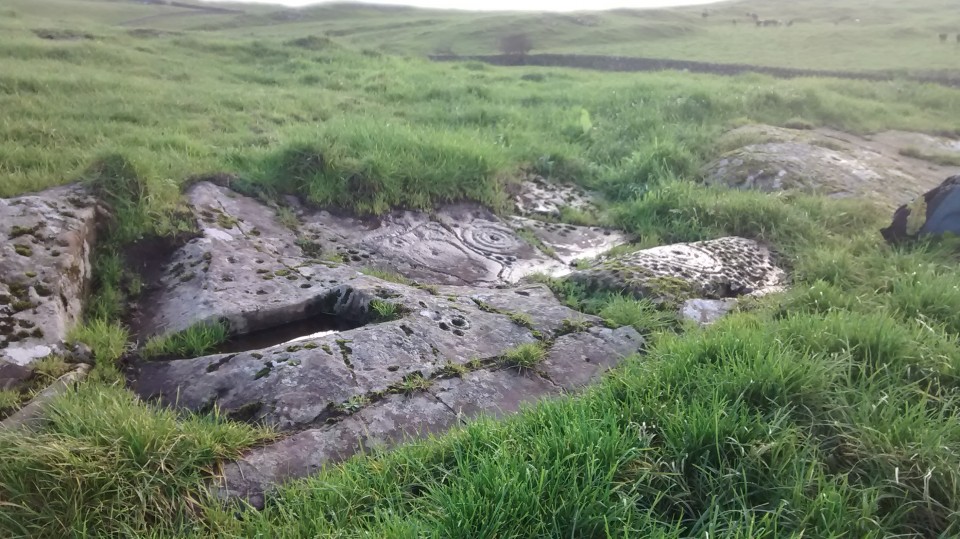
This appears to be a personal excavation by Brian Robertson (no Thin Lizzy connection) on a site covered by Historic Scotland and RCAHMS. The excavation does not appear to have been carried out by either of these organisations. This is a rock art site of national importance. From the picture the turf appears to have been stripped back substantially and from the text appears to have involved weeks of "digging"... mibbe with a spade?
I am sure if a local well-meaning individual decided to strip back the turf on Priddy Henges or Stonehenge we would all be reading about it here. Especially if they found that people had been burying treasure "caches" there in recent years.
http://www.arranbanner.co.uk/2012/11/16/mairis-treasure-unearthed-near-brodick
Mairi’s treasure unearthed near Brodick
on November 16th,2012
Brian Robertson of Brodick has unearthed an interesting little treasure cache just outside the village. For some weeks he has been clearing a prehistoric Neolithic cup and ring site in Stronach Wood and has found some buried treasure no more than seven years old.
He said:‘ On the fourth day I came across this small plastic box. ‘When I took it home and opened it I found nine coins,one of each denomination and the newest being dated 2005.
‘There was also a small decorative dolphin,a piece of agate and a heart-shaped stone,plus a small card with red ink writing. ‘It was addressed to ‘Miss Mairi Dare,with bunches of love’,and said inside:‘Well done Mairi! You’ve found the treasure. Now give your Mum and Dad a kiss. Much love from Great Aunty Fiona xxx’.’
Do you know who Great Aunty Fiona or Mairi? Read the full story in the Arran Banner edition of November 17 2012,or on line at www.arranbanner.co.uk/digital and let us know if you know who these people are.
http://www.arranbanner.co.uk/2012/11/16/mairis-treasure-unearthed-near-brodick
|
|
Grey Weather at Calla
This site has long intrigued me. A broch... here in the dark badlands of South Lanarkshire? Well... why not? After all... on my short twenty minute journey to the site of Calla Broch I drove past a henge, a Norman Motte, the oldest roofed building in Scotland, the late Upper Paleolithic site at Howburn, an important roman crossroads, a roman fortlet and a field with two emus in it.
The broch site is just that... just a site, A stump.. but it is a beautifully elevated platform with stunning views to Tinto, Quothquan Law and within sight of the massive roman complex at Castledykes by Ravenstruther. It is thought that the legions had a hand in bringing this mighty structure crashing down at the end of the first century.
The broch was known locally as "the quarry" for centuries and has provided the drystane dykes for many of the fields here. The site itself has intact walling most of the way round, but it is just well concealed under turf, deep undergrowth and fallen trees.
A quiet site with little to catch your eye. There are some large blocks of worked and hewn masonry scattered at the edge of the platform and here and there where you can find the curtain wall's edge, it is robust and stands quite a few courses in height.
The site has never really been excavated. Chatting with a local archaeologist about it a few years back, he described the broch as having been toppled into itself. The resultant heap was then quarried over centuries and then the area around the broch heap was planted with conifers and Beech. Many of these old trees have blown down around the edges of the broch platform and remain uncleared. It would take an army to clear this place in order to let any excavation take place. A very limited dig some years ago uncovered a couple of pieces of cannel coal.
|
 
|
|
   
|
High Auchenlarie - October 2012 - Notes in Grey Weather.
Three days and nights of unrelenting rain have rendered what is normally a well-drained, steeply-sloping pleasant field of springy upland pasture into a flowing quagmire of muddy goo. My climbing boots skite left and right as I clamber up like a novice ice-skater. The possible "cairn" lies uphill, in the top right corner of the first field above High Auchenlarie Farm (best park at the wide point below the farm road-end where the Auchenlarie Burn flows under the Laggan Outdoor Centre B-road). Follow the track up from the minor road and turn left through a metal gate just before the farm.
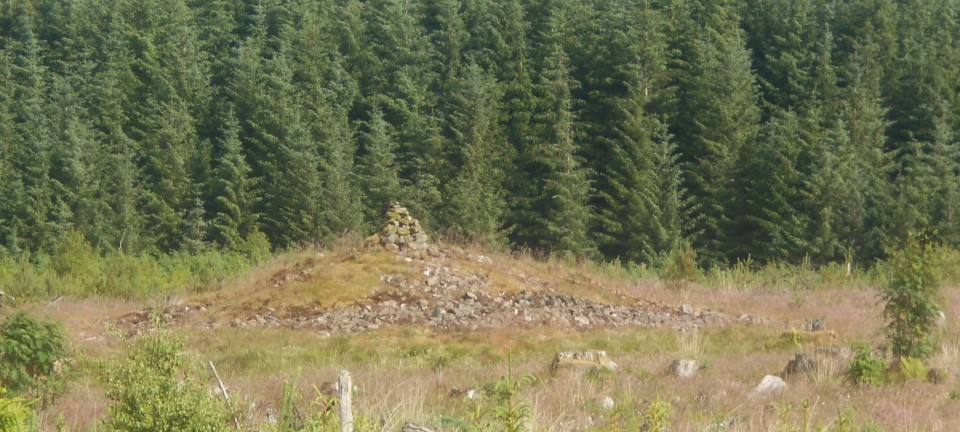
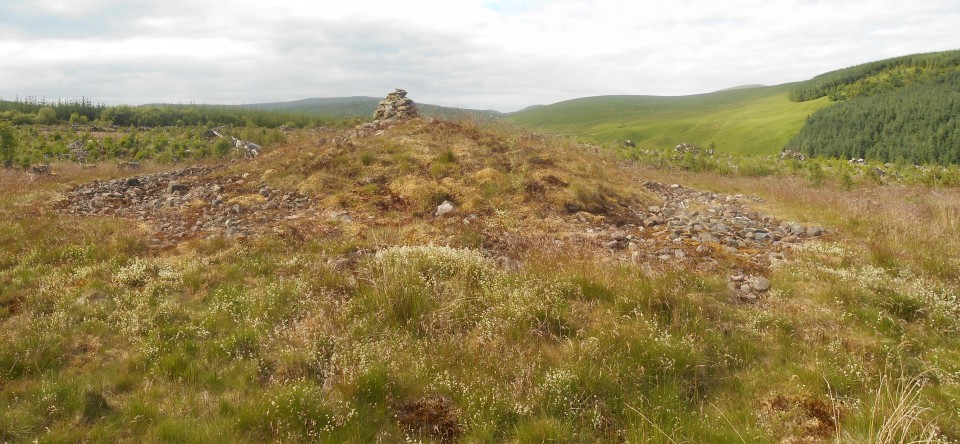
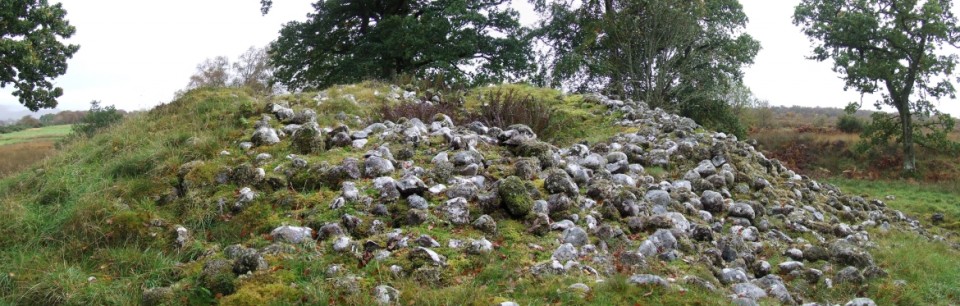
The “cairn” is disappointing, being formed of a number of large slabs and boulders dumped on top of a low mound of smaller stones. It is not quite a metre high now. The whole thing looks exactly like a low pile of field clearance and the fields around here are full of such field clearance cairns – some much larger. The views down over the roofs of the static caravans at Mossyard and out over Fleet Bay to Wigtown Bay and beyond are spectacular. The view hung like an apocalyptic storm-scene as painted by a depressed Turner, nursing the mother of all hangovers. I have seen this site in beautiful summer and autumn weathers many times and the views out to the Isle of Man are spectacular. The walk over from Cambret over Cairnharrow and Barholm Hill via Cauldside takes in a few sites well off the track and worth of a few hours stiff walking. Half a mile or so above the disputed cairn in unimproved hill-sheep land is a spectacular cairn, quite undisturbed and standing over 10 feet high proud and confident of what it is. Not this place though. Without excavation I think it must remain a site of disputed antiquity – albeit one surrounded by authentic sites and with an outlook worthy of Galloway’s best.
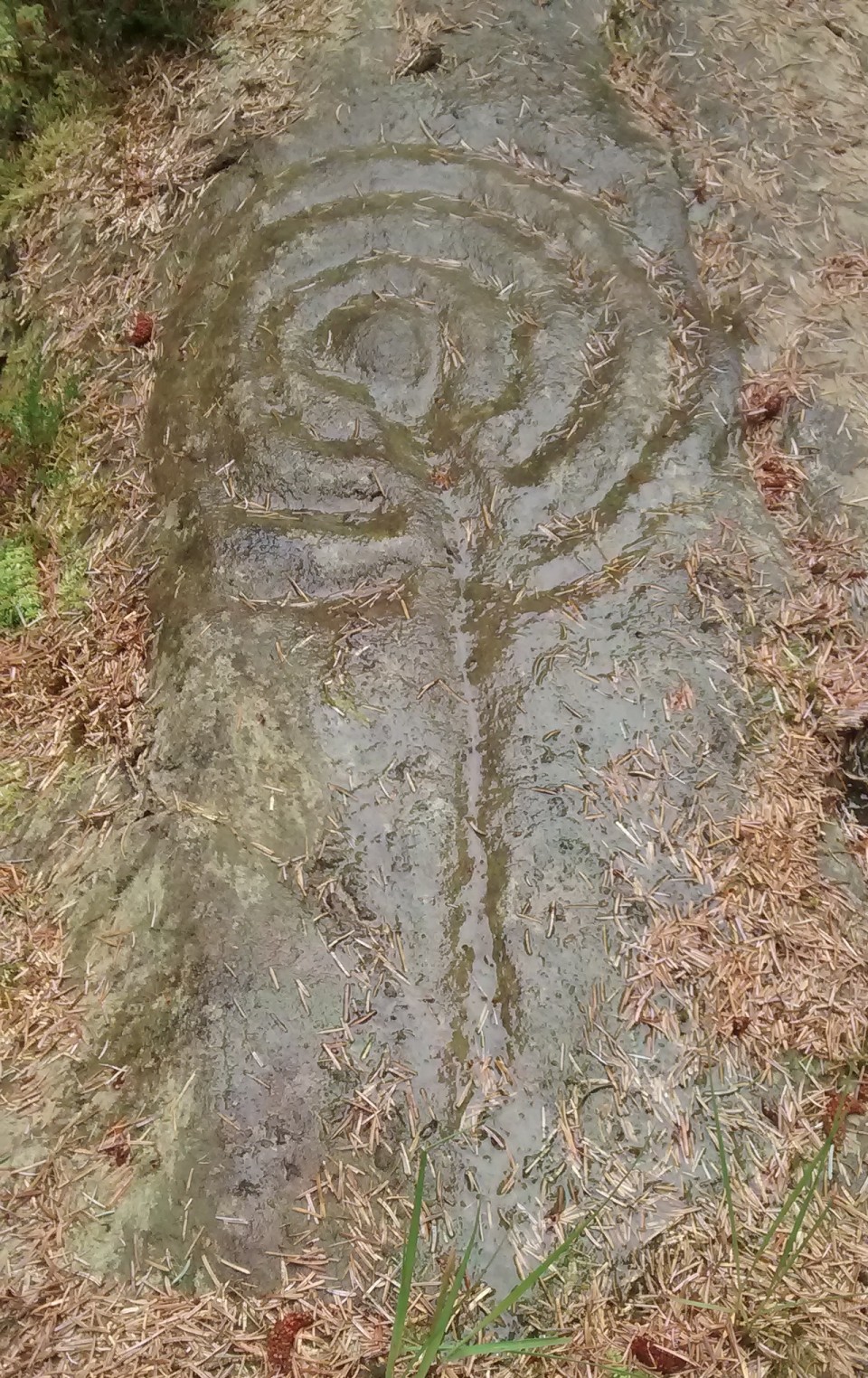
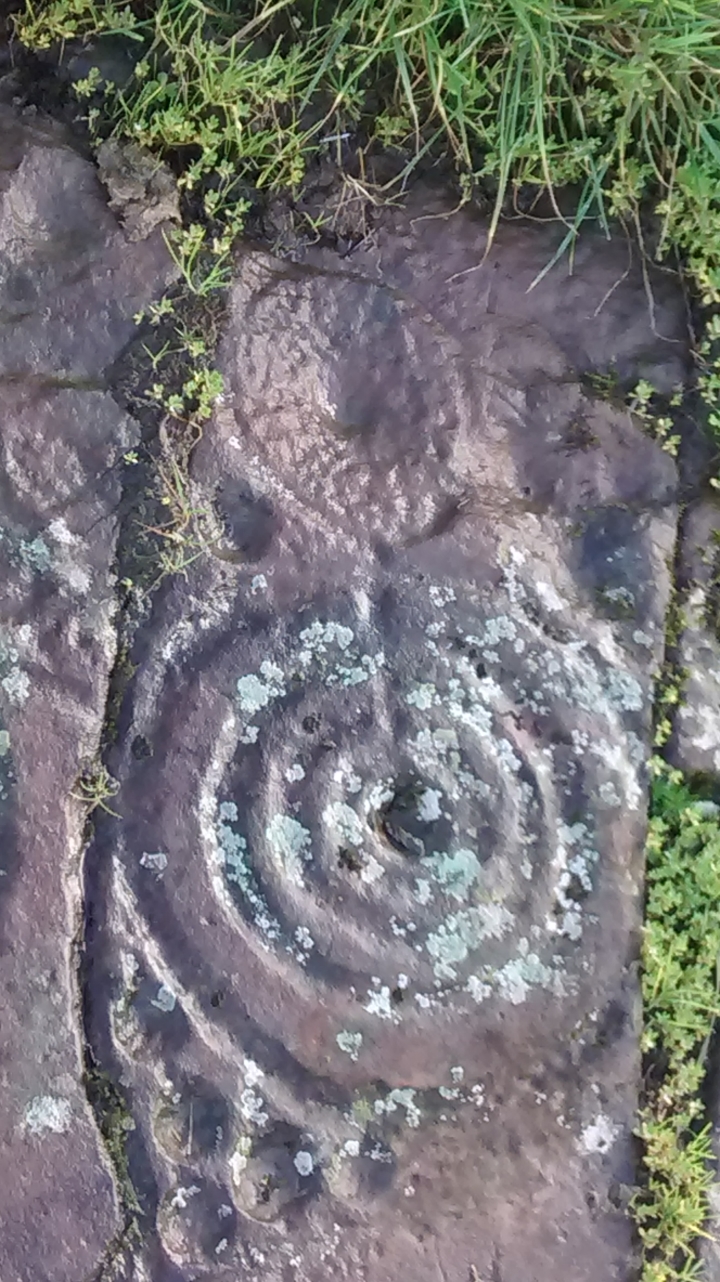
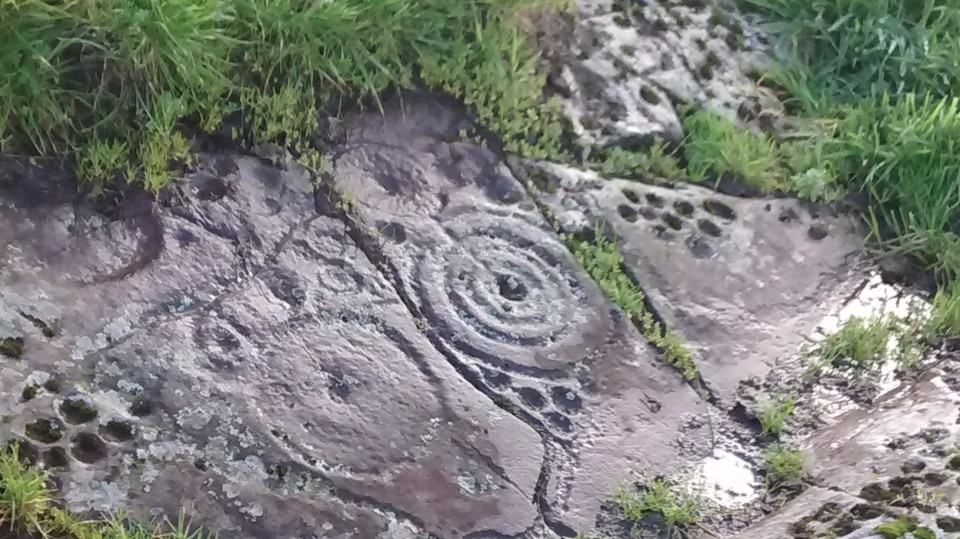
The cup and ring marked outcrop 15 yards SW is well turfed up and once the deluge started again I quit and slithered back down the hill to my car. I'll take my trowel the next dry day I am up there!
|
|
|
|
|

|
     
|

|
It was my OH who picked this summer's Arran holiday cottage deep in the heart of the Merkland Wood. My preliminary researches confirmed my suspicions - the cist I had unsuccessfully sought in previous years lay somewhere within the cottage's grounds. Last July I had spent a frustrating couple of hours getting eaten alive by midges and cut and scratched by bracken and rhododendron as I tried to find the cist said by the antiquarians to be "situated on a small eminence" above a burn and described by the OS to be "poorly preserved".
I parked in the small tarmacked boat ramp and crossed the road to the trackway leading up to 2 cottages at Maol Don. Do not go up this track, instead enter the rhododendron jungle to the left of the cottage track but to the right of the roadside stone wall.
I found a vestigal path which sort of becomes a burn. To the left rises the "small eminence". This "small eminence" turns out to be a thirty foot cliff whose top is swathed in head-high bracken and rampant rhododendron. As I clambered up the steep crumbling bank I found myself gazing into a dark hole surrounded by mossy stones. I knew I was right on the money. Badger activity six feet below this cist has left it in a bit of a precarious position. This cist is not poorly preserved - indeed it is in great nick - and sits jutting out of the sloping bank above the burn just just below the flat top of the "eminence". In previous attempts to find this cist I'd been stumbling around on the eminence's "summit top" among the tick-laden, midge-ridden ferns and shrubs.The landowner's attempts to hack back the invasive rhododendron has left many ankle breakers and stumps which are real trip hazards in the deep undergrowth. But you don't need to go there & if you find yourself up there amongst the bracken you have passed the cist.
The cist is complete, the mossed-over capstone is in place, the four side slabs sit vertical and in position. This cist's dimensions are a bit larger than those described on Canmore, so a part of me wonders if this is the same cist. There are no photographs or sketches of the Merkland cist described on Canmore (or in Balfour's Book of Arran Vol 1)) to work from, but I am presuming it has to be the same one. This is a very quiet, deep woodland setting for a cist in a fine state of preservation. I stood brushing off midges with the slanting bars of evening sun transforming the wood into a tropical rainforest of rhododendron blooms, green ferns and deep moss with tall natural Scots Pines forming a scented canopy. I got the impression that no-one had visited in a very long time. A very cool resting place.
|
| |