|
 Log in |
Register Log in |
Register
|

|
|

The Sweet TrackAncient Trackway
|
||||||||||||||||||||||||


 0 discussions


 Show map (inline Google Map)
|
|
|
News |
 Add news Add news |
Somerset Celebrates - good news for future development of the Avalon MarshesNot strictly stone news, but the good news that a landscape is being preserved and getting some money as well! Especially after the closing down of the Sweet Track Centre...... continues... |
 Posted by moss
21st May 2010ce |
Images (click to view fullsize) |
Add an image |
|
Fieldnotes |
Add fieldnotes |
|
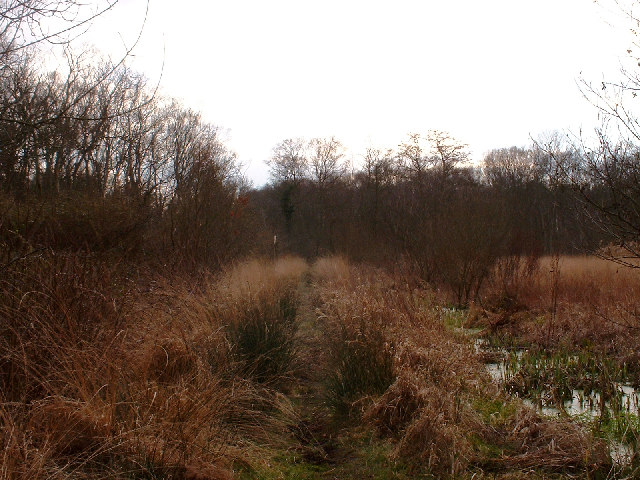
I spent a very tranquil afternoon at Shapwick Heath today. It was so sunny, and when you're wandering along the tracks in the dappled shade, dodging the soggiest peatiest spots, and being followed by dragonflies, it's just marvellous. We sat in a hide for ages, looking out over one of the lakes, listening to the rustling reedbeds. It really is so quiet and remote feeling, you've got Glastonbury Tor poking up on the horizon, and you feel miles away from modern life. It's very good for me. But to get to the point, at the moment, English Nature have opened the path that follows the line of the Sweet Track - it's not always open as often it's too wet. But at the moment you can walk through the wet woodland, brushing through all the sedges and the ferns (there are Osmunda royal ferns mmm) and walk pretty much where the builders of the track walked, back in 3800BC. How mad is that. It was a total pleasure. I recommend it very much. There's even a very decently surfaced path to where you can see (imagine) where the track was - EN take access pretty seriously at Shapwick. The other tracks around the reserve are variously accessible (most very much so), and of course they are all pretty flat, it being the Somerset levels. The specially-opened track does require you to climb up and down a few steps, wind along a narrow path, and hop across trainer-swallowing squishy peat though. There's some good information about the way the Sweet Track was built at Digital Digging. (And I finally discovered today that it's called the 'Sweet' track because Mr Sweet was the man who spotted it. Just in case you were wondering too.) |
 Posted by Rhiannon
22nd July 2012ce Edited 23rd July 2012ce |
Miscellaneous |
Add miscellaneous |
|
Details of trackways on Pastscape (ST 42184020 - 42904178). The 'Sweet Track', between the Shapwick Burtle and Westhay 'island', was discovered in 1970 by Mr Ray Sweet, and was excavated in three stretches, 'B' (Burtle), 'F' (Factory), and 'R' (Railway), between 1970 and 1977 (see Plan). Closely associated with it was a slightly earlier track, the 'Post Track', which was roughly on the same line and was probably largely dismantled when the Sweet Track was built. The construction of the Sweet Track was relatively refined and consisted in stretches F and R of a pegged plank catwalk laid over peat packing round a continuous rail of cross-pegged tree stems (see Diagram). In stretch B however, as drier land was approached, the track was cruder, with various improvisations - timber matting, clay surfacing etc. (1) A number of radiocarbon and pollen analysis tests give a consistent dating to the track of about 3200 bc, making it the earliest known timber track in Britain. (2) In the F and R stretches a great quantity of well-preserved rough wooden artifacts was found - paddles, a dish, arrow-shafts, parts of bows, yew-pins, etc. There were also flint-flakes, leaf-arrowheads (one shafted), a chipped flint axe in mint condition (typologically late 4th millennium), a jadeite axe (also late 4th millennium, cf 2a), and pieces of at least 9 Neolithic pots. (3) The Sweet Track has now been investigated at four major sites along its route - The factory site, F, and the southern terminal, B (see reference 1 above) the Railway site, R (see reference 2 above) and the Drove Site, D. This report concerns excavations in 1977 at the Drove site, situated between the factory and burtle sites at the S. end of the route. (See Illustration Card for location plan). (4) In 1980 the full length of the Sweet Track was established and information obtained on its state of preservation. (5) Timber trackway scheduled at ST 423403, ST 422404-425409 and ST 426411. (7) |
 Posted by Chance
10th April 2016ce |

|
The Sweet Track is an ancient causeway in the Somerset Levels, England. It is one of the oldest engineered roads known and the oldest timber trackway discovered in Northern Europe. Tree-ring dating (dendrochronology) of the timbers has enabled very precise dating of the track, showing it was built in 3807 or 3806 BC. It has been claimed to be the oldest road in the world. The track was discovered in the course of peat digging in 1970, and is named after its discoverer, Ray Sweet. It extended across the marsh between what was then an island at Westhay, and a ridge of high ground at Shapwick, a distance close to 2,000 metres (about 1.24 miles). The track is one of a network of tracks that once crossed the Levels. Built in the 39th century BC, during the Neolithic period, the track consisted of crossed poles of ash, oak and lime (Tilia) which were driven into the waterlogged soil to support a walkway that mainly consisted of oak planks laid end-to-end. Curves at the bases of the poles show that they were from coppiced woodland. Due to the wetland setting, the components must have been prefabricated elsewhere. Most of the track remains in its original location, and several hundred metres of it are now actively conserved using a pumped water distribution system. Other portions are stored at the British Museum, London, while a reconstruction can be seen at the Peat Moors Centre near Glastonbury. Since the discovery of the Sweet Track, it has been determined that it was actually built along the route of an even earlier track, the Post Track, dating from 3838 BC and so 30 years older. http://en.wikipedia.org/wiki/Sweet_Track http://www.newscientist.com/article/mg12617212.800-science-the-day-the-sweet-track-was-built.html |
 Posted by nix
13th June 2009ce Edited 13th June 2009ce |
 Top of page