Friday 27/8/04
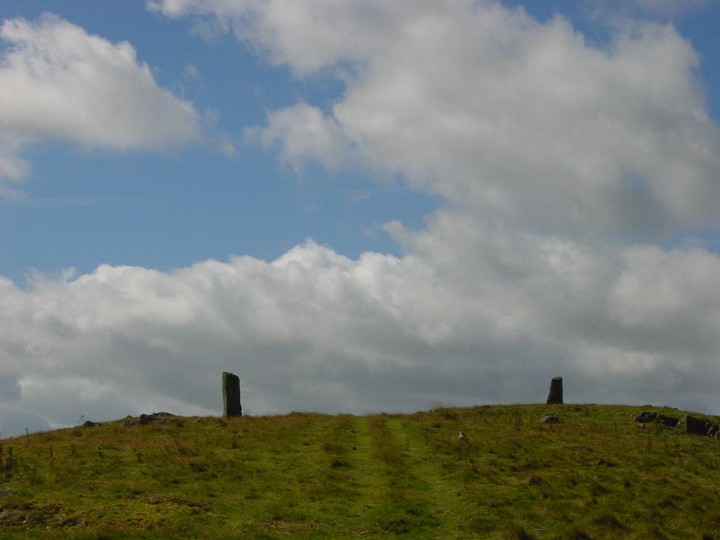
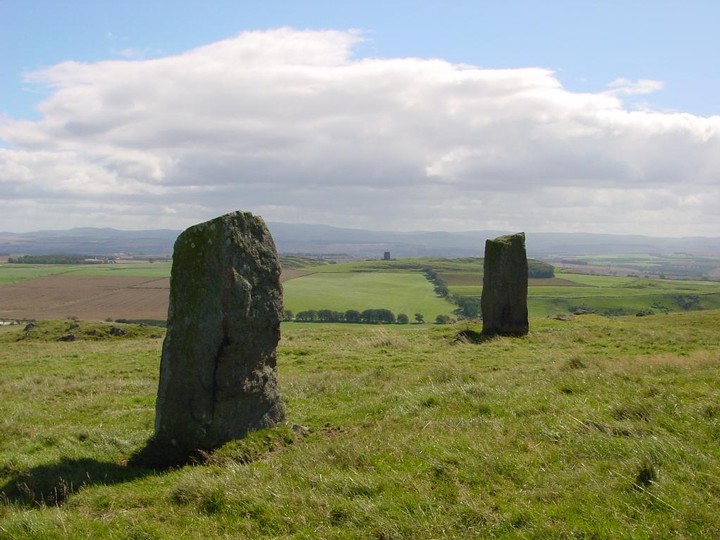
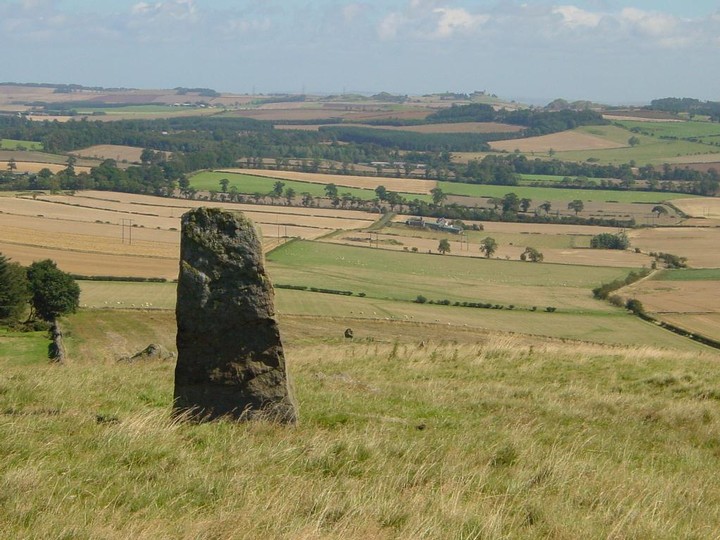
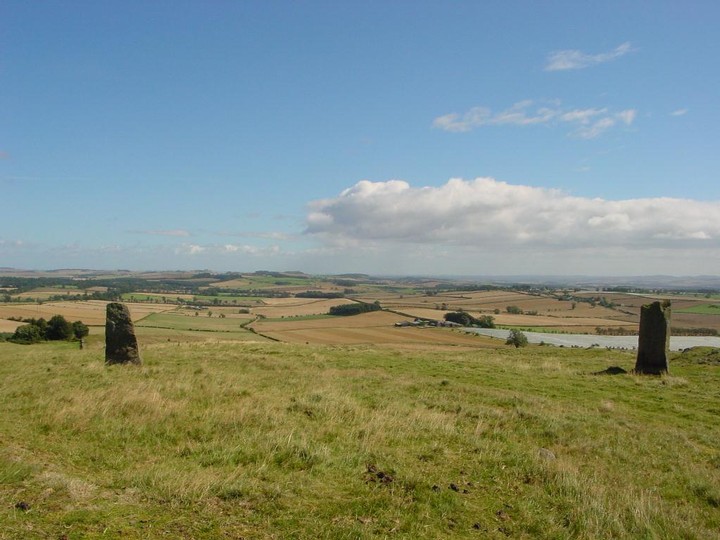
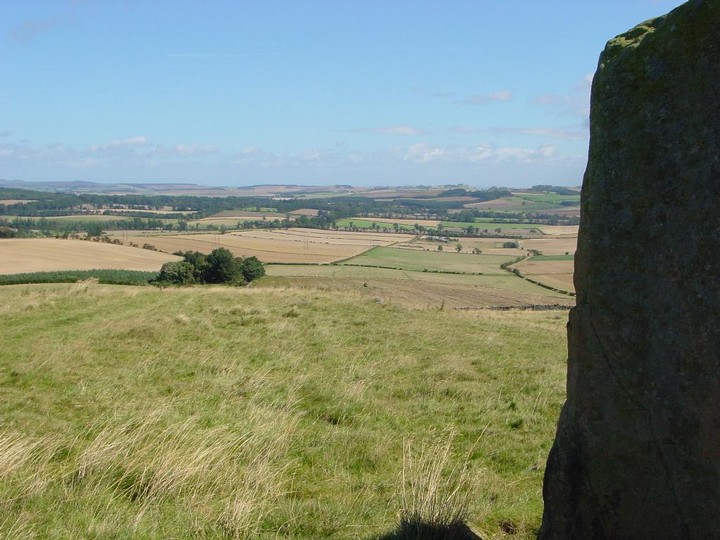
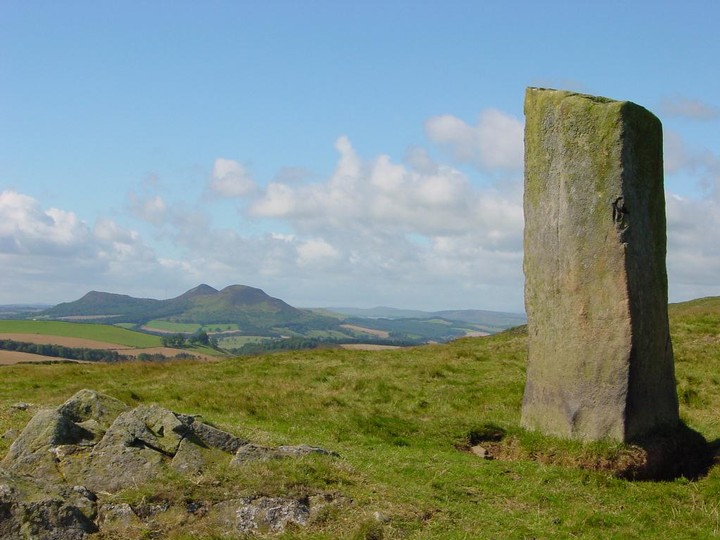
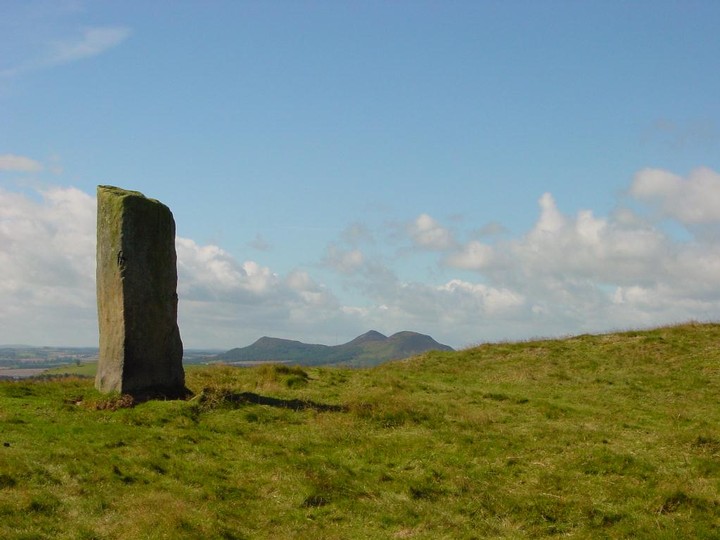
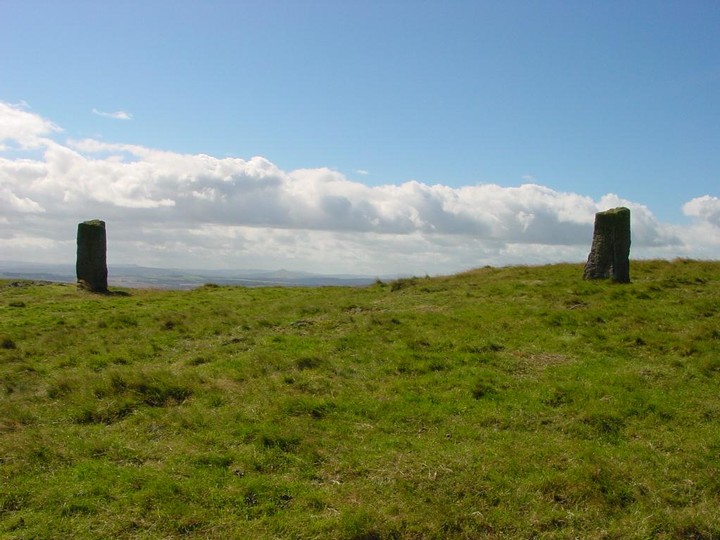
Absolute genius. The vision to place these stones atop this hill as a monolithic mirror image representation of the Eildon Hills is phenomenal. I am blown away by this (almost literally- it's a howling gale up here!). It's not until I visit the Cow Stone, just 320 m ENE and slightly downhill from here do I appreciate that these stones feel also like a gateway. I don't think that the Cow Stone should be seen as a completely separate monument as the three work so well together. I walk back up the hill from the Cow Stone to the Brothers Stones- and, in between these giants, the land to the West opens up and right in the middle- the Eildon Hills. I actually said 'WOW!'
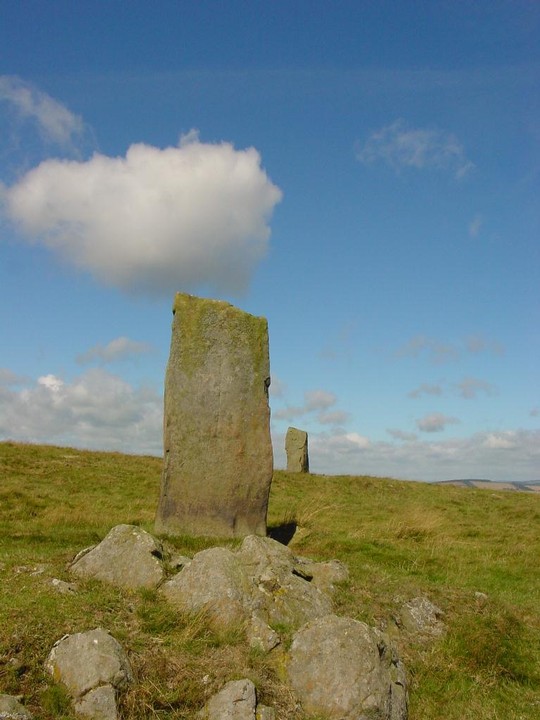
The pair are aligned NNW/SSE. The northernmost stone is rectangular in section measuring 75 by 57 cm. The stone tapers to the top (2 m high) and the rectangular top is angled and slopes up from E to W in the direction of the Eildons- as does the southernmost stone. The S stone is triangular in section and measures 90 cm by 1 m by 1 m. It's a beast at 2.5 m high. One side is aligned perfectly N/S.
Apparently two brothers grew up happily in this area, but went off separately to find their fortunes far away. When they returned (curiously, at the very same time) one of them had become a firm believer in Catholicism, the other was a staunch Protestant. Foolishly starting a conversation about religion (surely a renowned topic to avoid) and finding they could not agree, they took the obvious decision to draw swords and sort it out in a duel (Jesus would be so proud). Naturally they both suffered a mortal blow and died - just on the spots where the two stones are, which were erected by the local people in memory of them. To place further burden on our credulity and add another popular theme it is also said that the brothers did not recognise each other when reunited (until, no doubt, just before they expired). I must be turning into a cynic.
***
This may well be the source, from a 1930 excursion of the Berwickshire Naturalists' Club:
The party then drove to Brotherstone farm, from where a short walk was taken to the two tall Greenstone Monoliths, from which hill and farm take their name. The rain ceased just long enough for this to be done in moderate comfort, but much of the fine view - practically the whole of the Merse to Berwick, the Lammermoors, Lauderdale, and the valleys of Tweed and Teviot - which lies spread out before the eyes on a clear day, was lost in heavy cloud.
The Rev. W.S. Crockett, D.D., said the Brotherstones must have stood there for a thousand years. They are one hundred yards apart, and might mark the burial place of some ancient chieftain. Some people held that the stones marked the site of a battle, but history made no mention of a battle ever having been fought there.
Local tradition held that the two stones were erected because of an incident that took place in Covenanting times. It was said that two brothers, having fought in foreign wars, returned home, and meeting on the top of the hill began an argument on theology. They grew so angry with one another that swords were drawn, and they fought until one was fatally wounded. It was only then, as he cried out his name, that the survivor realised he had killed his own brother. Dr Crockett pointed out, however, that long before Covenanting times the name "Brotherstone" appeared in the charters of Dryburgh Abbey as far back indeed as 1150.
Brotherstone Hill. -- On the summit of Brotherstone Hill, on the boundary between Mertoun parish and the County of Roxburgh, stand two greenstone monoliths from which the hill and farm derive their names. The name occurs in the Chartulary of Dryburgh during the thirteenth century.
The stones are placed 17 yards apart; the south stone measures 8 feet 6 inches by 3 feet 7 by 2 feet 11, and the north stone 5 feet 7 inches by 2 feet 10 by 2 feet 2. One of the stones fell in 1906, but was re-erected. Another large stone, called the Cow Stone, lies within the bounds of the County of Roxburgh some 350 yards to the north-east.
From 'History of the Berwickshire Naturalists' Club' v 26 (1923).
An entry from Ancient Stones, an online database that covers most of the standing stones, stone circles and other stones found in South East Scotland. Each entry includes details, directions, photograph, folklore, parking and field notes on each location.
 Log in |
Register
Log in |
Register


 0 discussions


 Show map (inline Google Map)
 Add an image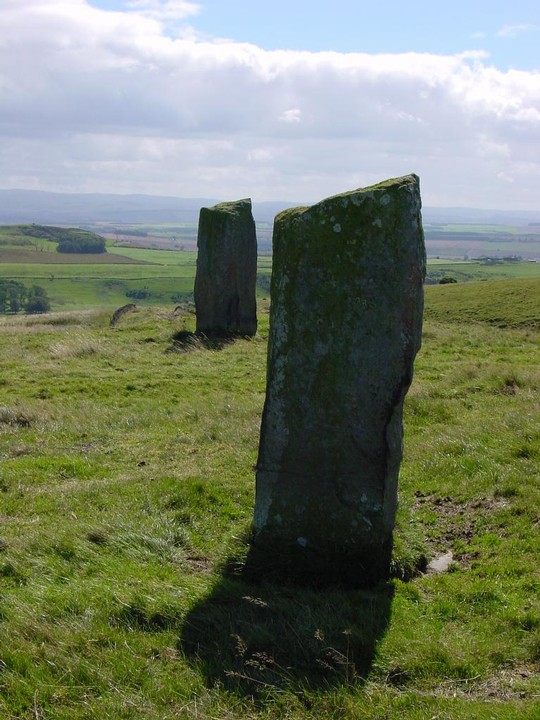
 Posted by Rhiannon
 Top of page