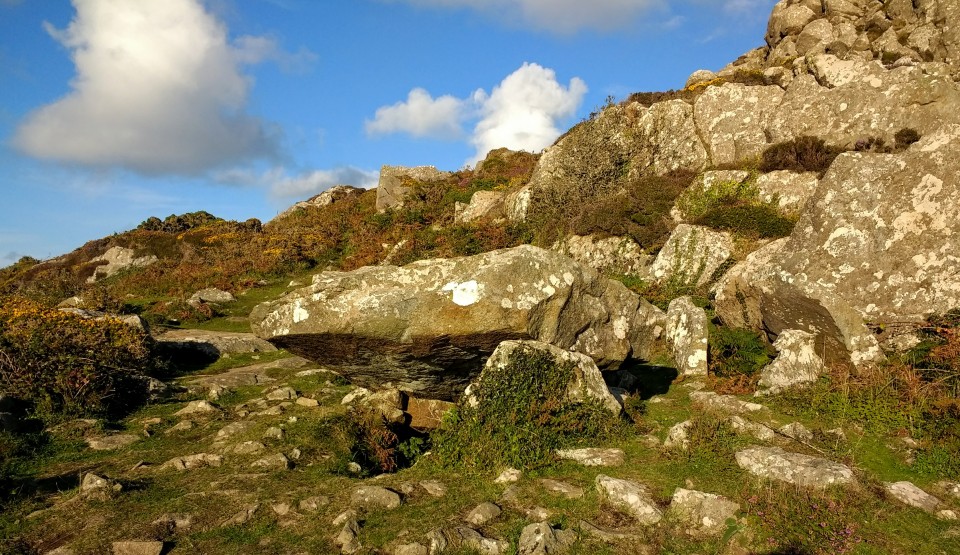
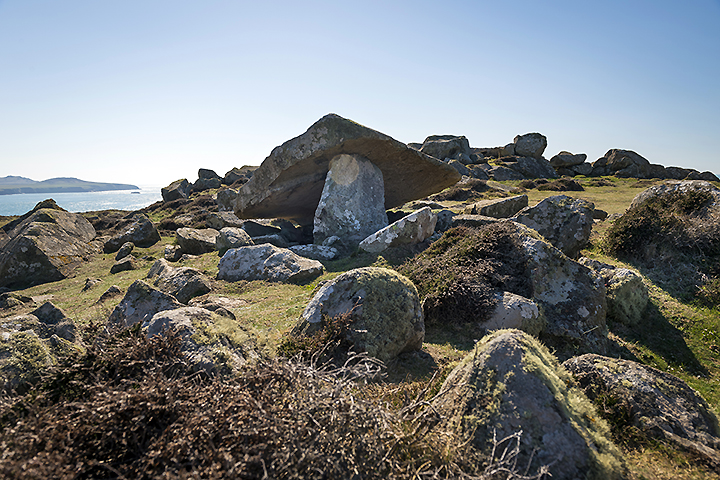
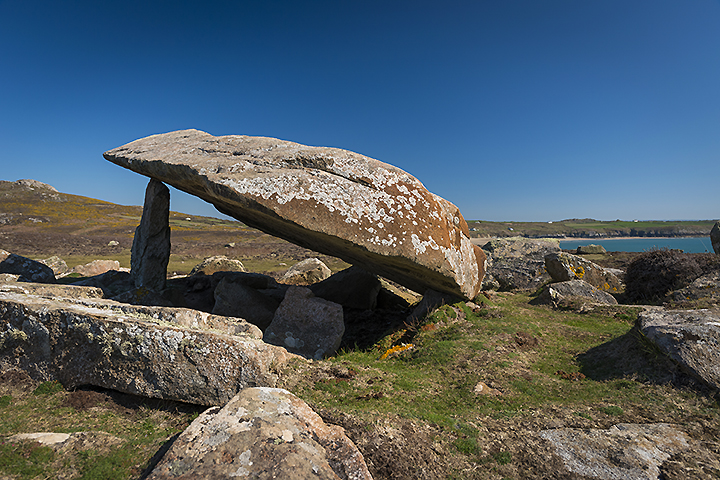
It may not be man-made but it's certainly 'megalithic', and (like in Cornwall??) may well be related to the siting of tombs like the nearby Coetan Arthur?:
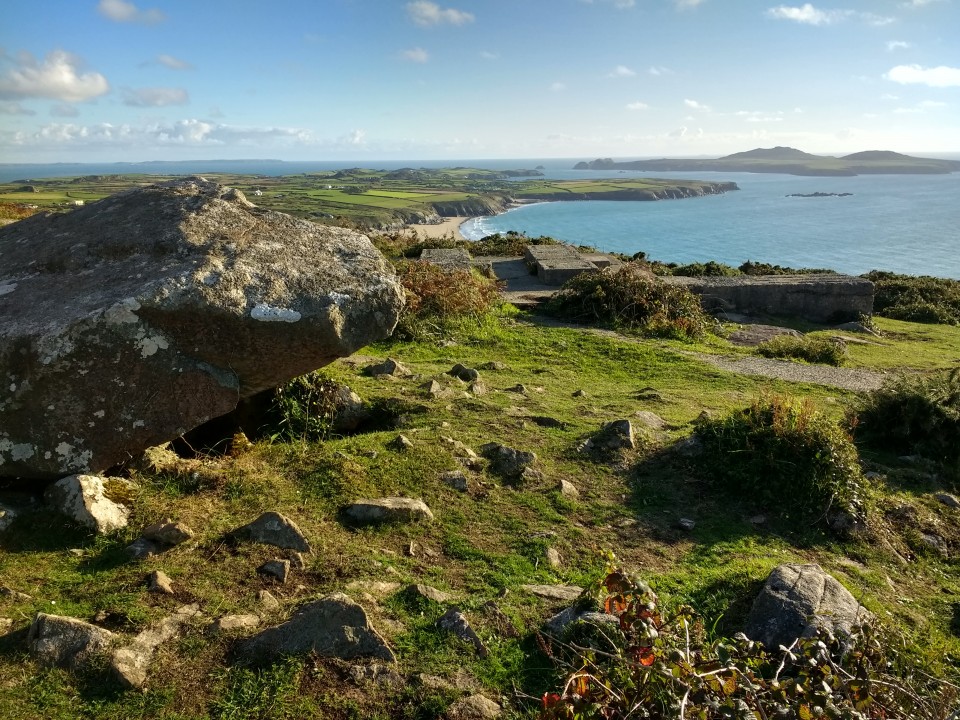
The Rocking Stone (we give it a title of courtesy which has survived its peculiar property) stands on the western slope of Carn Llidi, at a short distance from the cliff, and from the road leading to St. David's Head. Its height is five feet, its extreme length and breadth each six feet six inches; and it narrows somewhat towards the bottom. A little to the east there is a point of rock which may have acted formerly as the fulcrum.
Its displacement is ascribed to the Puritans by E. Lhuyd; but we fortunately possess an account of its original state in the unknown author quoted by Browne Willis:-
About a quarter of a mile from hence is the famous Stone which they call here the Shaking-Stone, Y-maen-sigl. It is so large, that 20 Yoke of Oxen will not remove it from its Place, and yet it lieth upon a Bank; and notwithstanding its Hugeness, (they say) a Child of eight Years of Age will shake it. I never saw any Child shake it; but I can move it, tho' six Men should stand upon it, with less than the Strength of one of my Hands, so much that a Man that stands upon it, would be afraid of falling.
From p24 of 'The History and Antiquities of Saint David's' by WB Jones and EA Freeman (1856). Browne Willis was an antiquary who wrote many books in the first half of the 18th century.
You can read Jones and Freeman's book online at Google Books. It's got lots of information about the location of destroyed sites in the area, which I'm sure will be of interest to those that know the area well.
Carn Llidi is the highest point on the St David's Peninsular, and home to various forts and settlements. Two burial chambers here have pits cut into the rocks.
An aerial photograph of St David's Head. From this page you can overlay the Ordnance Survey map by clicking on the Overlay Map link on the left hand side of the screen (this is a slow process though).
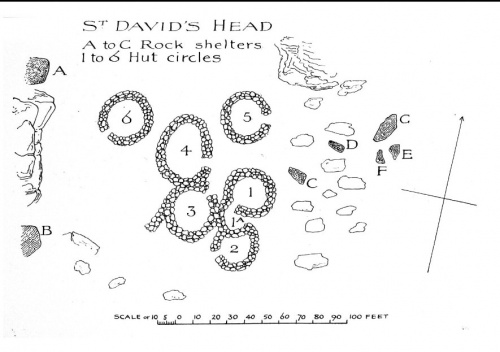
A chambered tomb, set in a disturbed area, c.70m E-W by 24m, possibly resulting from quarrying activity.
Two upright stones, 1.1m & 0.8m high, and a broken slab, 2.0m by 1.0m, along with other large stones, are set in a one of a series of hollows.
There is a reputed well in the rock of Clegyr Voya that is supposed always to have water in it, but to fill especially when the tide flows. It is a small hollow in the igneous rock, from which a core or crystal has fallen, and is about large enough for the fist to be inserted. This "Fynnon" is still in repute, and its water is regarded as sovereign, especially for sore eyes.
Whilst I was engaged on the exploration of Clegyr Voya, I went several times a day to the reputed spring, but never found water in it, though the rock and sediment at the bottom remained wet.
A tradition exists that, eighty years ago, a party of men resolved on treasure seeking in the camp. The first day, they had hardly begun to dig before a pouring rain came on which drove them away. They went again, and next day a thunderstorm broke over them; but they did not leave till they had uncovered a kettle. They attempted the third day to dig out the kettle, but on reaching the rock thunder and lightning played about it, and the storm continued with such violence, and so long, that they retreated and abandoned the attempt. The origin of the story seem to be this:-- It is commonly held that a subterranean passage connects Clegyr Voya with St. David's Cathedral, and that considerable treasure is hidden in it.
The approach from Coetan Arthur was a lot more tiring and time consuming than I thought... thick gorse and soggy mud the culprits. However the concrete access path just seemed too, well... perhaps some will understand.
The tombs stand near the concrete bases of what I take to be World War II gun emplacements - historic monuments of immense significance, let it be remembered. However the summit of Carn Llidi, rising to the appox east, calls the stronger, as I guess such places always have to me. It is perhaps significant that the chambers are sited in a subservient location below and not at the summit itself. Then again this could have simply been a matter of practicality, I guess, since there's not much room on top. What there is, however, is the most exquisite 360 degree view! Ramsey Island sits off the coast to the south-west, beyond the white breakers of Whitesands Bay, like some enormous beached whale. Hey, or sea monster! Yeah, this is a place for superlatives, the overblown... for legend... for burying your dead, in fact. Funny you should say that? Well, other people had the same idea, did they not?
Although only rising to 181m (whatever that is in proper height) the proximity of the sea ensures the head swims, the mind reels at the enormity of being here in the approaching dusk. Suddenly I realise I must make my way down - like, er, now - to avoid being be-nighted upon this rocky crag. But what of the tombs? I will have to return some day for a proper look, I guess.
Another site I've been meaning to get to for, oh, ages... but continually baulked at the long drive. Let's face it, it's quite a pilgrimage for most of us. But then I guess that's the whole point... wouldn't be a kosher pilgrimage if the journey was easy, would it?. So no more excuses man! It won't get any easier with time, that's for sure.
Entering St David's upon the A487 is a somewhat odd experience. So this is a city, then? Hang on, Brecon's also got a cathedral... yet remains a town? Good for Brecon, I say. I don't get to see St David's famous building, instead veering up the B4583 to park beside the thundering breakers of Whitesands Bay. Judging by the size of the car park, this is a popular spot in season. And rightly so, numerous 'Johnny Utah' surfer dudes ridin' the crests in lieu of the bucket 'n spade brigade... when they are not 'wiping out', that is. Awesome! Anyway, The Pembrokeshire Coast Path heads north from here, hugging the coastline - as you would probably expect of a coastal path - and consequently providing some excellent views down into rocky coves. Hey, this is worth the parking fee in itself. Except, out of season, there is no parking fee. Nice.
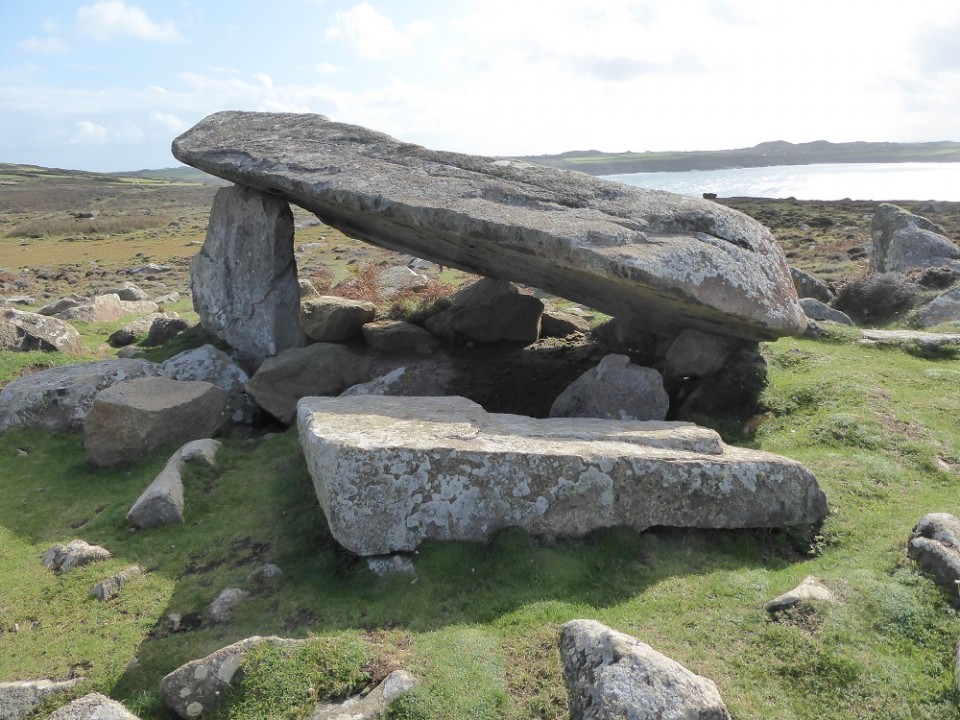
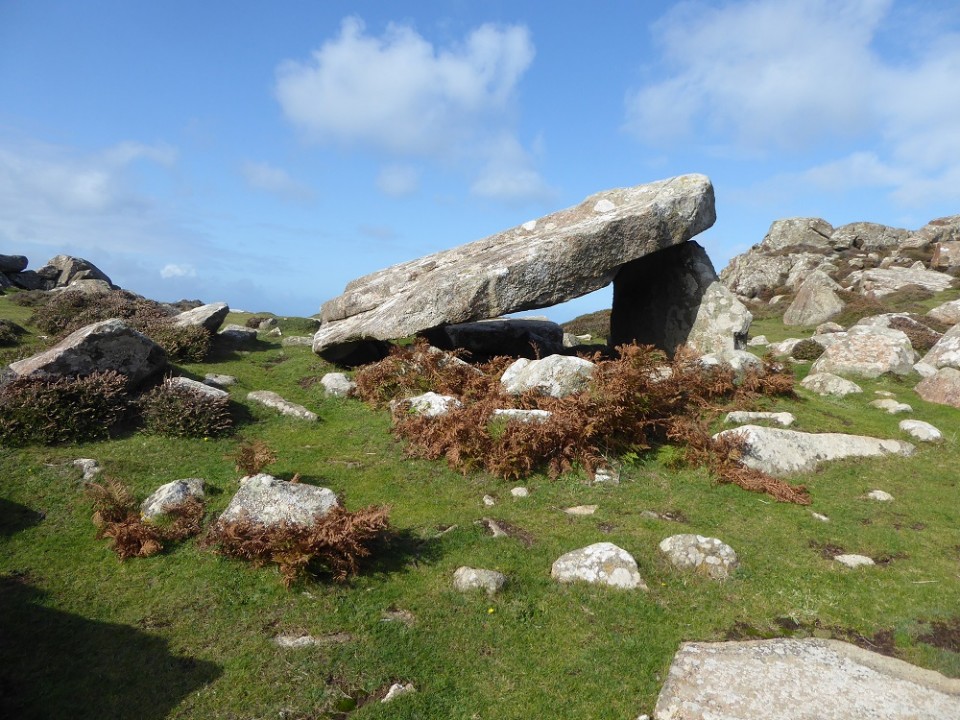
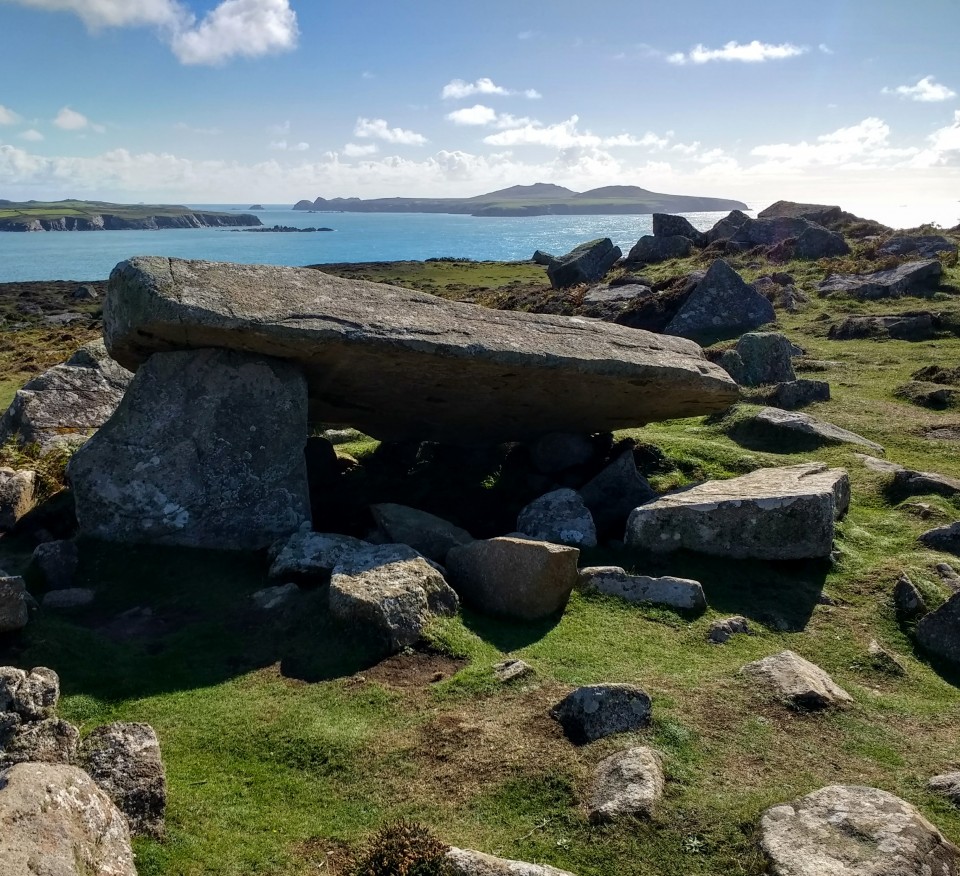
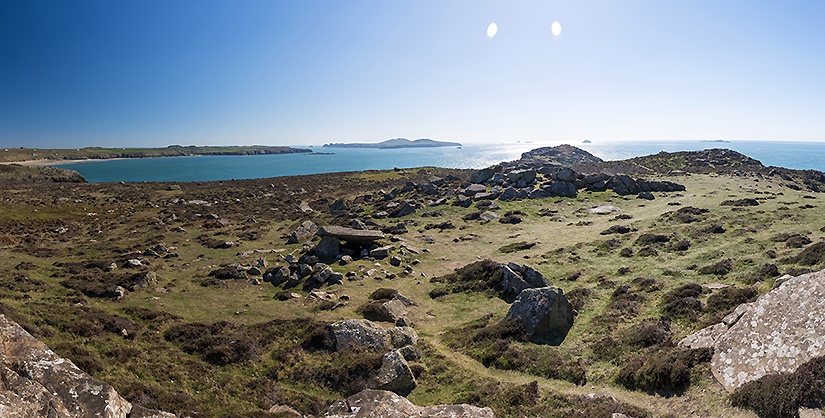
Coetan Arthur - certainly got around a bit, that Arthur, didn't he? - is visible from a long way off, the chamber sited (arguably) somewhat unusually between crags upon St David's Head itself. Incidentally, the map cites a 'fort' to the west. Upon arrival, I'm surprised at the size of the monument... for some reason I expected it to be diminutive. Perhaps because of the 'sub-megalithic' construction of the chamber, that is with one end of the capstone resting upon the ground, the other supported on an orthostat. However any aspersions of insubstantiality are strictly illusory, the chamber able to accommodate me with ease. This is just as well, since a vicious rain front suddenly sweeps in across Carn Llidi to give the landscape a pasting. But not me this time. Cheers Arthur. As I sit - or perhaps more accurately 'slump' - the sight of Carn Llidi looming beyond intrigues. Was there an association here?
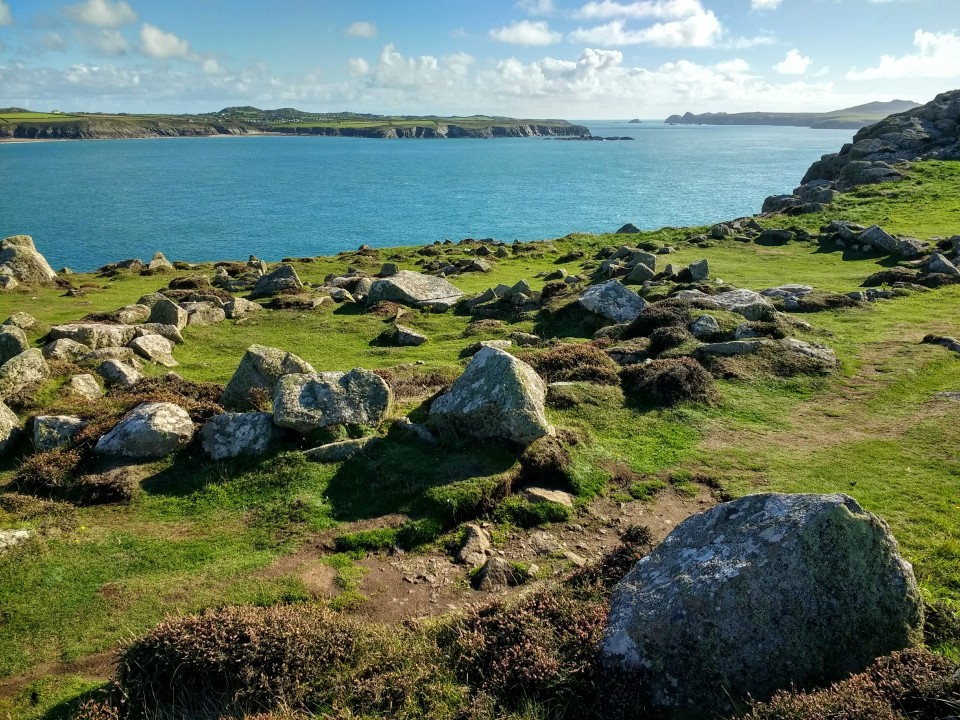
The squall passes, the sun vanquishes the cloud and illuminates St David's Head. I check out the capstone, a fine slab of stone with a pronounced 'spine' or ridge which... hang on... appears to point straight towards the site of the tombs upon the aforementioned Carn Llidi. Now, being somewhat the realist - I hesitate to say 'cynical', but perhaps - I'm wary of making the evidence fit a desired outcome. But, hell, it does appear to be a possibility [see image post]. Perhaps. Whatever, I find it difficult to leave this spot. The coastal views are sublime, Ramsey Island probably taking the plaudits in this respect, the chamber seemingly, well, just made for this very corner of Wales. Which, come to think of it, it was! I am glad I came.
Then, all too soon, time has expired. Can I make Carn Llidi before dark? We'll see.