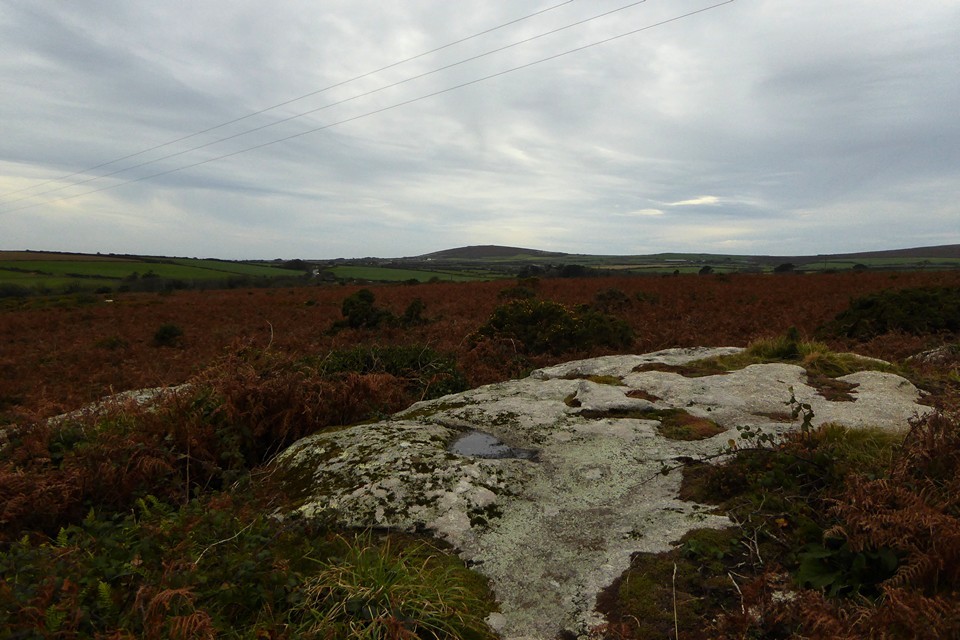
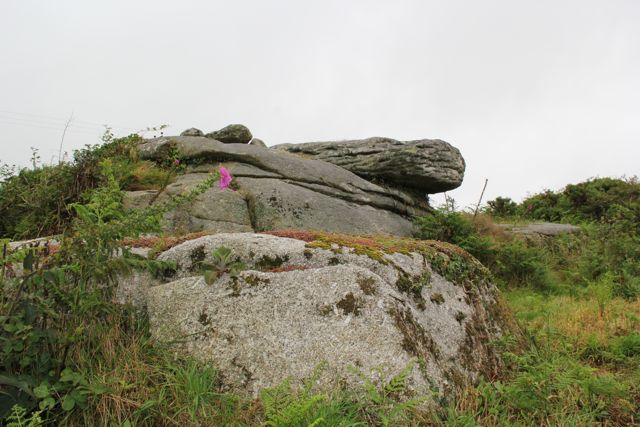
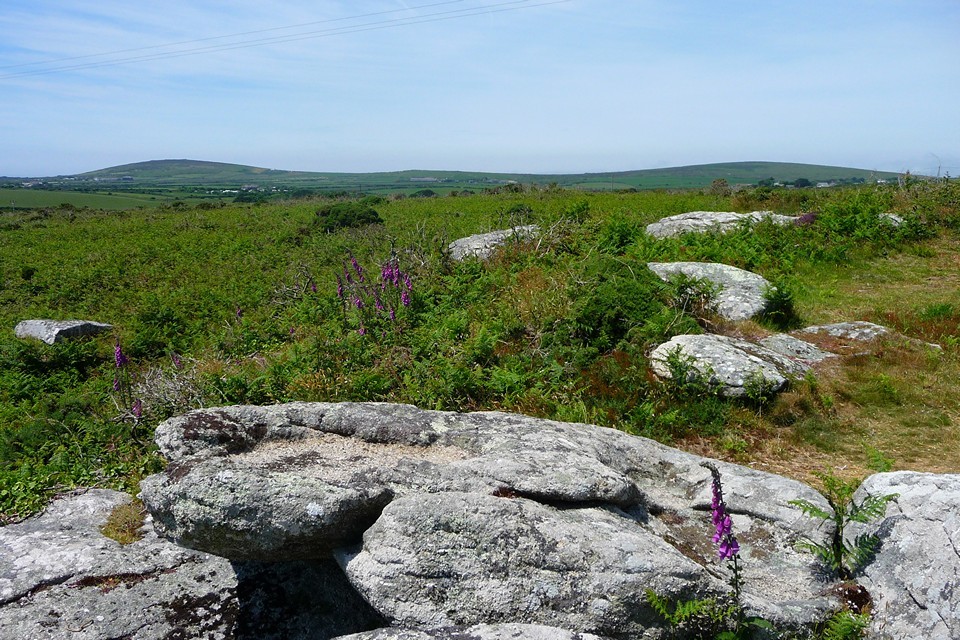
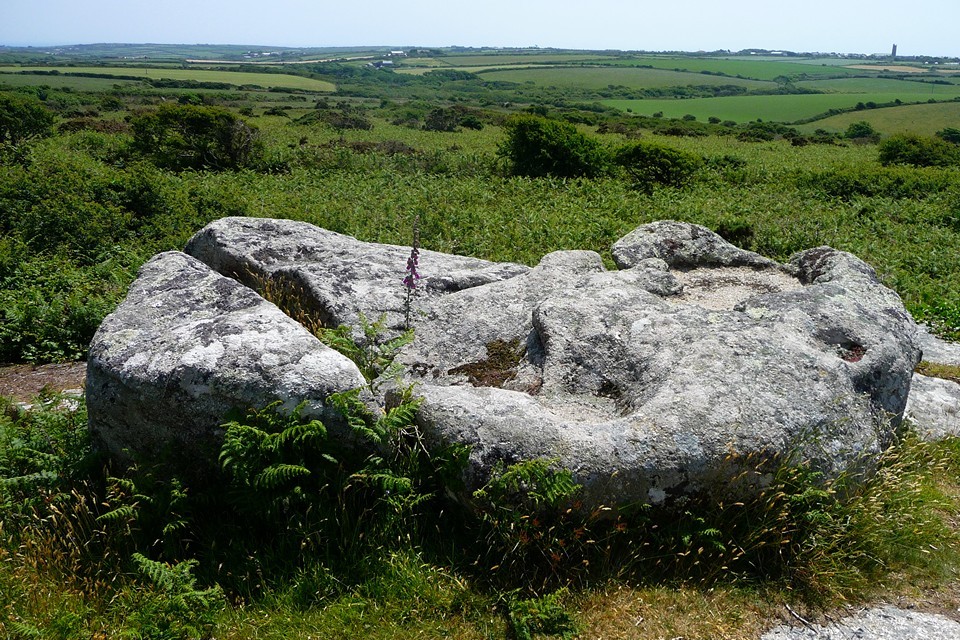
On the way back to the carriages [from the Boscawen-Un circle] the party visited Careg-Tol, a fine pile of granite rocks not far from the Circle, commanding an extensive view. Thereon are some shallow rock basins, the outline resembling a human foot, and which, being of superhuman size, are locally called giant's or devil's footprints.
From a report of an excursion of the Penzance Natural History and Antiquarian Society, in the Cornubian and Redruth Times, 3rd September 1869.
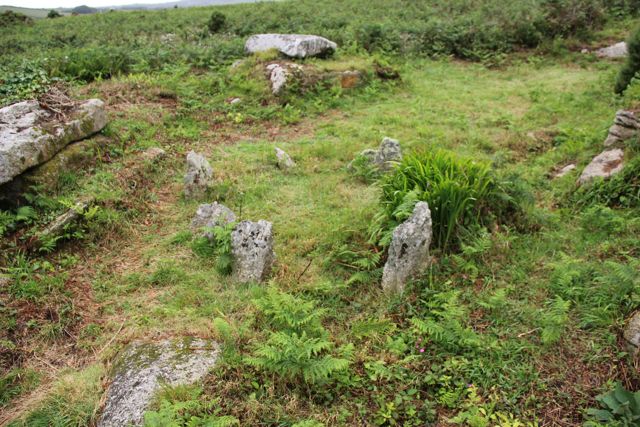
Among the rocks at Creeg Tol is what appears to be a tiny (a few feet across) stone circle, consisting of nine stones. I'm assuming it's a recent addition, as I've found no mention of it so far. Any ideas? It's certainly been made to look like the 'real thing', if only for the local piskies.
MARCH 2013: Accidentally found the answer to this on the West Cornwall Dowsers' website regarding a field trip to Boscawen-un stone circle: "In March, the West Cornwall Dowsers went for the first time for them to Boscawen-un stone circle. A good turn out of people went firstly to Creeg Tol rocky outcrop above the circle, where an energy line was found crossing the site on the way to and from St.Buryan church, which was visually apparent on the skyline. The Giant's Footprint and Rory Te Tigo's small stone circle were also investigated."
Rory Te Tigo is a local artist/Pagan/witch living in Penwith, so it is a reasonably recent addition.
I suppose this must be the Carn Boscawen referred to by Hunt in 'Popular Romances of the West of England'?
Dr Borlase has been laughed at for finding rock-basins, the works of the Druids, in every granitic mass. At the same time, those who laugh have failed to examine those rock-masses with unprejudiced care, and hence they have erred as wildly as did the Cornish antiquary, but in a contrary direction. Hundreds of depressions are being formed by the winds and rains upon the faces of the granite rocks. With these no Druid ever perplexed himself or his people. But there are numerous hollows to be found in large flat rocks which have unmistakably been formed, if not entirely, partly by the hands of man. The Sacrificing Rock, or Carn Brea, is a remarkable example. The larger hollows on the Men-rock, in Constantine, several basins in the Logan Rock group, and at Carn Boscawen, may be referred to as other examples.
"In going or returning from the circle a pile of rocks is passed on which are several cavities, two of them resembling the impressions of human feet, but much larger. They are called the "Giant's Footsteps". The cairn is known as Careg or Creeg Tol, the holed rock.
 Log in |
Register
Log in |
Register


 0 discussions


 Show map (inline Google Map)
 Add an image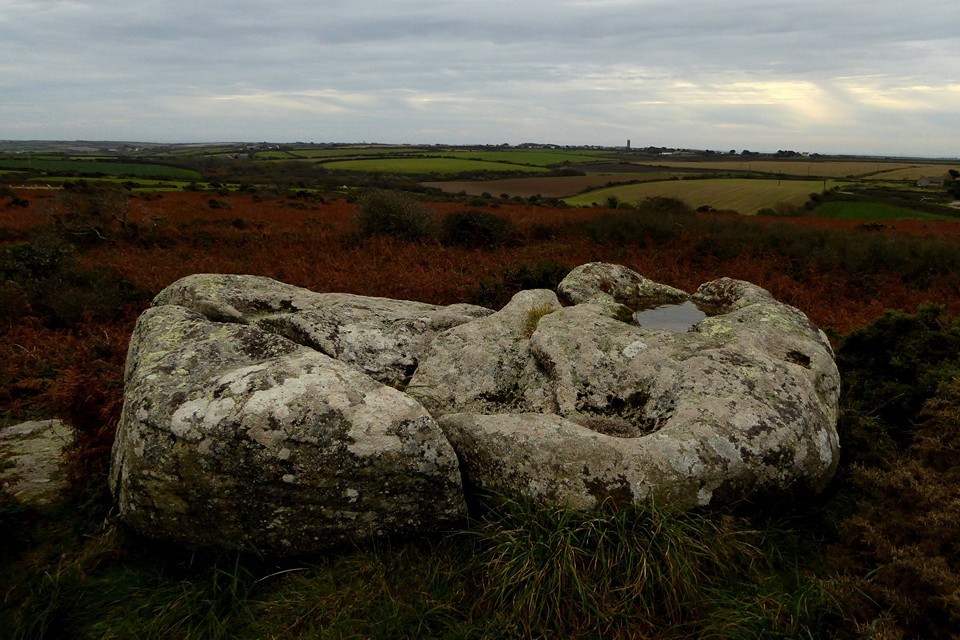
 Posted by Rhiannon
 Posted by Incoming Traveller
 Posted by Mr Hamhead
 Top of page