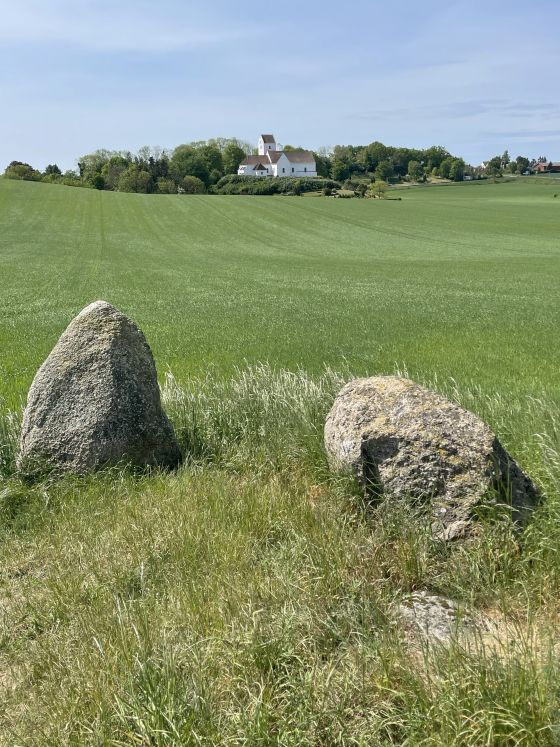
Image credit: Bjørn Houdorf


And all is revealed! Apparently they found the bones of 36 adults and 17 children in here including evidence of brain and dental surgery


Not sure how many of these I have crawled into now, regardless, always a thrill to see what’s inside

Judging by the well worn path this is one of the most visited passage graves on the island
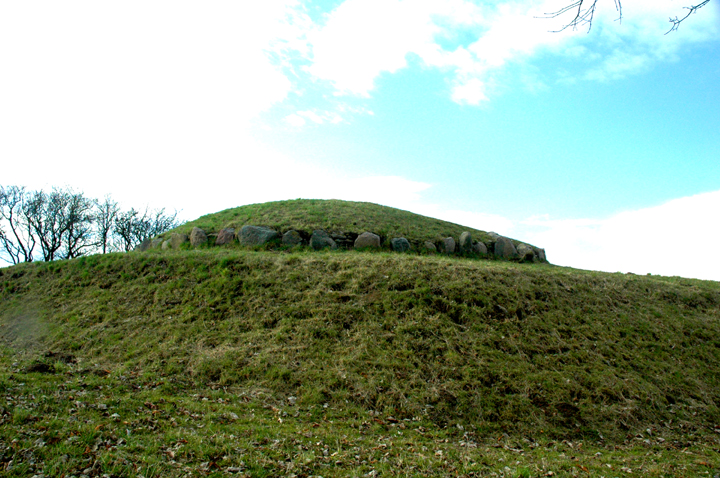
5 April 2006 From below the ‘pre-mound’ looking roughly WNW


5 April 2006 Chamber from the south – entrance passage goes off to right

5 April 2006 Jane squeezes into the passage
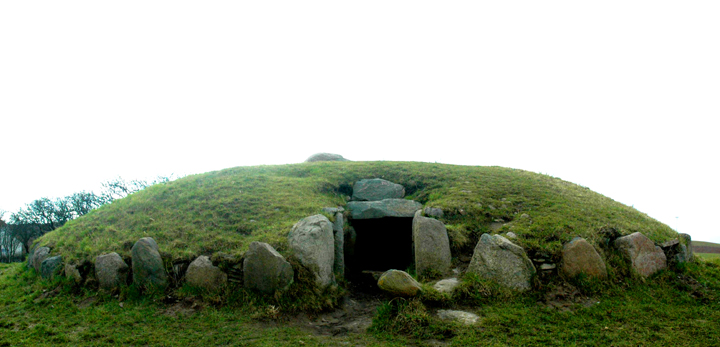
5 April 2006 From east showing entrance

5 April 2006 Approaching from car park at south

5 April 2006 From north-south road to east, approaching Søgard
The Hulbjerg Jættestue (Hulbjerg Passage Grave) is recognized as Langeland’s finest and best-preserved passage grave. It is situated on the southern end of the island of Langeland, near Bagenkop. This megalithic structure is an ancient monument with special cultural heritage, located within the UNESCO Global Geopark Det Sydfynske Øhav.
The Hulbjerg Passage Grave dates back 5,000 years, specifically to 3300–3200 BCE, placing it within the Neolithic Funnelbeaker culture. It served as a collective grave and ritual site.
The grave is set in a round barrow, approximately 20 to 21 meters in diameter and 2.5 meters high, framed by a ring of kerbstones and dry stone walling (tørmurstætninger).
The rectangular grave chamber measures 6.5 x 2 meters and is supported by 13 upright bearing stones. While the ceiling originally had five large rock slabs, only three remain, with the missing sections replaced by granite beams during restoration. The floor is paved with flat stones. A notable feature is the 5-meter long passageway that opens on the east side of the mound. Visitors must crawl to enter the grave due to the low passage. The passage has two doorframes, and a large flat stone at the entry may have functioned as a door.
The grave was excavated in 1960–1961 by Håkon Berg of the Langeland Museum.
The site has undergone restorations in subsequent years, including 1990, 2010, and 2023
The passage grave was used for over 1,000 years, with the oldest bones dating back 5,000 years and the youngest from the beginning of the Bronze Age, around 1700 BCE.
Over 2,000 human bones were discovered, corresponding to at least 36 adults and 17 children. The bones were found scattered and partially sorted, indicating that older remains were moved aside to make space for new burials. Analysis revealed that the men had an average height of 172 cm, and the women averaged 157 cm. Grave goods recovered from the passage and chamber included pottery (decorated ceramics), flint tools, weapons, arrowheads, and amber beads.
The Hulbjerg Jættestue is particularly famous for discoveries related to early surgical and dental procedures:
Trepanation.
One skull found has a trepanation hole in the left side of the forehead, indicating an operation where part of the cranial wall was removed.
This procedure was potentially related to treating combat wounds or possibly ritual practice. Crucially, the edges of the hole were healed, demonstrating that the individual, possibly referred to as the “Hulbjerg man,” survived the operation. Only about 10 to 13 trepanned skulls from the Neolithic period are known in Denmark.
Oldest Dental Drilling in Denmark.
A molar tooth belonging to a 35–50-year-old man shows a 4 mm wide and 6 mm deep hole, which was drilled using a flint point drill.
This intervention, considered the earliest known record of dental treatment and the only one known from antiquity in Denmark, was performed to relieve pain caused by severe caries and chronic inflammation/abscess. The presence of tartar on the bore hole shows that the patient survived for a period after the procedure.
The excavated objects, including the significant skulls, are on display at the Langeland Museum in Rudkøbing.
Access: Small carpark very close to monument. Short uphill walk of maybe 20 metres on grass.
Hulbjerg-jættestuen is in the far south of Langeland, but pretty easy to reach from Kong Humble’s Grav. From there, continue south on the 305 towards Bagenkop. About 1km before it reaches Bagenkop, the 305 swings right (west), just past Søndenbro. As the road bends right, there is a smallish road off to the left (in a way, straight on) towards Gulstav & Dovnsklint. Take this (Gustalvej) and at the next junction (almost immediately) continue south.
Keep on this road for just about 1.5km and as the road kinks right, look out for a turning to left called Keldsnorvej. You don’t want this, this turning, but take the next right onto Søgardsvej (may be signposted to Bagenkop). As you approach, you should be able to see the monument ahead to the right on the hillside. There is a small car park on the right as you reach the monument.
Visited 5 April 2006
The word jættestuen or jættestue seem to just be used as an umbrella term. Other monuments similar to this are called runddysser (the ‘r’ seems to make it plural) or højs....
Beautifully cared for, this is an imposing and very complete barrow, which has a huge ‘pre-mound’ – presumably natural. If not, it’s a spectacular feat. Although I can’t read Danish, Oldtidsminder På Langeland seems to say it was restored in 1960-61.
The passage is a bit of a squeeze, but the chamber is pretty impressive once inside.